





Phone Screen Repair Cost: 2026 Singapore Guide
Your phone slips out of your hand, clips the pavement, and lands face-down. You already know that pause before you pick it up. If the glass is cracked but the screen still works, you might get away with a straightforward repair. If the display turns green, black, or stops responding, the decision gets more expensive very quickly.
Customers commonly ask the same three questions right away. How much will this cost, is it worth fixing, and who can I trust with the phone that holds my photos, banking apps, work chats, and two-factor logins. In Singapore, that decision isn't only about the quoted repair fee. It's also about downtime, data safety, and whether you're throwing good money after an ageing device.
A screen repair quote only tells part of the story. The smarter question is whether the repair makes sense for your phone, your budget, and your day-to-day use. That's why it also helps to think about prevention after the fact, especially if you haven't already looked at a proper phone screen protector.
Table of Contents
That Heart-Stopping Moment Your Phone Hits the Floor
A cracked phone never arrives at a convenient time. It happens on the MRT platform, outside the office, in the school canteen, or while getting out of a Grab. The first reaction is usually panic. The second is trying to use the phone anyway with one thumb while pretending the damage isn't that bad.
That's where people often make the wrong decision. They focus only on the first quoted price. They don't factor in the bigger cost of being without the phone, handing it over without backing it up, or repairing a device that was already close to replacement.
The real cost isn't just the glass or display. It's the disruption to your day once the phone stops being dependable.
That matters for students who need payment apps and notes, and for working adults who rely on WhatsApp, email, maps, and banking every hour of the day. Guidance on cracked phone repair consistently points out that the cost extends beyond the fee and includes downtime, data risk, and lost productivity in the decision process, especially for people who depend on the device daily, as discussed in this overview of repair disruption and indirect costs.
The first checks to make
Before you even ask for a quote, check these four things:
- Touch response: Can you still use the phone and type normally?
- Display quality: Are there black patches, flickering lines, or colour distortion?
- Frame condition: Did the impact bend the side or corner of the phone?
- Rear damage: Is only the front broken, or did the back glass and camera area take a hit too?
If the phone still works, you've got time to decide carefully. If touch is failing or the screen is bleeding internally, don't wait too long. Moisture, pressure, and repeated use can turn a repairable screen into a larger repair job.
The Three Factors That Actually Determine Your Repair Cost
Most customers assume repair pricing is based on labour. It usually isn't. Labour matters, but the bill is driven far more by what screen the phone uses, how the device is built, and what part quality you choose.
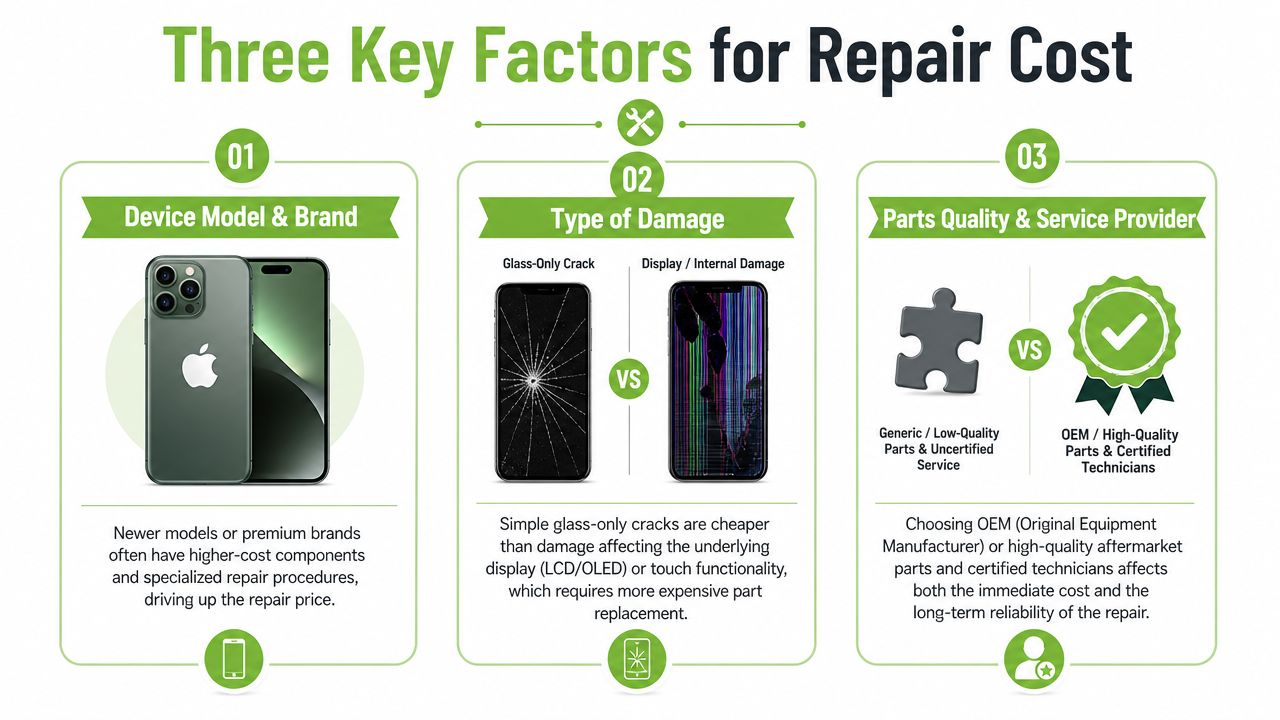
If you understand those three variables, a quote stops looking random. You can also compare repair options more fairly when reviewing a phone screen repairs guide or speaking to a technician.
Device tier changes the whole quote
A budget Android, an older iPhone, and a current flagship aren't in the same repair category. Newer premium models usually use more expensive assemblies, tighter construction, and more model-specific parts. Even before a shop starts work, the replacement part itself may already account for most of the bill.
In practical terms, this is why an older standard handset can be economical to fix while a recent flagship may trigger a serious repair-versus-replace discussion. Customers often compare by brand only, but model generation matters just as much.
Screen technology matters more than most people expect
LCD screens are generally cheaper to replace. OLED and similar premium panels cost more because the display assembly is more complex and the parts themselves are more expensive. Foldables sit in their own category because the part, handling risk, and assembly complexity are all higher.
Samsung's published repair pricing is a good example of how architecture drives the quote. Mainstream models sit in one bracket, while foldable inner-screen repairs can reach US$699.50 or higher, showing how sharply price changes when the screen design changes, according to Samsung's cracked screen repair pricing information.
Part source affects both price and result
This is the part that isn't always thoroughly inquired about. A screen can be described as replacement, compatible, aftermarket, OEM, original pull, or service pack, and those labels do not all mean the same thing.
Here's one way to look at it:
| Part choice | What it usually means | Trade-off |
|---|---|---|
| Official or OEM route | Parts supplied through the brand's own service chain | Higher bill, stronger compatibility confidence |
| High-quality aftermarket | Third-party manufactured replacement with better grading | Lower price, quality depends on supplier |
| Cheap aftermarket | Lowest-cost compatible part | Lower upfront cost, greater risk of weaker brightness, touch feel, or durability |
Practical rule: Don't judge a quote by price alone. Judge it by the part category, what functions are preserved, and what warranty the shop will stand behind.
The cheapest quote can end up costing more if the brightness is poor, touch sensitivity feels off, or the screen fails early. A good technician will tell you plainly what part is being installed and what compromises, if any, come with it.
Decoding Your Repair Quote What Are You Paying For
A proper repair quote should be easy to understand. If it isn't, ask questions before approving anything. The phone screen repair cost you're given should reflect the actual repair method, not a vague promise to “change screen”.
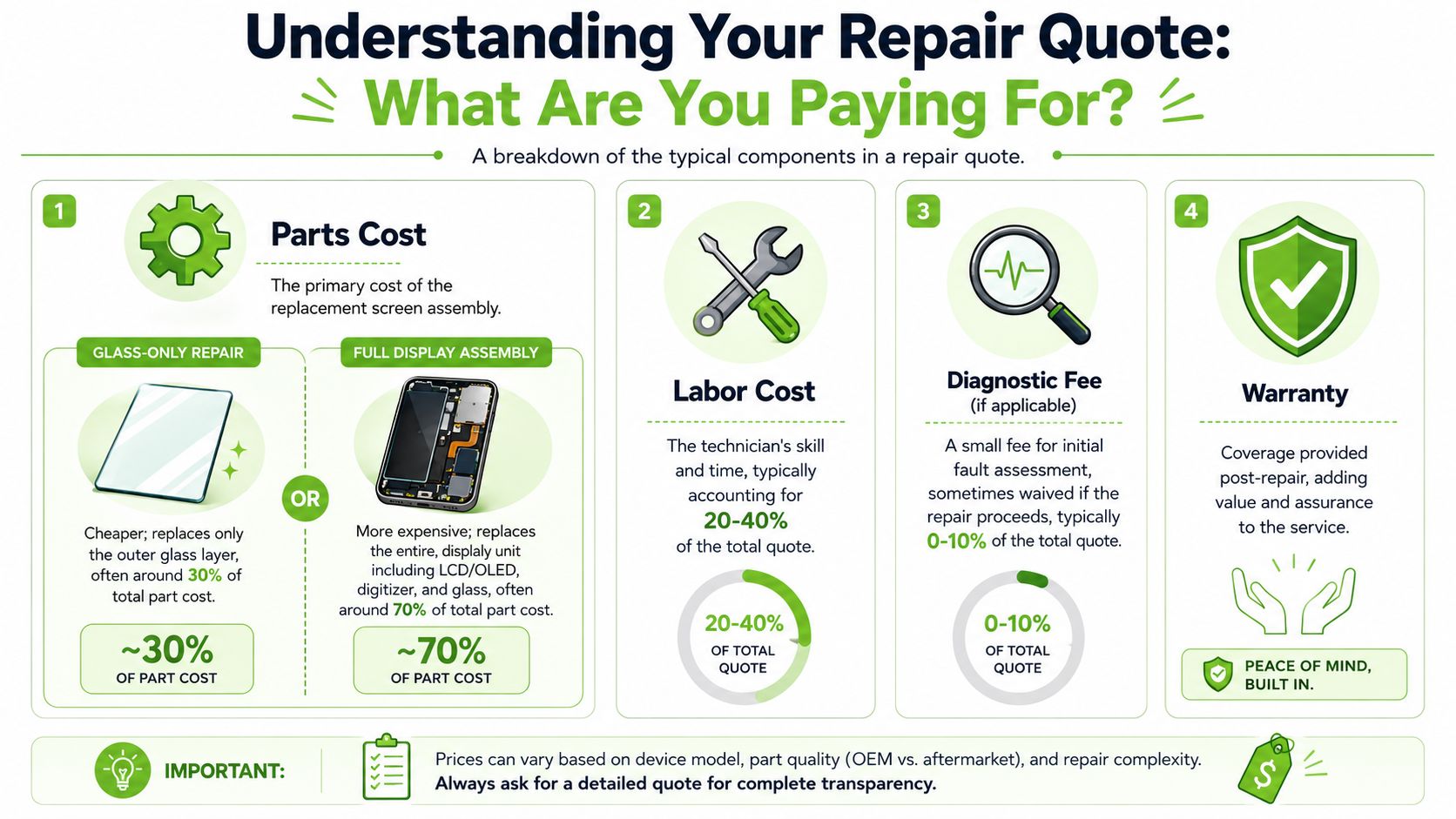
In Singapore, independent repair guides commonly place standard smartphone screen replacement around S$100 to S$250, while newer flagship models can rise to S$250 to S$379, and foldables can exceed S$400, with the gap often reaching 2x to 4x depending on the handset and display technology, based on this overview of Singapore phone screen repair cost ranges.
Glass only versus full display assembly
These two jobs are not the same.
A glass-only repair means the outer layer is replaced while the underlying display and touch layer are still usable. When it's possible, it can lower the bill. The catch is that it isn't suitable for every phone and every type of damage. If the display has lines, dead pixels, black patches, or touch issues, glass-only usually isn't the right fix.
A full display assembly replacement is the more common repair on modern smartphones. That means replacing the full front screen unit rather than separating only the outer glass. It costs more because the part itself costs more.
What a sensible quote usually includes
A good quote normally breaks down into a few practical elements:
- Replacement part: This is usually the largest share of the total.
- Labour: The time and skill needed to open the device, remove the old assembly, fit the new one, test it, and reseal it.
- Assessment or diagnostics: Some shops include this in the repair. Others charge only if you decline the repair.
- Post-repair warranty: This reveals if the shop is standing behind the workmanship and the part.
Here's how I'd read a quote in the shop:
| Quote item | What to check |
|---|---|
| Screen type | Is it glass-only or full display assembly? |
| Part grade | Official, OEM-equivalent, or aftermarket? |
| Function check | Will touch, brightness, Face ID or fingerprint-related functions be tested? |
| Warranty terms | What is covered after installation? |
A suspiciously cheap quote usually means one of two things. Either the part is much lower grade, or the job scope has not been explained properly.
If you're comparing two quotes, don't ask only “how much”. Ask what part is being installed, whether frame damage is included, and whether the phone is water-resistant afterwards. That's where the key difference lies.
Official Centre vs Independent Shop Where to Go
There isn't one correct answer for everyone. The right repair channel depends on what you care about most. Some people want official handling and nothing else. Others want a sensible bill, faster turnaround, and clear advice on whether the repair is even worth doing.
When official service makes sense
Official brand service centres are usually the safest fit when your phone is still under manufacturer support, tied to a care plan, or you want the brand's own process from start to finish. If warranty preservation is your main concern, official service is the cleanest route.
That comes at a price. Apple's out-of-warranty screen repair reference price for some iPhone models is US$379, while iFixit kit pricing for similar-era iPhones sits around US$81 for iPhone 11-era models and about US$140 for iPhone 12-era and newer models. That gap shows how large the difference can be between official service pricing and parts-only economics, as shown in Apple's screen replacement pricing reference.
Official service usually suits customers who prioritise:
- Manufacturer process: You want brand-controlled parts and procedures.
- Warranty continuity: You don't want any uncertainty around existing coverage.
- Model-specific support: You're dealing with a newer or more complex premium device.
When an independent shop is the better call
An independent shop is often the practical option when the phone is out of warranty and you want a better value repair. This is especially true for devices that are still useful but don't justify premium official pricing.
The key word is reputable. A good independent technician should tell you exactly what part is being used, what limitations exist, and when you should walk away instead of repairing. If the phone has multiple issues, a good shop won't push a screen job that doesn't make financial sense.
A useful comparison looks like this:
| Repair channel | Usually best for | Main trade-off |
|---|---|---|
| Official centre | Newer devices, warranty-sensitive owners | Higher price |
| Authorised provider | Customers who want some brand alignment with more convenience | Varies by provider |
| Independent shop | Out-of-warranty phones and value-focused repairs | Part quality depends on shop standards |
What doesn't work is choosing purely by the cheapest online ad. The lowest price often skips the important details. A clear diagnosis, honest part disclosure, and written warranty matter more than flashy promos.
Is It Worth Fixing Repair Trade In or Replace
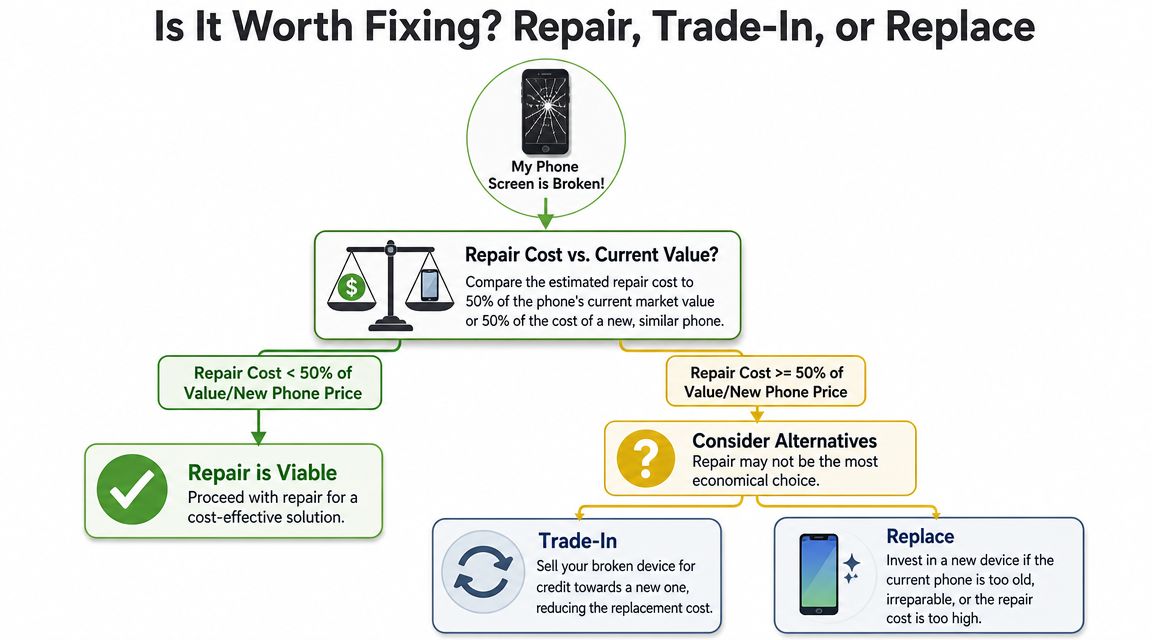
Not every cracked screen should be repaired. Some should be traded in. Some should be replaced outright. The right call depends on the phone's current value, what the repair will cost, and whether the rest of the device still has life left in it.
Use the 50 percent rule properly
A practical benchmark is simple. Repair is generally not advised when the cost exceeds 50% of the phone's current value, according to this guidance on when to repair or replace a phone. That rule is more useful than asking whether the repair fee feels high.
Here's how to think through it:
- Repair it if the phone still performs well, the battery is acceptable, and the quote sits comfortably below that threshold.
- Pause first if the phone already has battery issues, charging issues, camera problems, or frame damage.
- Skip the repair if the screen quote is close to what the phone is worth on the resale market.
This same mindset applies outside phones too. If you've ever compared replacing lenses versus replacing full frames, the logic is similar. A piece like this on Prescript Glasses lens replacement is a useful example of how a component-level repair only makes sense when the rest of the product still justifies the spend.
When trade in or refurbished makes more sense
For premium phones, a costly OLED repair can still be rational if the device keeps strong resale value after the work. But once the numbers stop making sense, moving to a refurbished replacement often gives better overall value than sinking more money into one damaged handset.
That's where a trade-in check becomes useful. If you're already weighing alternatives, it helps to review how a phone trade-in in Singapore works before approving an expensive repair.
A quick decision filter:
| Situation | Smarter move |
|---|---|
| Recent phone, screen damage only | Repair is often viable |
| Older phone with other faults | Trade-in or replace is often cleaner |
| Premium phone with expensive OLED repair | Compare repair against refurbished replacement |
| Covered by care plan | Claim first before paying out of pocket |
If you have a protection plan, check it before doing anything else. Verified guidance notes that AppleCare+ and Samsung Care+ can reduce out-of-pocket screen fixes to around US$29, which can completely change the decision when compared with paying full repair pricing.
The myhalo Difference Transparent and Trustworthy Repair
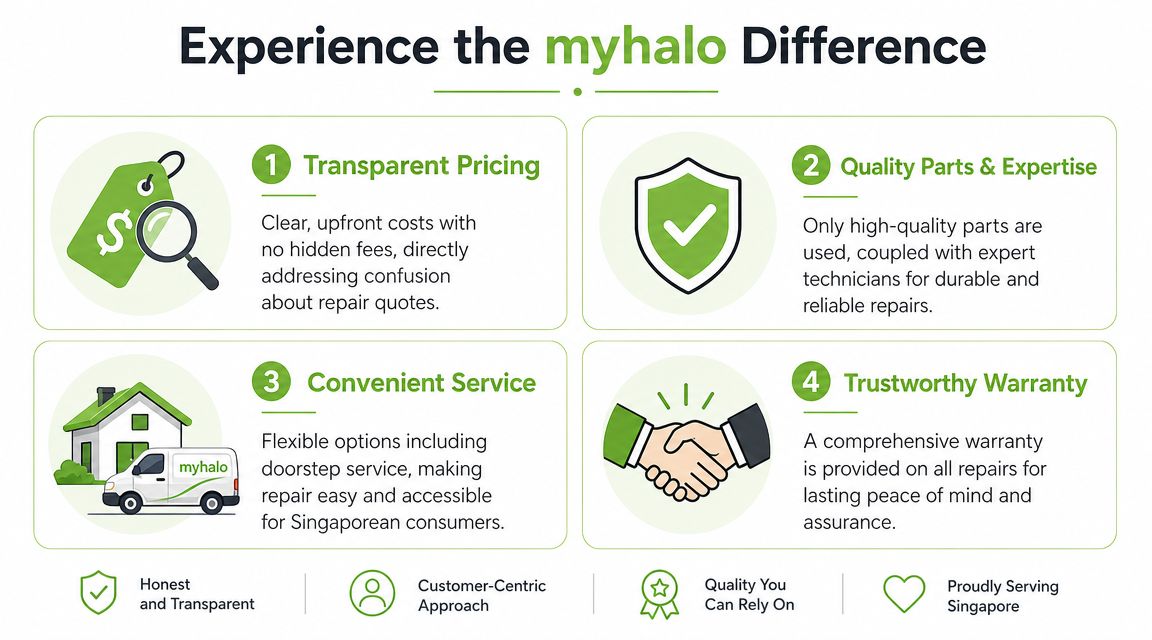
A good repair experience usually comes down to four things. A clear quote, sensible part options, proper testing, and a warranty that means something if there's a problem after collection.
What people actually want from a repair shop
Most customers aren't looking for a lecture. They want straight answers.
They want to know whether the screen needs a full assembly, whether the phone is worth saving, and whether their data is likely to stay untouched. They also want the technician to flag extra damage early instead of surprising them halfway through the repair.
The practical standard should be:
- Transparent pricing: No vague “screen issue” fee without part details
- Quality control: The phone should be tested after repair, not just switched on
- Clear warranty terms: Customers should know what is covered
- Honest recommendation: Some phones shouldn't be repaired, and the shop should say so
Worth remembering: The most trustworthy technician is often the one willing to tell you not to spend money.
A practical option if repair is not the right answer
myhalo fits this decision framework because it doesn't stop at repair. It also handles trade-ins, data and device migration, and refurbished replacements, with devices going through a 30-point quality check under an ISO 9001:2015-certified process according to its published company information. That matters when the right answer isn't “replace the screen” but “move on from the phone without wasting value”.
That broader approach is useful in Singapore because customers often need a complete solution, not just a repair bench. Some need the quickest path back to a working phone. Others need a lower-cost replacement with warranty support. Others want to offset the upgrade through trade-in instead of paying for a high screen quote on an ageing handset.
Frequently Asked Questions About Phone Screen Repair
How long does a screen repair usually take
It depends on the phone model, parts availability, and whether the damage is limited to the screen. A common repair can be relatively quick, but I always tell customers not to assume speed before the phone is checked properly.
If the frame is bent, screws are stripped, the battery is swelling, or the display damage is tied to deeper internal issues, the job can take longer than expected. Fast service is good. Rushed diagnosis is not.
Will my data be safe during the repair
Your data should always be treated as private, but you should still protect yourself before handing over the phone. Back up the device if the screen still works, remove what access you can, and ask the shop what its process is for passcodes and function testing.
A professional repairer doesn't need to browse your photos or messages. In some cases, basic device access may be needed for testing touch, display, cameras, sensors, or face and fingerprint-related functions. If you're uncomfortable, ask what can be tested in front of you or with limited access.
Is it worth repairing an older phone
Sometimes yes, sometimes no. Age by itself isn't the deciding factor.
What matters is the phone's current value, the rest of its condition, and how long you realistically plan to keep using it. If the battery is already poor and the charging port is loose, a screen repair on an older phone can become a stopgap rather than a good investment. If the phone still runs well and the damage is isolated, repair can still be the sensible choice.
Does a non-official repair void the whole warranty
Not automatically in every situation, and not in the same way for every brand or issue. The safer answer is to check your warranty terms before booking the repair.
What often happens is more specific. A manufacturer may dispute later claims related to the repaired part or to damage caused during unauthorised work. That's different from saying every part of the phone instantly loses all support. If warranty status matters to you, confirm it first and get the shop to explain exactly what its own repair warranty covers.
If you're deciding right now and want a clear next step, start with a proper diagnosis rather than guessing from the crack alone. myhalo can help you compare repair, trade-in, and refurbished replacement options so you spend money where it makes sense.