





Best Phone Cases Singapore 2026: Expert Buying Guide
You unbox a new phone on Saturday, use it bare for the weekend, and by Monday it is already sharing space with keys, an EZ-Link card, a damp umbrella, and a crowded MRT commute. That is usually when the case stops being an accessory and starts becoming risk control.
Choosing among phone cases in Singapore is less about brand hype and more about how your phone is used here. Heat, humidity, sudden rain, packed bags, and hard tile floors all affect what kind of protection makes sense. A slim case feels good in hand, but it may not do much after a drop at the station. A bulkier case adds weight, yet it can save you from a cracked corner, camera damage, or the nuisance of being without your phone while it is repaired.
Protection also works as a system. A case helps with impact and grip. A screen protector deals with scratches and face-down drops, and this guide on choosing the right phone screen protector in Singapore is worth reading alongside your case options.
There is also the full ownership cycle to consider. Many buyers focus on the first day. Fewer think about six months of pocket lint, yellowing, stretched corners, loosened buttons, or what happens to the old case after an upgrade. Good buying decisions account for all of that. If you want to support local with durable phone cases, durability matters more when the product has to survive real commuting and daily handling, not just look good on a product page.
This guide keeps the focus on practical trade-offs. What protects well, what feels too bulky, what ages badly in Singapore conditions, where to buy, and what to do with a case once it has reached the end of its useful life.
Table of Contents
Protecting Your Investment in a New Phone
You step out of the MRT during a light shower, tap your phone to check the next bus, and your grip slips for half a second. That is how a lot of phone damage happens in Singapore. Not during extreme use, but during ordinary commuting, quick coffee runs, humid walks between buildings, and the constant in and out of bags, pockets, and office desks.
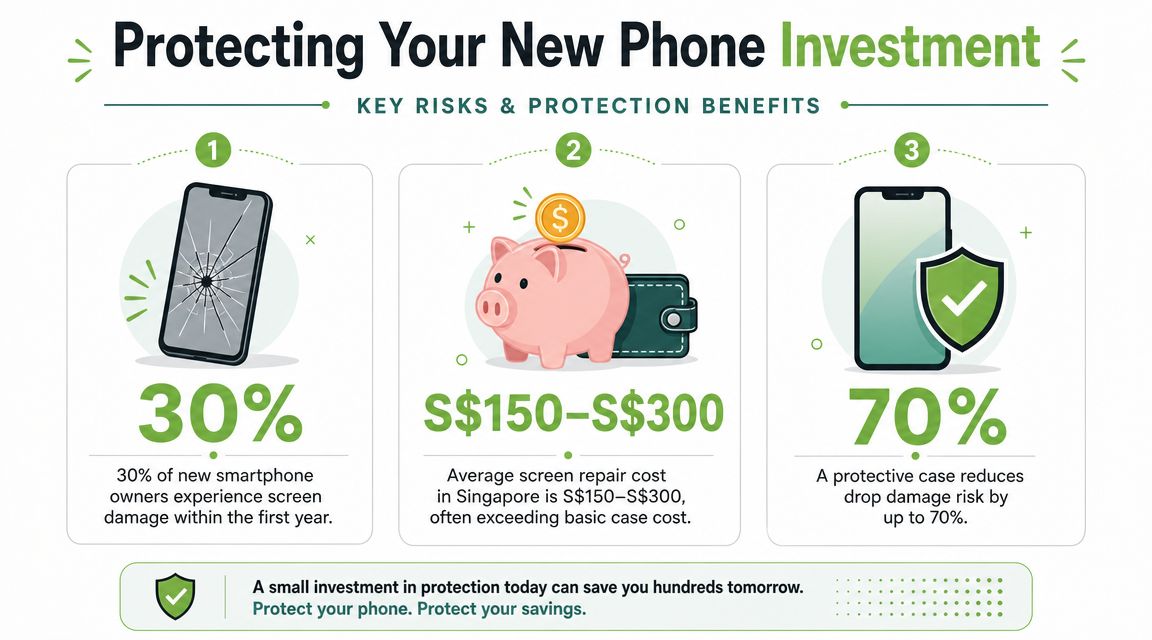
A case is part of the cost of owning the phone properly. If you spent serious money on a new device, it makes little sense to leave its weakest points exposed on day one. In local conditions, that risk adds up fast. Humidity affects grip, wet hands are common, and crowded transport increases the chance of bumps, drops, and pressure against hard objects in a bag.
Why the case matters from day one
Cases remain one of the biggest parts of the local accessories market, as noted earlier in the article. That lines up with what repair shops and regular users already know. Screens crack, camera rings get chipped, frames pick up dents, and resale value drops quickly once visible damage starts.
The practical question is not whether a case looks good in a product photo. It is whether it reduces the kind of damage you are likely to face. For many people in Singapore, that means accidental drops on tiled floors, wet pavement, bus-stop concrete, or the rough interior of a work bag.
A simple rule works well here.
Practical rule: If replacing the screen, camera glass, or frame would annoy you financially or logistically, buy the case before the phone becomes part of your daily routine.
A smarter setup than case-only thinking
A case lowers risk. It does not remove it. Raised edges and reinforced corners help, but face-down drops on uneven surfaces can still damage the display. That is why a case and a screen protector usually work better together. If you are comparing both, this guide to how to choose the right phone screen protector is a useful companion.
There is also a practical middle ground that gets overlooked. You do not need to choose between a thin decorative shell and a bulky rugged case meant for harsh job sites. Many users are better served by support local with durable phone cases that add proper corner and frame protection without making the phone unpleasant to carry.
What usually works in daily use
For most buyers, a good everyday case should cover five basics:
- Raised front lip: Helps keep the display off tables and other flat surfaces.
- Protected camera surround: Useful now that camera modules stick out more.
- Grippy sides: More practical than a glossy finish during rainy commutes or one-handed use.
- Covered buttons with a clean click: Poor button design gets irritating very quickly.
- Extra structure at the corners: Corners usually take the first hit in a real drop.
One more practical point often gets missed. A phone case is not just about the first month. It is part of the device's full lifecycle. If you upgrade often, choose something you will keep clean, remove safely, and replace responsibly. A worn-out old case should not just sit in a drawer forever. Check whether the seller has a recycling option, pass usable cases to someone with the same model, or dispose of damaged ones properly with other small accessories.
The best case is the one that fits your real routine. It should give you more grip, more protection, and fewer repair headaches without making the phone bulky enough that you stop using it comfortably.
Decoding Case Materials from Plastic to Plant-Based
Materials decide most of the practical experience. Grip, yellowing, stiffness, drop response, how the case ages in humidity, and whether it still looks decent after months in a bag all trace back to what it's made from.
Singapore conditions make this more obvious. Heat, moisture, hand oils, and daily carry can expose weak materials quickly. A case that feels fine in a product listing can turn sticky, cloudy, loose, or grimy after regular use.
What the common materials are actually like
Silicone usually feels soft and comfortable in hand. It adds grip, which is useful on trains and wet walkways. The trade-off is that it can attract lint, show grime, and sometimes develop a tacky feel over time.
TPU is one of the most practical everyday materials. It has some flexibility, usually handles minor bumps well, and tends to offer better shock absorption than hard plastic alone. Many users find TPU easier to live with than pure silicone because it balances grip with easier cleaning.
Polycarbonate is hard and structured. It's useful when a brand wants a slim shape with a firmer shell, or when it's combined with softer inner layers. On its own, though, a very rigid case can feel less forgiving on impact than a layered design.
Leather or leather-style finishes can look more polished in work settings. They age differently from plastic cases and often suit buyers who care about appearance and texture. The weak point in Singapore is maintenance. Moisture, sweat, and bag friction can mark them more easily than synthetic rugged cases.
Phone case material comparison
| Material | Protection Level | Feel & Grip | Durability in SG Climate | Eco-Friendliness |
|---|---|---|---|---|
| Silicone | Good for light everyday knocks | Soft, grippy, can attract lint | Can get grimy or tacky with heavy use | Usually limited |
| TPU | Strong everyday balance | Grippy without being too sticky | Generally handles humidity well | Mixed, depends on blend |
| Polycarbonate | Better when paired with softer layers | Smooth, firmer feel | Structurally stable, can scuff | Usually limited |
| Leather or leather-style | More about surface protection than heavy drops | Premium feel | Needs more care in humid use | Depends on source and construction |
| Plant-based or recycled blends | Varies by design | Usually matte or lightly textured | Depends heavily on build quality | Often the better choice if durability is also good |
A material isn't good just because it sounds premium. It's good if it still grips well, cleans easily, and stays structurally sound after months of normal Singapore use.
The sustainability question most guides skip
Many buying guides stop at colour and finish. That misses an important point. Old phone cases often become waste because they're made from mixed materials that standard e-waste systems don't handle easily. That's one reason this discussion of case end-of-life matters. Choosing a durable or recyclable case material can reduce personal e-waste because many worn cases otherwise end up in general waste.
That leads to a practical test I recommend:
- Choose durability first: The most sustainable case is often the one you don't replace quickly.
- Check for mixed-material complexity: Heavily fused materials may be harder to deal with at end of life.
- Prefer finishes that clean well: A case that looks filthy after a short period gets replaced sooner.
- Be realistic about “eco” labels: If the case is too flimsy for your routine, you'll buy another one anyway.
Plant-based or recycled-material cases can be sensible choices, but only when they still meet daily protection needs. A greener case that fails early isn't the better option in practice.
How Much Protection Do You Really Need
You step off the MRT in a sudden downpour, tap your phone to reply with one hand, and it slips onto a station floor. That is the kind of risk a case in Singapore should be built for. Daily protection here is usually about wet hands, crowded commutes, hard tile, bag friction, and repeated small impacts. It is rarely about expedition-level abuse.
A good case choice is risk management. The goal is to reduce the kind of damage you are likely to face, without adding so much bulk that you stop using the case properly or remove it every few days.
What military-grade usually means
The phrase military-grade usually refers to MIL-STD-810G-style testing. That can be useful, but only if the brand tells you what it tested. This explanation of military-style case standards is a decent starting point.
The label alone is not enough. One case may survive repeated drops at a stated height. Another may use the same phrase with very little detail behind it.
Check for specifics such as:
- Stated drop height: A measurable claim is more useful than a broad slogan.
- Number and type of drops: Repeated corner and face-down drops matter more than a vague “drop tested” badge.
- Corner structure: Corners take a lot of impact during real falls.
- Raised screen and camera lips: These reduce contact with tables, concrete, and train platforms.
- Two-part construction: A firmer outer shell with a shock-absorbing inner layer usually protects better than a single hard piece.
Practical filter: If a listing says “military-grade” and gives no test method, treat it as advertising, not proof.
Water resistance helps, but it does not replace a good case
Modern phones already have some water resistance. That helps with light rain and accidental splashes. It does not solve everything.
Water seals can wear down over time. Many local accidents are not full submersion cases. They are wet fingers, damp tote bags, condensation, slippery sidewalks, and a phone landing on a rough surface while the exterior is already slick. A case still matters because it improves grip, adds separation between the phone body and wet surfaces, and protects the first impact points.
For Singapore use, these details usually matter more than dramatic marketing:
- Textured sides: Better control when your hands are damp from rain or humidity.
- Raised front lip: Reduces the chance of screen contact on flat drops.
- Camera ring protection: Large camera modules are common impact points now.
- Tighter cut-outs and secure button covers: Better for users who get caught in rain often.
- A snug fit that stays snug: Loose cases shift on impact and collect grime faster.
Match the case to your actual failure pattern
Start with one question. How does your phone usually get damaged?
Some office commuters drop it while tapping in and out of stations. Students often scrape it in crowded bags with chargers, keys, and pens. Delivery riders and field staff deal with rain, vibration, and more frequent one-handed use. Parents often hand the phone to children, which changes the risk profile immediately.
That is why the thickest case is not automatically the smartest choice.
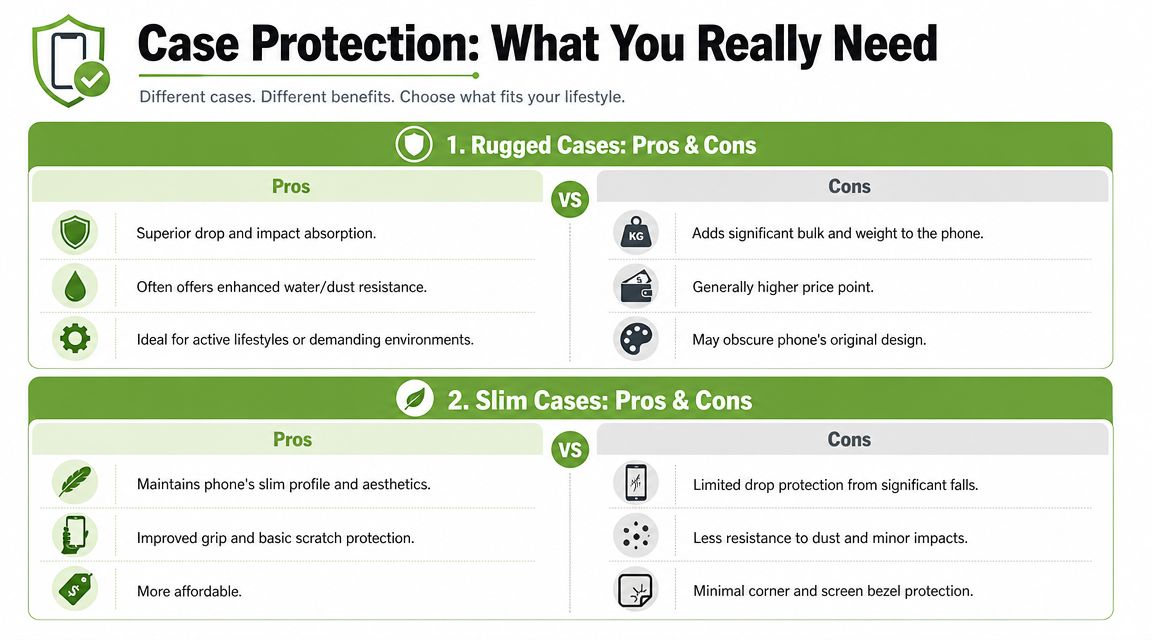
A slim case can be enough for careful users who mainly want scratch protection and better grip. A medium-protection case suits many people in Singapore because it covers the common risks without making the phone annoying to hold. A rugged case makes sense if your phone is exposed to repeated drops, outdoor work, or hard surfaces every day.
I usually suggest this simple test:
- Mostly desk, office, car, and careful handling: Slim or mid-weight case
- Daily MRT commute, frequent one-hand use, crowded bag: Mid-weight case with grip and corner protection
- Outdoor-heavy work, riding, site visits, or repeated drops: Rugged case with stronger corner design and covered buttons
The right case is the one you will keep on the phone for the next 12 months, not the one with the loudest spec sheet. That also affects the full lifecycle. A durable case that fits your routine is less likely to crack, yellow, or get replaced early, which means one less old case going into general waste.
Here's a useful walkthrough if you want to see case types discussed visually before buying:
Balancing Style Function and Your Budget
Individuals don't buy a case in a vacuum. They're balancing three things at once. How it looks, how it works, and how much compromise they can tolerate every day.
In Singapore, that balance gets shaped by commuting and weather. With about 2,340 mm of rainfall in 2024, the choice between a slim case and a rugged one is often a practical risk decision, not just a fashion preference, as noted in this Singapore-focused discussion of case buying.
The real trade-offs buyers feel
A slim case usually wins on pocketability, one-hand feel, and appearance. It's easier to slide into trousers, smaller handbags, and jacket pockets. It also tends to preserve the phone's original shape better.
A rugged case changes the experience. You get more structure and impact buffering, but also more bulk, more weight, and sometimes worse fit in small pockets or wireless chargers. Some people buy one for peace of mind, then stop using it because it annoys them by week two.
That's why “best” depends on the user:
- Office commuter: Often does well with a slim-to-midweight case, raised lip, and clean finish.
- Student: Usually needs grip, scratch control, and decent corner protection at a sensible cost.
- Delivery rider or outdoor-heavy user: Benefits more from stronger drop design and better rain handling.
- Parent: Usually values durability, wipe-clean surfaces, and a secure grip over minimalism.
A simple way to choose without overthinking
Use this filter when comparing options:
-
Start with your environment
Train platforms, buses, coffee runs, school bags, stroller compartments, and shared desks create different risks. -
Decide your tolerance for bulk
Some users hate thick cases. If that's you, buy the strongest slim case you can live with consistently. -
Check compatibility early
Wireless charging, stand use, magnetic accessories, and car mounts can all be affected by thickness and materials. -
Think about replacement habits
If you change phones often, a lower-commitment case may be fine. If you plan to keep the phone longer, build quality matters more.
The right case is the one you'll keep using on a rushed Monday morning, not the one that looked toughest in a product photo.
A stylish case isn't a bad choice. It's only a bad choice when style removes the features your routine clearly needs.
Where to Buy Phone Cases in Singapore
Where you buy matters almost as much as what you buy. A good product page can still hide poor fit, weak button feel, slippery texture, or a camera lip that's too shallow to do much. Buying channel affects how much of that risk you can check before paying.

Physical stores
Physical shops are still useful for one reason. You can test the fit in your hand. That matters more than many buyers expect. A case can look neat online and still feel awkward once installed.
In-store buying tends to suit people who care about:
- Grip: Easy to judge immediately.
- Button response: One of the first things cheap cases get wrong.
- Bulk: Photos often understate thickness.
- Finish quality: Matte, glossy, fabric-like, and rubberised surfaces age differently.
The downside is selection. Shops usually can't stock every colour, material, and model variant at once.
Marketplaces and online shops
Online platforms give you range. You'll usually find more designs, more niche models, and more price points. They're useful when you already know what case profile you want and just need the right fit for your device.
The trade-off is inconsistency. Product photos can be heavily staged, and some listings focus on design while saying very little about edge height, material blend, internal lining, or long-term fit. When buying online, I'd pay close attention to:
- Cut-out accuracy shown from multiple angles
- Whether the camera bump sits recessed
- Whether the side buttons are covered or open
- Whether the case is described as rigid, flexible, or layered
Buying from a retailer that fits a wider device plan
Some buyers aren't just buying a case. They're replacing a phone, adding a screen protector, planning a trade-in, or trying to extend a device's life without unnecessary waste. In that situation, it helps to buy from a retailer that treats accessories as part of a larger ownership cycle.
One option in Singapore is myhalo, which sells accessories through its mobile accessories collection and also operates as a broader device retailer and service provider. That matters if you want to handle a case purchase alongside repairs, trade-ins, refurbished devices, or protection planning in one place rather than piecing it together separately.
A case store is useful. A retailer that understands how the phone will be used, maintained, repaired, or replaced is often more useful.
For many buyers, the best channel is the one that reduces mistakes. If you're very particular about feel, go in person. If you already know your exact preferences, online buying is more efficient.
Decision Checklists for Every User
At checkout, the problem often isn't lack of options. It's too many options that sound similar. A short checklist usually makes the decision clearer.
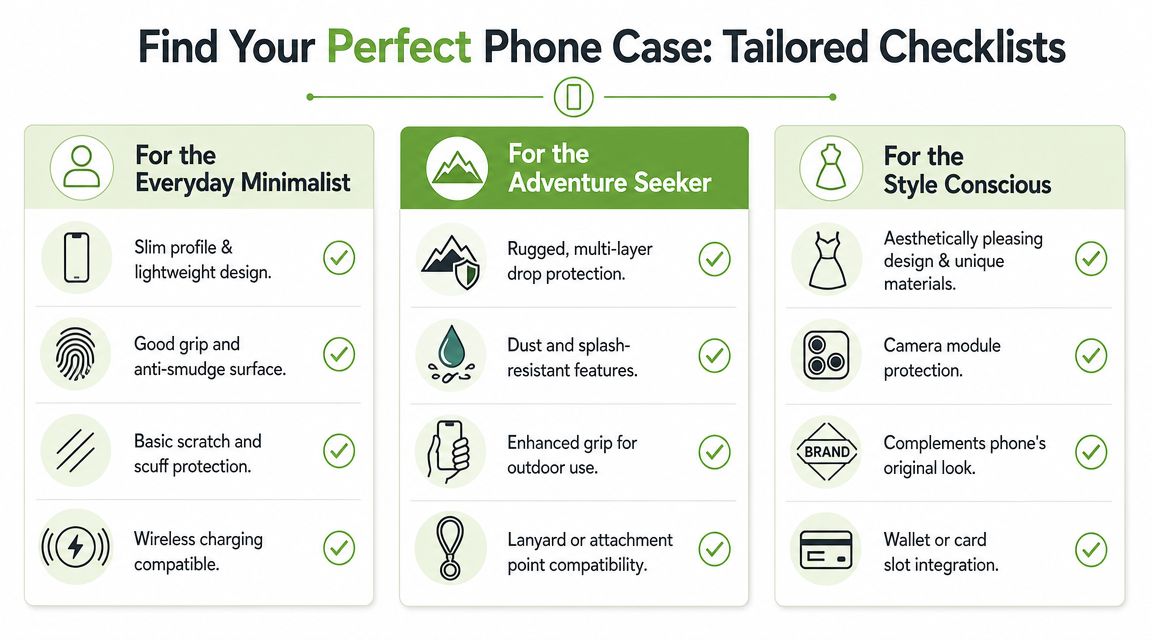
Everyday minimalist
If you hate bulk, don't force yourself into a heavy-duty shell you'll remove after a week.
- Keep it slim: Choose a low-profile case that still covers the corners.
- Prioritise grip: Smooth-looking cases can be annoying on public transport.
- Protect the camera area: A neat design still needs a usable rear lip.
- Check charging fit: Make sure it works with your usual wireless charger or cable.
Student on a budget
Students usually need something forgiving, not fancy. Bags, desks, shared spaces, and fast movement between classes are hard on phones.
- Go for TPU or hybrid builds: They're often the most practical for daily knocks.
- Avoid very glossy finishes: They show wear quickly.
- Choose darker or textured surfaces: Easier to keep looking presentable.
- Pair with a screen protector: This is often the better spend than paying for looks alone.
Parent or heavy-use family phone
Family-use phones get handled by more than one person. That changes the requirement immediately.
- Choose strong corners: Drops rarely happen in a controlled way.
- Use wipe-clean materials: Sticky surfaces become frustrating fast.
- Make sure the case stays tight: Loose edges collect dirt and reduce confidence.
- Don't chase thinness: Daily resilience matters more here.
Eco-conscious buyer
A sustainability-minded purchase starts earlier than disposal. It starts with what you buy and how long it lasts.
- Look for durable construction first: Fewer replacements means less waste.
- Prefer recyclable or recycled materials where practical: But only if build quality is still sound.
- Skip throwaway novelty finishes: They often wear out faster.
- Keep the old case clean and reusable if possible: A backup case is better than immediate disposal.
Style-conscious user
You can care about looks without sacrificing all function.
- Check side grip, not just back design: That's what affects daily handling.
- Protect the lens area: Large camera modules need structure.
- Watch for yellowing or staining risk: Clear and pale finishes need more upkeep.
- If it includes card storage, test bulk tolerance: Wallet features change the in-hand feel quickly.
Buy for your most common day, not your most aspirational one.
FAQ Caring for Your Case and Understanding Policies
How should you clean a phone case properly
A case in Singapore gets dirty faster than many people expect. Humidity, hand oils, pocket lint, MRT commutes, and sudden rain all leave a film that makes the phone feel grimy and sometimes more slippery.
For routine cleaning, remove the case, wipe it with a soft cloth, and use mild soap with a little water. Dry it fully before putting it back on the phone. Avoid harsh cleaners unless the maker specifically says the material can handle them. Alcohol-heavy products can dry out some finishes, fade prints, or make clear cases turn dull sooner.
Silicone, soft-touch coatings, and clear cases usually need the most upkeep because they show lint, yellowing, and oil marks more easily.
Can a heavy-duty case make a phone feel hotter
Yes, sometimes. Thicker cases can trap warmth for longer during charging, gaming, navigation, or long video calls, even if the phone is still operating normally.
The trade-off is straightforward. More material often means better drop protection, but also less heat dissipation and more bulk in the hand or pocket. For Singapore users who spend time outdoors, use mobile data heavily, or charge on the go, very enclosed designs can become uncomfortable faster. If your phone already runs warm, choose a case with good corner protection and a less bulky overall build instead of the thickest shell on the shelf.
Does a water-resistant phone still need a protective case
Yes. Water resistance helps, but it should be treated as backup protection, not a reason to go caseless in wet conditions.
Real life is rougher than lab testing. Rainy walks to the bus stop, sweat during outdoor use, and moisture trapped in bags all add wear over time. Water resistance can also reduce as a phone ages. A case will not make the phone waterproof, but it does add grip, keeps the camera area off wet tables, and reduces the chance of damage from a drop right after your hand slips in the rain.
What should you check before buying from a retailer
Start with the basics. Confirm the exact phone model, check the return policy, and see whether the seller explains the material and fit clearly instead of relying on generic marketing terms.
Then check the lifecycle details that get ignored too often. Can you return it if the buttons are too stiff? Is there support if the fit is wrong? What should you do with the old case if you are replacing one that is cracked, stretched, or no longer hygienic? If you want those policy details upfront, read the myhalo FAQ page for support and purchase terms before ordering. It saves time and reduces the chance of buying a case that looks right online but does not suit daily use.