





Find a Phone Accessories Store in Singapore That Lasts
Your charging cable frays at the worst time, usually on the MRT platform or just before school pickup, and the quick fix is to grab whatever's nearby. That's exactly where many buyers get tripped up. A good phone accessories store in Singapore should do more than sell you a case or charger, it should help you keep devices working longer, avoid mismatched purchases, and make the next replacement cycle cheaper and less stressful.
Table of Contents
- Why Your Next Phone Accessories Store Choice Matters
- Singapore Accessory Demand in Context
- What to Check Before You Buy Accessories
- Sustainability and Lifecycle Value Over One-Off Buys
- Local Services and Convenience to Prefer
- Evaluating myhalo as a Lifecycle Partner
- Your Practical Next Steps for Smarter Accessory Shopping
Why Your Next Phone Accessories Store Choice Matters
A cracked screen protector, a charger that runs hot, or a case that fits badly can turn a small purchase into a repeated expense. In Singapore, that matters because people rarely buy accessories once and forget about them. Phones get upgraded, handed down, repaired, resold, and re-used, so the store you choose affects the full life of the device, not just today's checkout.
Think beyond the cheapest shelf price
The cheapest accessory is often the one you replace first. A slim case that looks neat but offers little drop protection, or a cable that stops fast charging after a few months, usually ends up costing more in the long run. A better phone accessories store helps you match the accessory to the device, the user, and the way the phone is used.
Practical rule: buy for the device lifecycle, not just for the next few weeks of use.
That mindset shift matters for families, students, and SMEs alike. A parent buying for a child's tablet wants durability and easy replacement, while an SME outfitting staff phones needs consistent quality, clear warranties, and less downtime. If a store can also handle repairs, trade-ins, or reuse, that turns accessories into part of a wider device plan.
What a stronger store experience looks like
Look for a retailer that can explain compatibility in plain language, recommend protection before extras, and support the device after purchase. Stores that treat accessories as part of a broader technology lifecycle usually make better long-term partners than places that just push whatever is on promo. In Singapore's high-usage, high-replacement environment, that difference shows up in lower friction, fewer wrong buys, and better value over time.
A useful benchmark is whether the store helps you decide what to keep, repair, reuse, or replace. If it only sells boxes off the shelf, it's a transaction. If it helps you extend device life, it's a partner.
Singapore Accessory Demand in Context
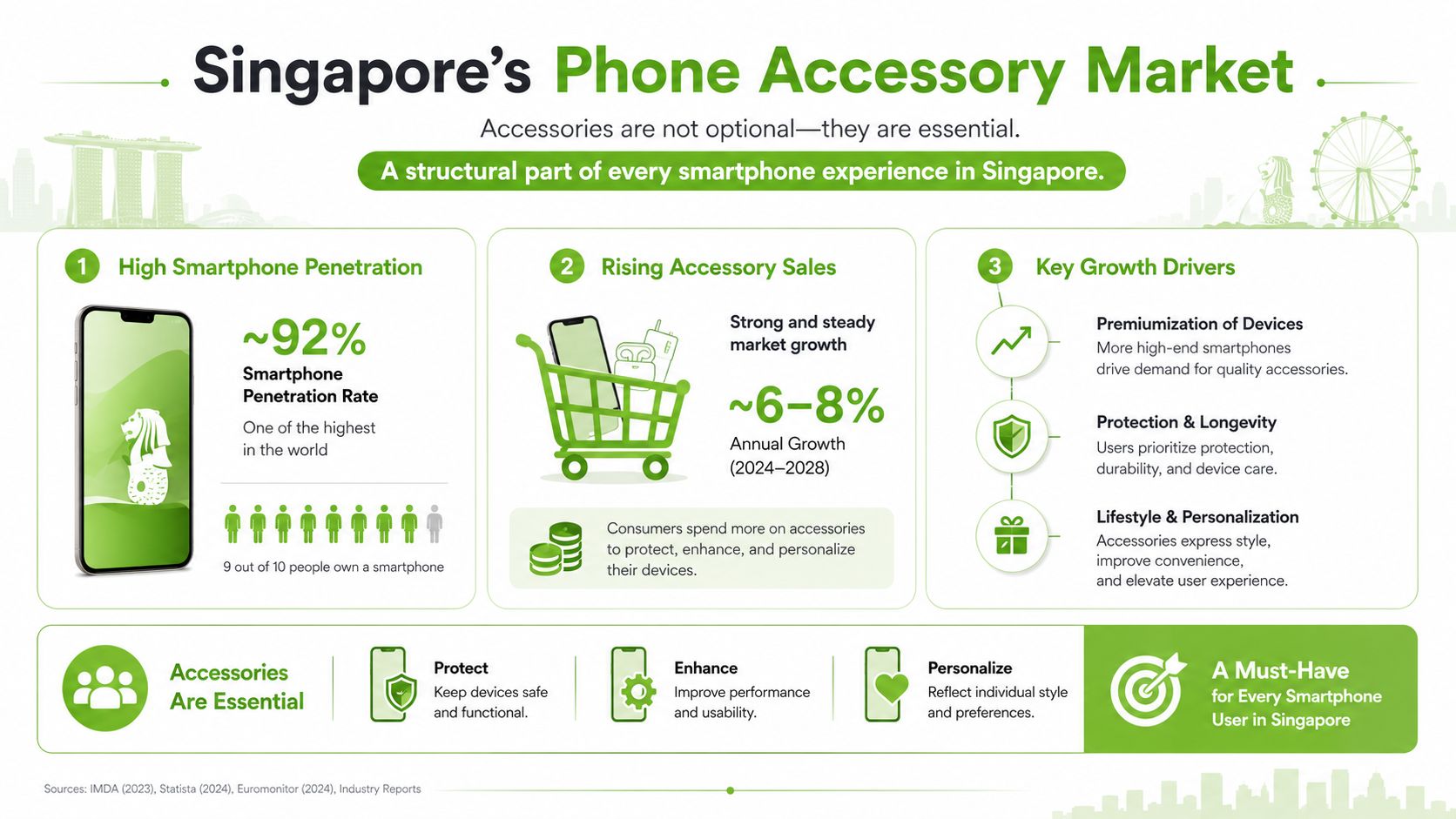
Singapore sits in a region where accessory demand is far from marginal. Asia-Pacific accounted for over 46.9% of global mobile accessories market share in 2025, according to IMARC Group, and that regional weight matters because Singapore is a dense, high-income, smartphone-heavy market inside the fastest-moving demand zone for cases, chargers, cables, earbuds, and power banks. The same source projects the global mobile accessories market rising from USD 98.8 billion in 2025 to USD 145.5 billion by 2034, with a 4.26% CAGR from 2026 to 2034. IMARC Group
That growth story points to a durable category, not a passing trend. People keep replacing accessories because phones keep evolving, charging standards keep changing, and ecosystems keep fragmenting across brands and models. For a Singapore retailer, that means the opportunity is not just selling more items, it's helping customers keep their devices useful for longer.
What the market signals for local buyers
A mature mobile market changes how people shop. Instead of asking whether accessories matter, the better question is which accessories deserve priority now and which store can keep supporting the same phone through repair, resale, and repeat use. That's especially relevant when the category forecast continues to expand alongside smartphone ownership rather than replacing it.
Another useful reference point is that global research reports place the mobile phone accessories market at USD 93.58 billion in 2025 and USD 99.58 billion in 2026, before reaching USD 147.41 billion by 2032 at a 6.70% CAGR. An independent forecast also puts it at USD 105.45 billion in 2025 and USD 189.92 billion by 2033 with a 7.8% CAGR. Research and Markets
Those forecasts line up with what you see in-store. Buyers are no longer just replacing a broken charger, they're choosing between protection grades, charging standards, battery health, and device-specific fit. In that environment, a strong phone accessories store doesn't merely stock products, it reduces uncertainty.
What to Check Before You Buy Accessories
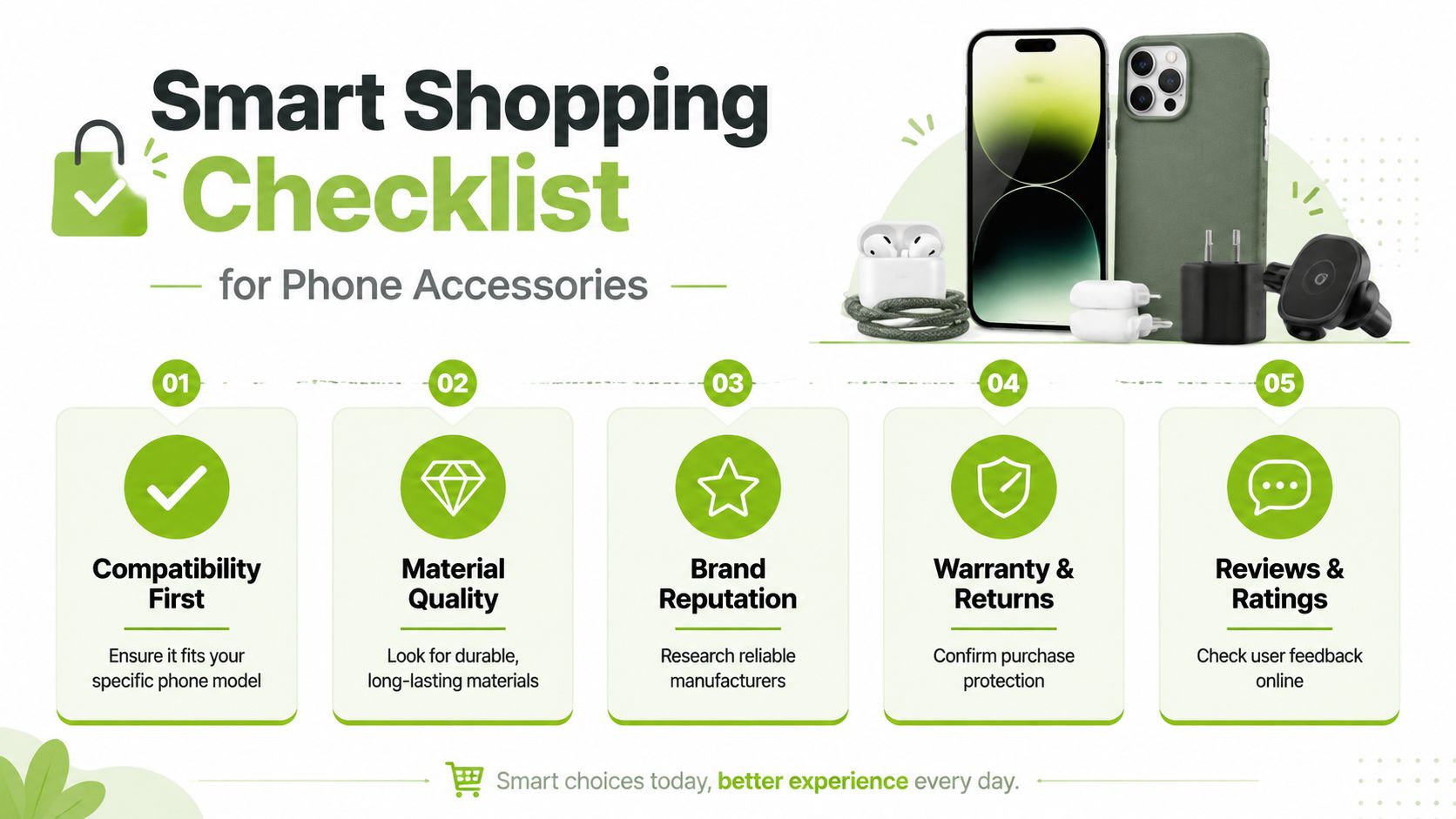
The first check is compatibility, and it sounds simple until you're standing in the shop with two nearly identical chargers in your hand. USB-C isn't automatically the same as fast charging, and wireless charging isn't automatically the same as safe charging for every phone. For a phone accessories store to be useful, it should help you match the accessory to the exact model and use case, not just the connector shape.
Start with fit, power, and charging standards
A charger or power bank needs to match the phone's input and charging behaviour, not just “work” in a general sense. If you're buying for a work phone, a child's tablet, or a newer handset with USB-C, the practical questions are simple, does it fit, does it charge at the expected speed, and does it remain safe under daily use. That's why model-specific advice matters more than broad category labels.
Plain-language test: if the seller can't explain how the accessory works with your exact phone, keep looking.
Quality markings, visible build quality, and warranty terms matter just as much. A proper warranty helps, but only if the seller also gives you transparent product details and a clear return path. For refurbished accessories or add-ons, stated condition grading and battery-health disclosure reduce the chance of buying something that looks fine but performs badly.
- Compatibility first: check the exact phone model, port type, and charging standard before you pay.
- Material quality: inspect the cable ends, case edges, stitching, and ports for obvious weak points.
- Warranty and returns: confirm what happens if the item doesn't work as expected.
- Battery health disclosure: ask for it on rechargeable items so you know what you're taking home.
- Price versus lifespan: compare the upfront cost against how long the item is likely to last in daily use.
A useful local example is a screen protector. If you're unsure how it should sit on the display, a practical guide like myhalo's phone screen protector article is the sort of compatibility-first content that saves you from guesswork. That's the right standard for a phone accessories store, educate the buyer before the sale, then back it with clear terms after the sale.
Sustainability and Lifecycle Value Over One-Off Buys
A buyer replaces a cable, then another. A case gets tossed after a drop. A charger sits unused in a drawer once a new phone arrives. That pattern feels convenient, but it wastes money and shortens the useful life of gear that could still serve someone well through repair, reuse, or refurbished resale.
One-off buying versus lifecycle thinking
Lifecycle thinking starts with a different question. Can this accessory be repaired, traded in, reused, or passed on with clear condition information? In Singapore, that question matters because the e-waste system is more structured now, and consumers can bring regulated e-waste to authorised collection points, including retail take-back points where available, under the Resource Sustainability Act framework. Business Plan document on Singapore e-waste obligations
The payoff is not only environmental. It is value retention. A phone that stays protected and usable for longer reduces the pressure to replace it early, while accessories that are handled properly can stay in circulation instead of ending up forgotten at the back of a drawer. For everyday users and SMEs, that is a better use of budget than paying for the same function again and again.
Useful test: if the store helps extend a device's usable life, it is adding value, not just moving stock.
myhalo's approach matches that logic because Certified ReLoved, Certified Surplus, repair, trade-in, and responsible recycling sit within one loop rather than separate offers. That matters for buyers who want affordable accessories without losing sight of condition, warranty coverage, or reuse potential. Clear disclosure matters more than a low sticker price.
Why this matters for Singapore users
Singapore's high smartphone and internet adoption means households and teams often hold several accessories at once, then replace them frequently. The better question is whether the item should be repaired, reused, or put back into circulation with clear condition details. For a consumer or SME, that lowers wasteful churn and gives tighter control over spending.
The same principle applies at the policy level. Learn more about Singapore's zero-waste initiatives here: https://shop.myhalo.com.sg/pages/a-zero-e-waste-world-how-can-you-help
If a seller only pushes fresh inventory, the relationship ends at checkout. If it supports repair, buyback, and responsible recycling, the store becomes part of the next upgrade cycle, and that is the partnership model worth looking for.
Local Services and Convenience to Prefer
A trustworthy phone accessories store in Singapore should remove friction after the sale, not add it. That starts with sensible basics, easy returns, clear warranty handling, fast fulfilment, and a way to ask questions without waiting days for a reply. For many buyers, a physical presence still matters because accessories are often urgent, especially when a cable fails, a protector cracks, or a staff phone needs immediate setup.
Services that signal real operational discipline
A Bugis Junction location at 200 Victoria Street #03-25/26 gives shoppers a concrete place to inspect products, compare fit, and get help in person. Fast fulfilment also matters for SMEs and families who can't wait for a replacement item to arrive later in the week. WhatsApp support is useful when you want a quick compatibility check before making the trip.
Look for the following signals before checking out:
- Repairs and trade-ins: these show the store is thinking about device lifespan, not just accessory turnover.
- Transparent warranty terms: clear wording reduces disputes later.
- 24-hour delivery options: useful when a phone is needed for work or school the next day.
- Hassle-free returns: important when fit, colour, or condition isn't what you expected.
- WhatsApp support: practical for model checks and quick clarifications.
Questions worth asking before you pay
Ask whether the seller uses 30-point quality checks for refurbished goods, and whether its process is ISO 9001 Certified. If the store also treats customer data carefully, ISO 27001 Certified processes are a reassuring signal when the transaction includes device handover or migration. Those aren't marketing flourishes, they're operational clues that the retailer is set up to handle lifecycle services properly.
If a store can't explain grading, warranty coverage, or after-sales support in plain English, assume the buying experience may be rough later too. Convenience is not just speed, it's clarity plus follow-through.
Evaluating myhalo as a Lifecycle Partner
A good way to assess any retailer is to compare it against a store that takes lifecycle support seriously. myhalo's documented strengths, Certified ReLoved, Certified Surplus, RescueAdvise, mylo AI Assistant, ISO 9001 Certified, ISO 27001 Certified, 30-point quality checks, and transparent device grading and battery health disclosure, point to a model built around informed reuse rather than one-off selling. Those are the signals that matter because they reduce ambiguity for both consumers and SMEs.
What to look for in the offer, not just the logo
The test is whether the retailer makes it easy to understand what you're buying and what happens after the sale. Transparent grading tells you whether a device or accessory is like new, lightly used, or visibly worn. Battery-health disclosure matters because rechargeable items live or die by performance, not appearance.
Support tools matter too. RescueAdvise helps frame repair and replacement decisions, while mylo AI Assistant can help customers find product fit and service questions without having to guess. That combination is useful because many accessory mistakes start with weak advice, not bad products.
A lifecycle partner should make the next decision easier, not harder.
That's where myhalo can be evaluated against any other phone accessories store. If the retailer can explain condition, support reuse, offer a repair path, and handle responsible recycling, it's operating as a partner in the device lifecycle. If it only offers a basket of cases and chargers, it's still useful, but it's not doing the same job.
For shoppers who want to see the accessory side directly, myhalo's all accessories collection is a practical starting point. For a wider view of resale and curated buying decisions, the Loyaltie curated shop is another useful resource to compare how lifecycle-friendly retail is being organised in Singapore.
Your Practical Next Steps for Smarter Accessory Shopping
Start with your exact device models, then shortlist stores that can prove compatibility, warranty terms, and post-sale support. If repair, trade-in, and transparent grading matter to you, a phone accessories store should also make those services easy to find, not buried in fine print. For local buyers, myhalo is one verified option with Bugis Junction support, WhatsApp access, and a clear accessories catalogue at myhalo.
myhalo offers accessories alongside repair, trade-in, Certified ReLoved and Certified Surplus options, so you can choose what fits your device and budget instead of buying blind. If you want a Singapore-based phone accessories store that thinks about longevity, transparency, and responsible reuse, visit myhalo and compare the options for your current phone or team devices.