





Mobile Repair Near Me: Find a Trusted SG Shop in 2026
Your phone slips, the screen cracks, and suddenly a simple search for mobile repair near me feels urgent. You need your banking app, your work chats, your family photos, and your two-factor logins. The pressure makes it easy to choose the first shop with a nearby pin and a fast promise.
That's usually where people make the wrong decision.
A repair isn't only about fixing glass or replacing a battery. It affects your data privacy, the usable life of your device, and whether you'll end up paying twice for a bad job. It can also be the smarter financial move when your phone still fits your daily needs.
That's one reason repair keeps growing. The smartphone repair services market was valued at USD 46.57 billion in 2024 and is projected to reach USD 126.07 billion by 2032, with a 13.25% CAGR from 2025 to 2032, according to global smartphone repair market projections. In practical terms, more people are repairing because new phones are expensive, and a good repair often keeps a device useful for much longer.
Table of Contents
The Smart Way to Approach a Broken Phone
The first step is simple. Slow down before you hand your phone to anyone. A rushed choice often leads to hidden fees, low-grade parts, or poor workmanship that creates a second problem.
Start with the actual fault
Not every broken phone needs the same kind of help. A cracked display that still responds to touch is different from a phone that won't charge, overheats, or restarts on its own. Before searching for a shop, note three things:
- What happened: drop, liquid exposure, swelling battery, no power, charging issue
- What still works: screen, speakers, Face ID or fingerprint authentication, cameras, mobile signal
- What changed after the damage: lines on display, ghost touch, black screen, battery drain
That short list helps you describe the issue clearly and avoid vague estimates.
Practical rule: Don't approve a repair based only on a WhatsApp price quote if the fault hasn't been diagnosed properly.
Decide whether repair still makes sense
A repair is usually sensible when the phone still does what you need and the fault is limited to one or two parts. Screen damage, battery wear, charging port issues, and camera glass damage are common examples.
Replacement may be the better call when the device has several faults at once, no longer supports the apps or security updates you need, or has severe internal damage after water exposure. The key is to think beyond today's problem. Ask whether the repaired phone will still be worth using comfortably after the fix.
Treat repair as value protection
A proper repair protects more than convenience. It helps preserve the resale, trade-in, or hand-me-down value of the device. For students, families, and SMEs, that matters. Keeping a device in service longer can delay a larger capital outlay and make better use of what you already own.
It also supports smarter resource use. Extending a device's life through repair or reuse isn't only an environmental gesture. It's a practical way to stretch budgets, reduce disruption, and avoid unnecessary replacement cycles.
Finding Potential Repair Services Nearby
Searching mobile repair near me in Singapore gives you plenty of options, but volume isn't the same as quality. The goal at this stage isn't to pick a winner immediately. It's to build a shortlist worth checking properly.
Use maps like a filter, not a decision-maker
Google Maps is useful, but only if you read it critically. Start with shops near your home, office, school, or MRT route. Then look deeper.
Check these signals:
- Recent activity: Are there recent reviews and photos, or does the listing look abandoned?
- Repair-specific comments: Do reviewers mention the exact issue you have, such as screen replacement or battery repair?
- Operational clarity: Are business hours, contact details, and location details consistent?
A tidy listing suggests the business is active. It doesn't prove repair quality, but it helps remove weak candidates early.
Look beyond search results
Neighbourhood Facebook groups, Telegram chats, community forums, and workplace recommendations often reveal details that public listings don't. People tend to mention whether a shop honoured its warranty, explained the fault clearly, or returned the phone with a new issue.
That kind of feedback is more useful than generic praise.
If you want a broader local overview before shortlisting, this guide on mobile phone repair options in Singapore is a practical starting point.
Build a shortlist with variety
Don't stop at one option. Shortlist at least a few providers across different formats, such as:
| Type of provider | Good for | Watch out for |
|---|---|---|
| Neighbourhood repair shop | Convenience and walk-in access | Inconsistent process standards |
| Shopping centre repair counter | Fast access and visibility | Pressure to decide quickly |
| Service-focused tech provider | Broader support and post-repair options | Need to verify turnaround and scope |
A mixed shortlist gives you an advantage. You can compare response quality, not just location.
A good nearby shop should make you feel less rushed, not more rushed.
Watch how they answer basic questions
Before visiting, message or call. Ask what happens first: quote, inspection, or diagnostic check. Ask whether they explain part options and whether they provide a written record of the repair. You're not only collecting answers. You're judging how the business communicates under a simple request.
Shops that dodge clear questions at this stage usually don't become more transparent later.
Your Checklist for Vetting a Trustworthy Repair Shop
A nearby shop becomes a real option only after it passes a basic trust test. At this stage, many people often focus too much on convenience and not enough on process.
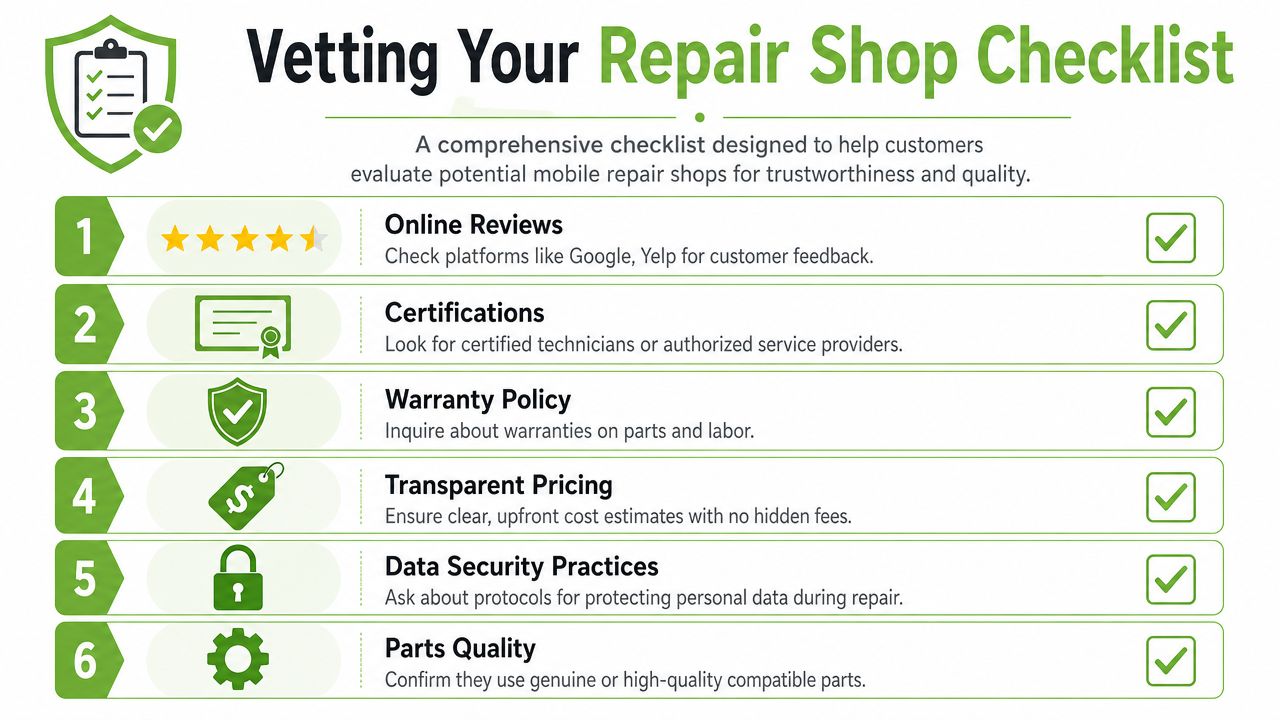
Ask how they control repair quality
Screen replacement sounds straightforward until you look at the actual work involved. In Singapore's repair sector, a standardised screen replacement process includes diagnostic validation, battery voltage verification of at least 3.7V, adhesive removal using a 45°C to 50°C heat gun, and reapplication of OCA with 98% optical alignment tolerance. Shops following this ISO-aligned process report a 94.2% first-time success rate for iPhone and Samsung OLED screens, while non-certified vendors average 76.8% according to Singapore screen replacement process data.
That gap matters. It's the difference between one clean repair and a phone that comes back with lift, dead pixels, touch issues, or hidden stress fractures.
Certifications aren't just corporate decoration
When a repair provider holds ISO 9001 Certified status, it signals an audited quality management process. When it holds ISO 27001 Certified status, it signals an audited information security framework. For customers, that doesn't mean perfection. It means the provider has formal systems for consistency and data handling.
For Samsung users, it also helps to understand how service pathways differ. This overview of the Samsung service centre landscape in Singapore is useful when comparing authorised routes with independent repair options.
Use this checklist before you agree
- Written estimate: Ask for a clear quote before work starts. It should identify the fault, the expected repair, and whether extra approval is needed if new issues appear.
- Part clarity: The shop should explain what kind of replacement part it uses in plain language. If the answer is evasive, treat that as a warning sign.
- Warranty terms: Don't settle for “got warranty” as a vague promise. Ask what is covered, what isn't, and how claims are handled.
- Data-handling process: Ask whether technicians need your passcode and, if so, why. A trustworthy shop should explain the minimum access required.
- Post-repair testing: A proper handover should include testing key functions such as display response, charging, signal, audio, and cameras.
- Documentation: Prefer shops that issue a job sheet or receipt with device details and repair notes.
What works: Providers that explain their process calmly and specifically.
What doesn't: Shops that keep everything verbal and ask you to “just trust”.
Preparing Your Device for a Safe Repair
People worry about data leakage during repair for good reason. A 2025 Singapore National Cybersecurity Centre report found that 34% of mobile users in Singapore fear data leakage during third-party repairs, while only 12% of local repair businesses publicly disclose their data-handling policies, according to Singapore repair data privacy findings. If you feel uneasy, that concern is reasonable.
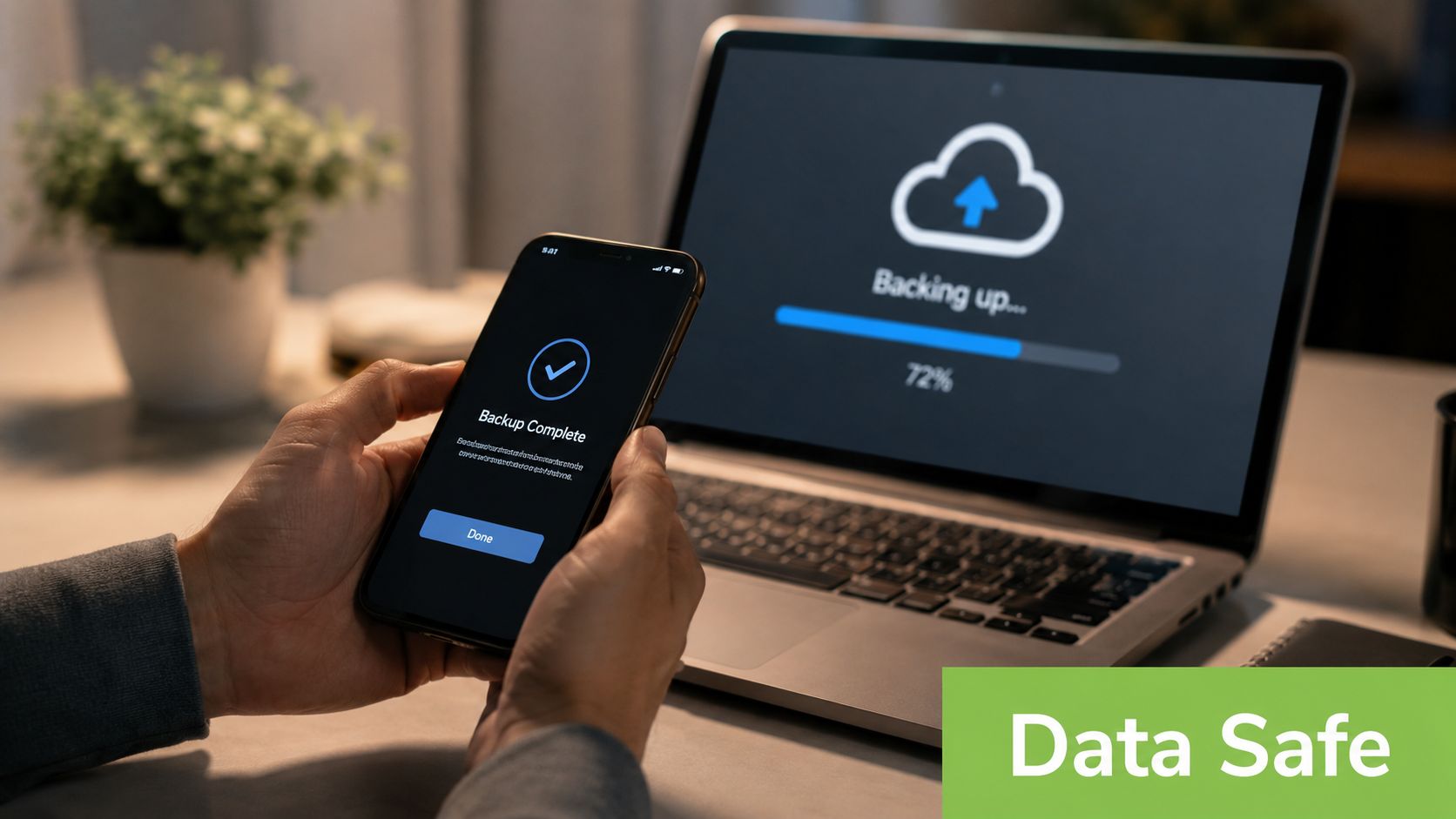
Do these before the handover
Think of pre-repair prep as a short security routine.
-
Back up your phone fully
Use your preferred cloud backup or a computer backup. Make sure photos, chat histories, contacts, and app data are included where possible. -
Log out of sensitive apps if practical
Banking apps, password managers, work email, and authentication apps deserve extra attention. If you stay logged in, make sure the device lock is strong. -
Remove SIM and memory cards
This is easy to forget. It also removes one unnecessary risk. -
Disable or prepare activation locks correctly
Some repairs require testing after part replacement. Clarify in advance whether any account-linked security feature affects the work. -
Photograph the device condition
Take clear photos of the front, back, corners, frame, and existing damage. It helps if there's any dispute later.
Be careful with passcodes
Some repairs require the phone to be accessible for testing. Others don't. Ask the shop exactly what they need access to and why. If you must share a passcode, change it afterwards.
A shop that treats this question casually is telling you something important about its operating standards.
Here's a simple visual guide that many users find helpful before they send a phone in for service:
For work phones and SME devices
Business devices need stricter handling. If the phone contains company email, client chats, document access, or mobile device management profiles, involve your IT lead before repair. A quick internal check can prevent account issues and compliance headaches later.
Don't hand over a business phone the same way you'd hand over a toaster. It carries accounts, records, and access.
Understanding Repair Costs Timelines and Warranties
Repair quotes can feel random if you don't know what drives them. Usually, three things shape the final figure: device model, damage severity, and part availability.
In Singapore, smartphone repair costs globally are commonly cited in the USD 50 to USD 400 range depending on the device and fault, and top repair shops typically offer 30 to 90 day warranties for critical repairs such as iPhone and iPad screen replacements, according to Singapore repair cost and warranty benchmarks.
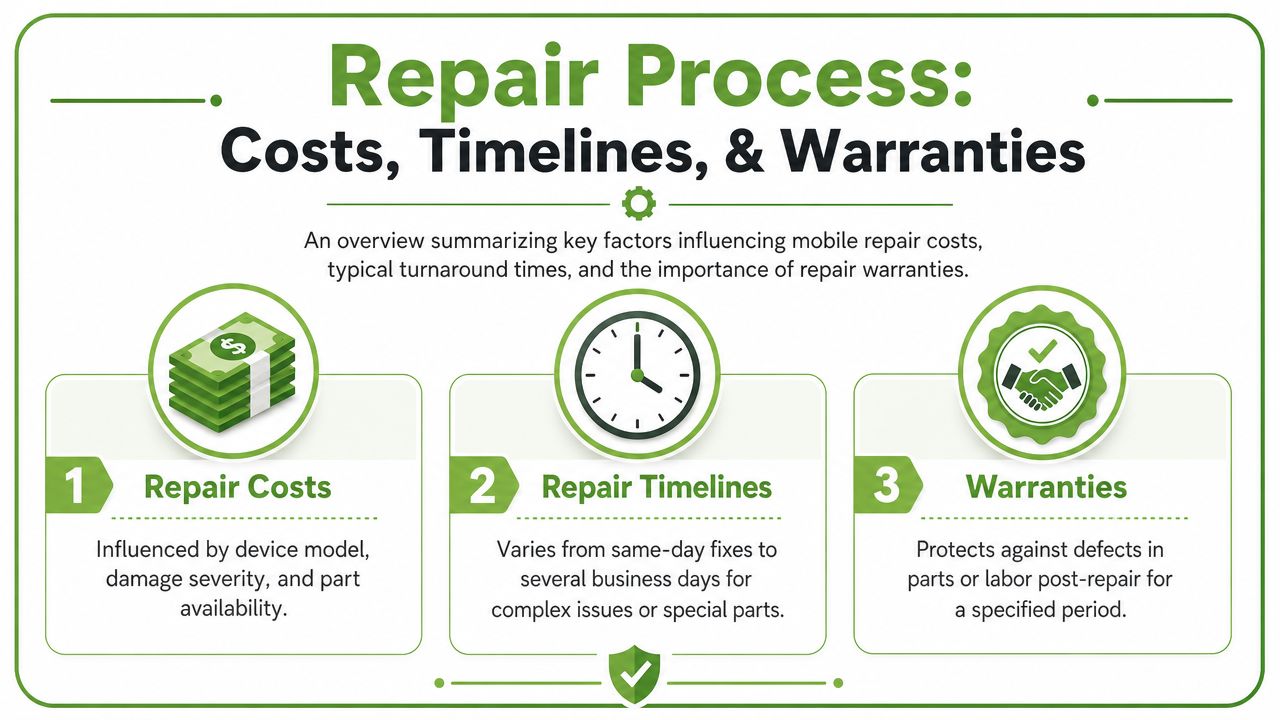
What affects the quote
A battery swap on a common model is different from an OLED display replacement on a newer premium phone. So is a straightforward glass issue compared with hidden frame damage after a hard drop.
Comparison helps. If you're trying to understand what commonly influences a display repair bill, this overview of phone screen repairs in Singapore gives useful context.
Ask for timeline details, not just “same day”
Some jobs can be completed quickly. Others take longer because the technician needs to test the device, source a part, or confirm there isn't a second failure underneath the obvious one.
Ask these questions:
- Is the part in stock today?
- How long is the diagnostic step?
- Will I be contacted before any extra work is done?
- What happens if the repair reveals additional damage?
Those questions reduce the chance of a vague promise turning into an open-ended delay.
Read the warranty like a practical person
A warranty only helps if you understand it. Focus on:
| Warranty question | Why it matters |
|---|---|
| Does it cover parts and labour? | Some shops only cover one, not both |
| What faults are excluded? | Accidental damage after repair is often separate |
| How do I claim? | A warranty that's hard to use has limited value |
A short warranty doesn't automatically mean poor quality, and a longer one doesn't automatically mean better service. What matters is whether the terms are clear and realistic.
Beyond Repair a Lifecycle Approach with myhalo
A broken phone is usually the start of a bigger decision. Do you repair it, trade it in, keep it as a backup, or move to a refurbished replacement that gives better value for work or daily use?
That's why it helps to work with a provider that sees technology as a lifecycle, not a single transaction.
Repair is one part of the decision
One practical option in Singapore is myhalo, which supports repair, trade-in, responsible recycling, data and device migration, and access to Certified ReLoved and Certified Surplus devices. For buyers who care about clarity, it also states transparent device grading and battery health disclosure, and every ReLoved device has a minimum verified battery capacity of at least 80%, as shown on myhalo's ReLoved device listings.
That broader model is useful when a repair isn't the only sensible path. Some users need a temporary replacement. Others want to trade in an aging phone and move into a refurbished device with known condition, documented checks, and a clearer cost-to-value balance.
The business case for longer device life
For households and SMEs, extending device life is about resilience. You reduce surprise spending, keep equipment in productive use longer, and make upgrades more deliberate. Services such as RescueAdvise, mylo AI Assistant, repair support, migration help, and structured quality checks all matter more when the device is part of work, study, or daily coordination.
There's also measurable carbon value in reuse. Reusing one smartphone in Singapore reduces emissions by about 72.4kg CO₂e, according to device reuse carbon savings in Singapore. That's a sustainability gain, but it's also a resource-efficiency decision.
Trade-in and circular options matter too
If repair no longer makes sense, a responsible exit path is just as important as a good repair path. myhalo's CircularXchange at Bugis Junction, 200 Victoria Street, #03-25/26, offers instant trade-in valuation with immediate cash payout after device assessment, and provides an S$30 reduction when customers donate old or unused digital devices while purchasing a refurbished phone, tablet, or laptop, according to myhalo CircularXchange details.
That kind of lifecycle support turns a stressful repair moment into a more organised technology decision.
If you're weighing repair, trade-in, or a move to a refurbished replacement, myhalo is one Singapore option that supports the full device journey, from repair and migration to Certified ReLoved devices, Certified Surplus products, and responsible recycling.