





iPhone Repair Cost Singapore: 2026 Price Guide
Your iPhone slips out of your hand, lands face-down, and the first thing you check isn't your messages. It's the screen. If the glass is shattered, the battery is dying by lunchtime, or the phone took a splash it shouldn't have, the next question is always the same. How much is this going to cost in Singapore?
That answer depends on more than the repair itself. The actual iphone repair cost singapore buyers face comes down to where you go, what parts are used, whether your device is still under warranty, and how much risk you're taking to save money upfront. A cheap quote can stay cheap, or it can turn into a second repair, a failed screen, or a voided warranty.
This guide focuses on the numbers that matter, particularly the trade-offs behind them. If you're comparing an Apple-authorised route with an independent repair shop, then the pricing starts to make sense.
Table of Contents
- That Heart-Sinking Moment Your iPhone Breaks
- Your Next Step A Reliable and Affordable Fix with myhalo
That Heart-Sinking Moment Your iPhone Breaks
A broken iPhone creates two problems at once. First, the device stops working the way you need it to. Second, you've got to decide quickly whether the repair is worth paying for.
In Singapore, that decision usually starts with a sharp price gap. Apple-certified centres charge predictable rates, but they're often the highest option. Independent shops can be much cheaper, especially for older models, but the quality gap between one shop and another can be huge.
That's where the pitfalls of a quote emerge. A quote that looks good on paper doesn't tell you whether the screen is genuine, whether Face ID or True Tone will behave normally, or whether the repair creates problems later. The cost isn't just the amount on the invoice. It's the total price of the part, the workmanship, the warranty position, and the chance you'll need to fix the same issue again.
Practical rule: If you only compare the lowest advertised price, you're not comparing the real cost of repair.
A cracked screen, weak battery, or water-damaged phone doesn't automatically mean you should choose the most expensive option. It also doesn't mean the cheapest quote is the smart one. What matters is matching the repair path to the phone's age, your budget, and whether you still care about official warranty protection.
For most owners, the right move starts with understanding how repair pricing is built.
Understanding Your iPhone Repair Bill
A repair bill works like a car workshop invoice. You're not paying for one abstract service. You're paying for parts, labour, and the level of risk protection that comes after the repair.
What you're actually paying for
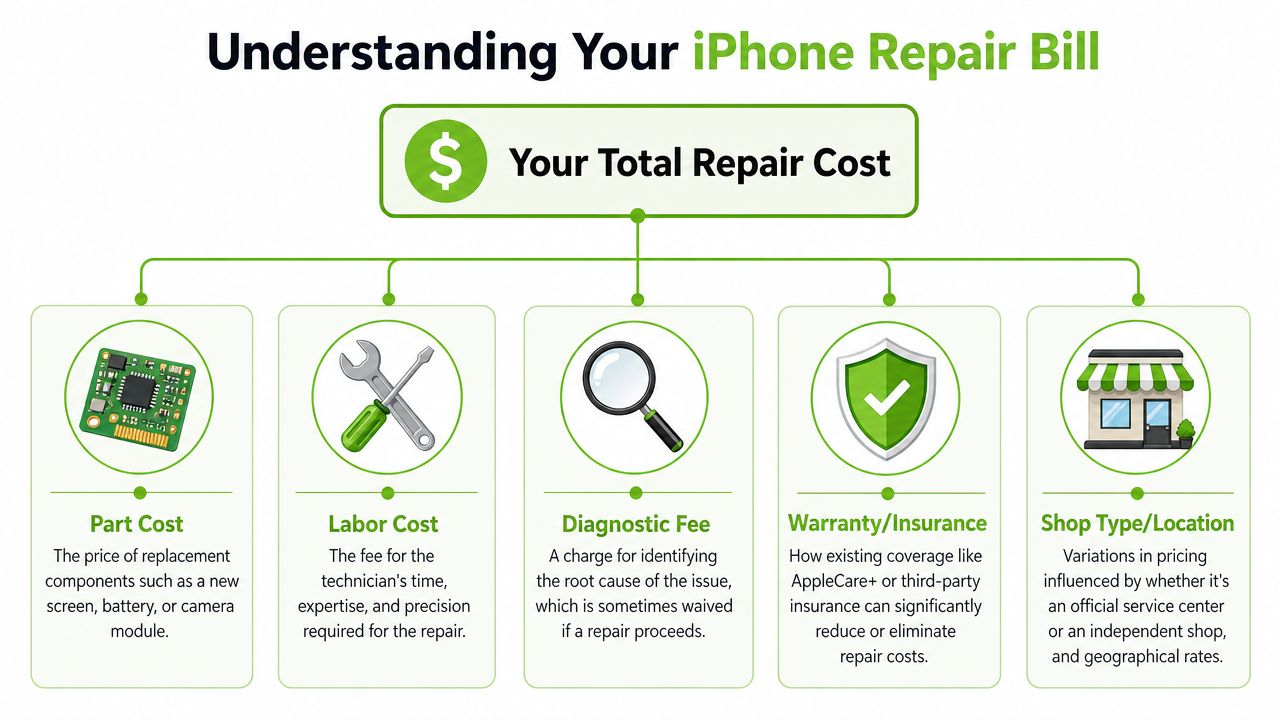
The biggest cost driver is usually the replacement part. That's why newer iPhones cost more to fix than older ones. A newer display assembly or battery is more expensive, and on some repairs the quality difference between genuine and aftermarket parts changes the price dramatically.
Then comes labour. A proper repair isn't just opening the phone and swapping a part. A technician has to disassemble the device carefully, test the fault, fit the replacement correctly, and verify that key functions still work after reassembly. Some shops bake this into one price. Others separate diagnosis, labour, and parts.
Warranty also has real value. A repair with post-repair support may cost more upfront, but it reduces the chance that you'll pay twice if the replacement part fails early. If you're comparing quotes, don't just ask “How much?” Ask what's included and what happens if the issue comes back.
A useful reference point is battery service. According to this Singapore battery replacement cost guide, iPhone battery replacement is critically recommended once battery health drops to 80%, because that threshold correlates with 30–50% performance throttling and reduced runtime. The same guide notes that replacements in Singapore can cost S$25–S$60 for high-grade equivalents or S$99+ for official Apple service.
For a model-specific breakdown of what affects battery pricing, see this battery replacement cost iPhone guide.
Why battery health matters more than most people think
Battery problems often feel less urgent than a cracked screen, but they can make a phone unusable in a quieter way. The device slows down, drains too quickly, and becomes unreliable outside the house.
Here's the practical way to read a battery quote:
- Low-cost equivalent battery can make sense if the phone is older and already out of warranty.
- Official battery service makes more sense if you want to preserve the official service route or keep the phone for longer.
- Unusually vague pricing is a warning sign. If a shop won't explain what battery grade they're using, the cheap quote may not stay cheap.
A good repair quote tells you what part is going in the phone, not just what you'll pay at the counter.
Typical iPhone Repair Costs in Singapore 2026
A customer walks in with a cracked iPhone screen and asks the question we hear every day: “Why is one shop quoting under S$100 while another is several hundred?” That is the iPhone repair cost Singapore problem. The price on the poster is only part of the bill. The part quality, model generation, feature compatibility, and warranty terms decide whether the repair stays affordable or turns into a second repair later.
Screen damage usually creates the widest pricing spread, especially once you compare older LCD models with newer OLED iPhones. Newer phones cost more to repair because the display itself costs more, and because a poor-quality replacement is easier to spot in daily use. Dim brightness, weak touch response, washed-out colours, and faster failure rates are common trade-offs at the low end.
Screen repair prices
For cracked displays, it helps to read quotes by model tier rather than by a single “screen replacement” price.
Older models such as iPhone 7, 8, X, and 11 usually have the biggest gap between budget and premium repair options. In the independent market, these phones can be repaired quite cheaply, but that range often includes both decent aftermarket parts and very poor ones. Two shops may quote similar labour for the same model while installing very different screens.
Newer models such as the iPhone 12 and 13 sit in a different bracket. Even outside authorised channels, repairs rarely fall into true bargain territory if the shop is using a decent OLED-grade part. If the quote looks unusually low, ask what display type is being installed and whether True Tone, brightness performance, and touch quality are expected to match closely.
For a closer look at what affects cracked display pricing, this guide to iPhone screen repair options in Singapore is a useful reference.
Battery replacement prices
Battery jobs are easier to compare on paper and harder to judge after the repair.
A battery quote may look simple, but the key difference is the cell quality and how honest the shop is about it. A cheaper battery can still be a sensible choice for an older phone near the end of its usable life. For a newer iPhone you plan to keep, paying more for a better-grade battery and clearer warranty terms is often the cheaper decision over twelve months.
This is why battery pricing often fools customers. Two invoices can differ by a modest amount, but one battery may hold charge properly and the other may drop health quickly, run hot, or trigger warning messages.
What the numbers look like side by side
| Repair Type | iPhone Model | Authorised Apple Cost | Typical Independent Cost |
|---|---|---|---|
| Screen repair | Newer OLED iPhones such as iPhone 12 and 13 | Higher official pricing | Mid-range to high independent pricing, depending on screen grade |
| Screen repair | Older models such as iPhone X and iPhone 11 | Higher than many independent options | Wide range, from budget parts to better aftermarket screens |
| Screen repair | Much older models such as iPhone 7 and 8 | Often hard to justify on pure cost | Lower entry pricing, but quality varies sharply |
| Battery replacement | Most models | More standardised official pricing | Wide spread based on battery grade and warranty |
A few practical patterns matter more than the headline price:
- Newer iPhones have less room for cheap repairs without visible compromises.
- Older iPhones offer the biggest savings, but also the biggest variation in part quality.
- Battery quotes are only comparable if the shop tells you the battery grade and warranty coverage.
- The cheapest screen quote can become the most expensive option if brightness, touch, or durability are poor and you need to redo the job.
A good repair quote answers three questions clearly. What part is going in, what functions may change after repair, and what happens if that part fails early. If a shop cannot answer those three points, the low price is incomplete.
Authorised Apple Service vs Independent Repair Shops
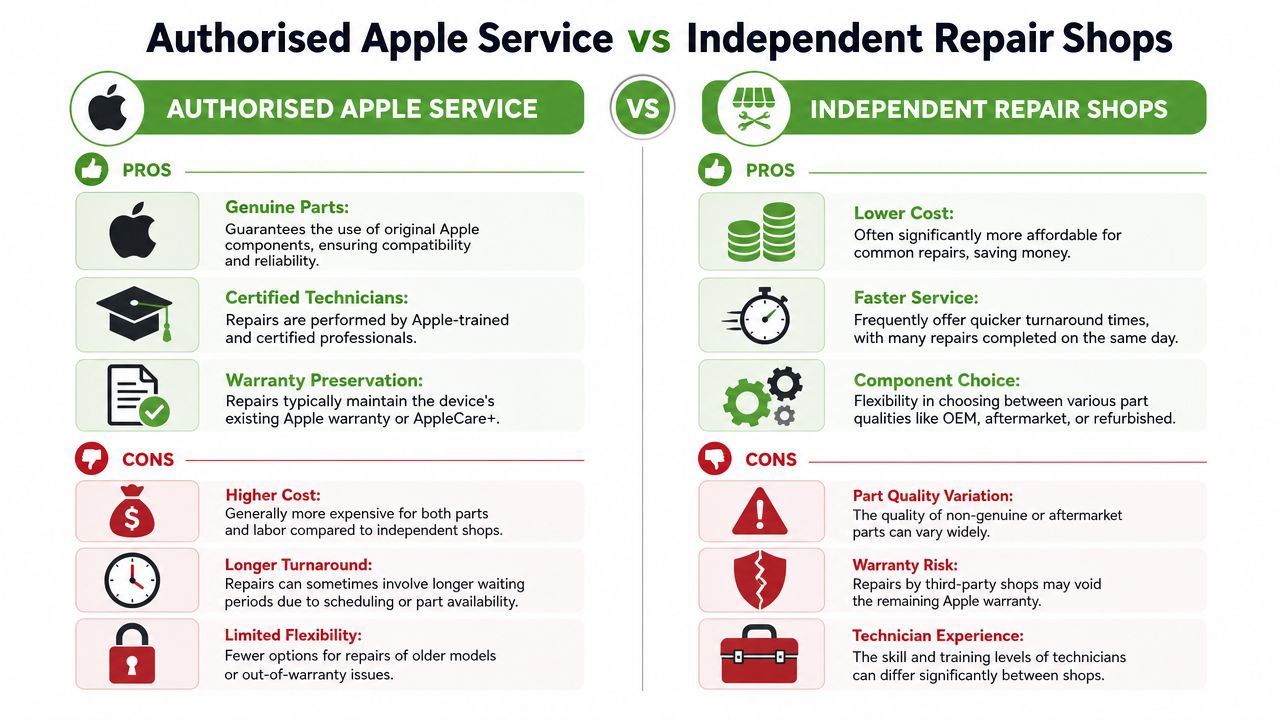
This decision isn't about right or wrong. It's about which compromise you're willing to accept.
When authorised service makes sense
Authorised Apple service is the cleaner route if your iPhone is newer, still covered, or important enough that you don't want to gamble on parts quality. The strongest advantage is consistency. You know the service path, you know the support structure, and you aren't left wondering whether the replacement part is genuine.
Part quality is a major reason for the price gap. According to this Singapore screen pricing analysis, genuine Apple OLED displays for iPhone 11 to 16 models cost S$258 to S$538 for the part alone, while aftermarket screens range from S$78 to S$148. The same source notes that screens under S$60 often use low-quality LCDs that degrade quickly.
That matters in real use. Colour accuracy, touch feel, display durability, and feature compatibility aren't cosmetic details. They affect whether the phone still feels like an iPhone after repair.
If you need a broader view of official support pathways, this guide to an Apple service centre in Singapore helps frame what to expect.
When an independent repair shop makes sense
Independent shops make sense when cost and speed matter more than preserving the official service route. For older iPhones, that can be the rational choice. Spending official-service money on a device that's already several generations old often doesn't add up.
The better independent shops are clear about three things:
- Part type: genuine pull, OEM-equivalent, aftermarket OLED, or budget LCD
- Turnaround: whether it's a while-you-wait repair or a longer diagnostic job
- Warranty: what the shop covers if the part or workmanship fails
The weak shops stay vague. They advertise one low number, then rely on customers not asking what screen quality they're getting.
If the quote looks unusually cheap, ask whether the replacement is OLED or LCD, whether True Tone is retained where relevant, and what the warranty actually covers.
Independent repair is often the practical answer for out-of-warranty devices. But it only works well when the shop is transparent enough for you to judge the trade-off, not just the price.
The Hidden Risks of Ultra-Cheap Repairs
The lowest quote in the market often hides the highest uncertainty.
The problem with the lowest quote
Cheap screen replacement is attractive because the pain is immediate. Your display is cracked, you need the phone back fast, and a bargain price feels like a quick win. The problem is that not all cheap repairs are equal. Some are fairly priced because the shop has efficient sourcing. Others are cheap because the part quality is poor.
That distinction matters more than most buyers realise. Low-grade screens can bring weak touch response, odd colour reproduction, brightness issues, or shorter useful life. Those problems don't always show up at the counter. They appear after a few days or weeks of normal use.
Why the cheapest repair can become the most expensive
A key warning sign comes from this AsiaOne cost guide discussing unofficial repairs. It cites a 2025 Singapore Consumer Association study finding that 34% of users who chose cheap, unofficial repairs experienced screen failures or performance degradation within 6 months. The same piece notes that using non-genuine parts can void any remaining Apple warranty.
That's the hidden cost. You may save money today, then lose warranty protection and pay for another repair later.
Watch for these red flags before agreeing to an ultra-cheap job:
- No part description: If the shop won't say what screen or battery is being used, you can't judge value.
- Unclear warranty terms: “Got warranty” isn't enough. You need to know duration and coverage.
- Pressure to decide quickly: Good repair shops answer technical questions. Weak ones rush the transaction.
- Prices far below normal market bands: Deep undercutting often means lower-grade LCDs or inconsistent workmanship.
A repair should restore function. It shouldn't turn your phone into a compromise you notice every time you access it.
Smart Ways to Save Money on iPhone Repairs
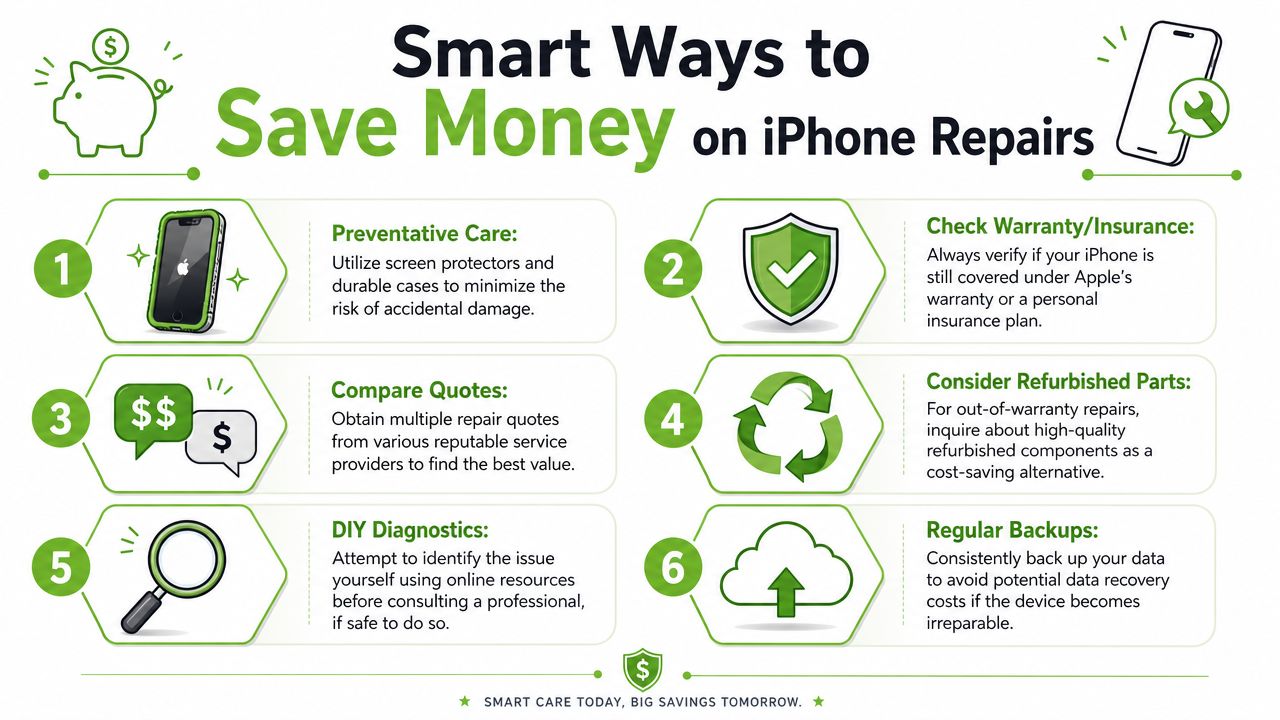
A cheaper repair bill starts before the phone breaks. The lowest total cost usually comes from preventing damage, using any coverage you already paid for, and knowing when a repair is no longer the sensible option.
Use the protection you already have
Many iPhone owners forget to check AppleCare+ or card-related device coverage before approving a repair. That can be an expensive mistake. If your phone is covered, the out-of-pocket cost may be far lower than a standard screen or back glass repair.
Good habits also reduce the chance of paying for a repair at all:
- Use a case with raised edges: It gives the screen and camera ring more protection on corner drops.
- Replace worn screen protectors: A cracked protector is cheap to change. Leaving it on can hide new damage underneath.
- Back up your iPhone regularly: If the repair quote is too high, you can switch devices without risking your photos, chats, or business data.
Compare quotes like a technician would
Price matters, but meaningful savings result from comparing what each quote includes. Ask for the part grade, repair time, warranty period, and whether Face ID, True Tone, battery health reporting, or water resistance will be affected after the job.
A shop that answers these questions clearly usually has a more reliable process. A shop that avoids specifics often leaves room for low-grade parts, rushed installation, or weak after-sales support.
Know when to stop repairing
Many people overspend when faced with extensive repairs. If an older iPhone needs a screen, battery, and housing work at the same time, the combined bill can get close to the value of the device itself. In those cases, repair is not always the cheapest decision in the long run.
Check the age of the phone, its resale value after repair, and how long you realistically plan to keep using it. Spending more on a repair only makes sense if the phone still has enough useful life left.
For business owners, downtime has a cost too. If your sales or support work depends on fast replies, a delayed repair can hurt revenue more than the part itself. Tools like IllumiChat plans for Shopify stores can help keep customer conversations moving while your main device is off the job.
A smart repair decision protects more than today's cash flow. It protects your time, your data, and the resale value of the phone.
Your Next Step A Reliable and Affordable Fix with myhalo
Most iPhone owners don't need the absolute cheapest repair. They need a repair that's priced fairly, uses sensible parts, and doesn't create another problem two weeks later.
For common jobs such as screen and battery replacements, speed matters too. In Singapore, LYK Repair notes that most common iPhone repairs are completed within 30 to 60 minutes and offers transparent quotes with a 100-day warranty. That's a useful benchmark for what efficient, customer-friendly repair service should look like.
myhalo fits into that practical middle ground. It offers repair support alongside refurbished and replacement-device options, which is useful when the smarter financial move isn't always a repair. If a device is too costly to fix relative to its age, it can make more sense to trade in the damaged phone and move to a professionally refurbished unit with warranty coverage instead of sinking more money into an ageing handset.
That flexibility matters. Some customers need a same-day fix. Others need help deciding whether repair, trade-in, or replacement gives them the better long-term result. A shop that can handle both conversations tends to give more grounded advice than one that only sells one outcome.
If you want a straightforward next step, myhalo is a practical place to compare repair support, trade-in options, and warranty-backed refurbished replacements before deciding what your iPhone is really worth fixing.