





Carbon Footprint Reduction: Singapore Actionable Guide
You're probably reading this on a phone, with a laptop nearby, maybe while your air-con is running and a delivery app is open in another tab. That's normal life in Singapore. It's also where carbon footprint reduction gets practical.
Climate news often prompts thoughts about big systems they can't control. Governments, power plants, shipping lanes, aviation. But the more useful question is simpler. Which decisions in daily life and business operations create the biggest avoidable footprint, and which of those choices also save money or improve resilience?
In Singapore, one of the most overlooked answers is technology. A new phone, laptop, tablet, monitor, server, or office fleet doesn't just consume electricity when you switch it on. It carries embedded carbon from manufacturing, transport, packaging, and eventual disposal. If you ignore that lifecycle, you can make small green habits in one area while unwittingly making high-impact carbon decisions in another.
Table of Contents
- Why Carbon Footprint Reduction Matters in Singapore
- Start With Your Tech The Overlooked Carbon Win
- Reduce Your Daily Energy and Transport Footprint
- Smart Consumption for Resilient Singaporean Businesses
- How to Measure and Track Your Impact
- Your Next Step Towards a Smaller Footprint
Why Carbon Footprint Reduction Matters in Singapore
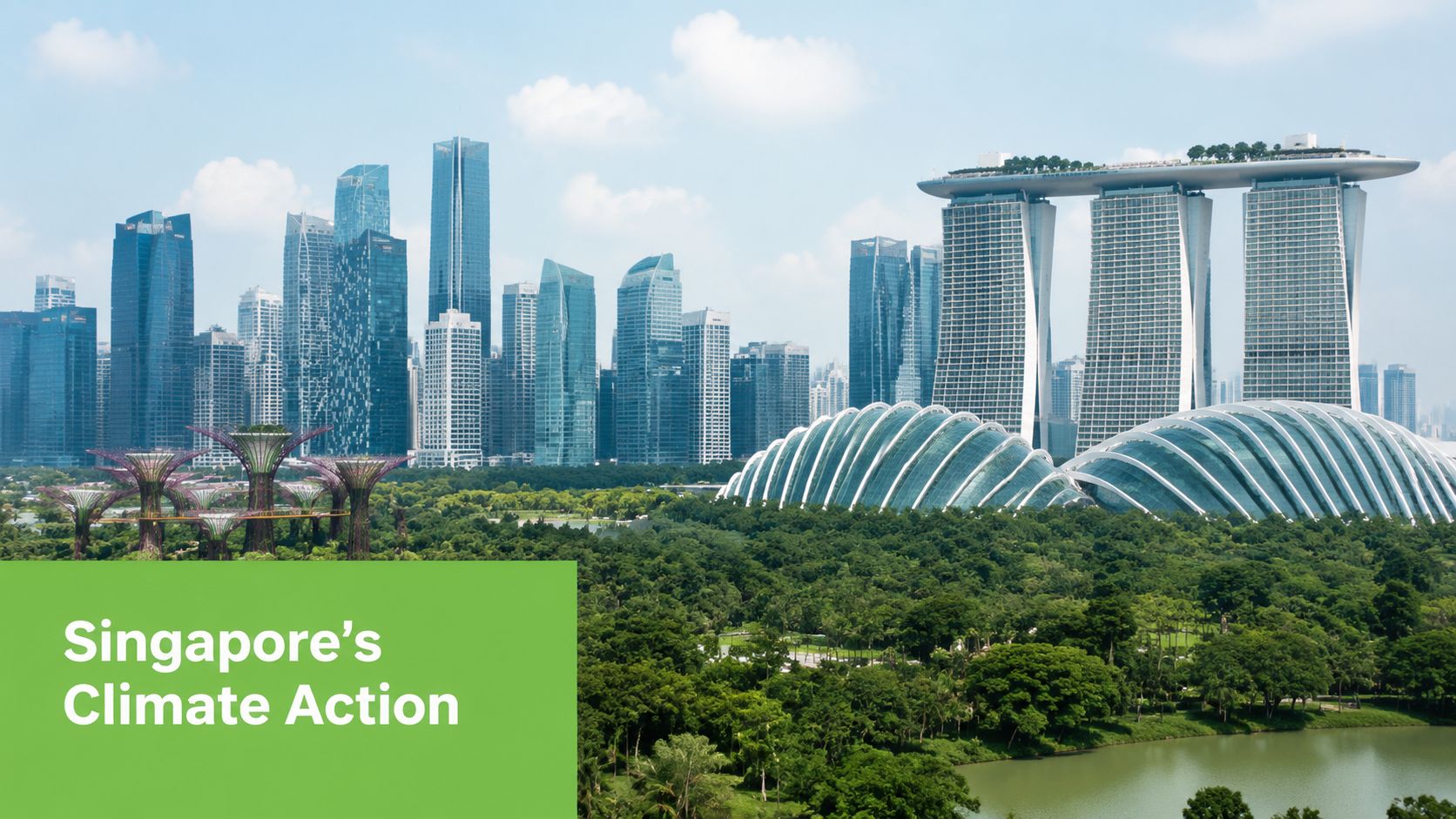
Climate targets can feel distant until they start affecting electricity bills, procurement choices, landlord requirements, and customer expectations. In Singapore, that shift is already happening. The country has committed to reducing greenhouse gas emissions to between 45 million and 50 million tonnes of CO₂-equivalent by 2035, on a pathway to net zero by 2050, and the carbon tax is scheduled to rise to SGD 45 by 2026–2027 and SGD 50–80 by 2030 according to the Singapore emissions target update from EDB.
That matters even if you never calculate a formal carbon inventory. Businesses will feel it through energy costs, reporting pressure, procurement standards, and supply chain expectations. Households will feel it through product pricing, utility-conscious design, and a growing need to make purchases that last longer.
Policy becomes practical at street level
A lot of sustainability advice stays too abstract. It talks about saving the planet but ignores how people make decisions. In practice, Singaporeans usually change behaviour for three reasons.
- Lower running costs. If a device, appliance, or process uses less energy or lasts longer, people keep it.
- Lower replacement frequency. If you don't need to buy new as often, you cut both spending and waste.
- Lower operational friction. If a greener option is also more convenient, adoption is easier.
For SMEs, this is no longer just CSR language. It's part of financial discipline. For households, it's part of smart budgeting.
Practical rule: The most durable sustainability move is the one that improves cash flow or reduces operational headaches.
The real decision areas
For most readers, carbon footprint reduction comes down to three areas.
| Area | What changes | Why it matters |
|---|---|---|
| Technology | Repair, reuse, refurbish, recycle properly | Cuts embedded carbon and avoids premature replacement |
| Energy | Use devices and appliances more efficiently | Lowers electricity use and recurring costs |
| Consumption | Buy fewer short-life products, choose better-fit items | Reduces waste, overspending, and disposal burden |
Many guides start with food, plastic, or general lifestyle reminders. Those matter. But if you want action that holds up financially in Singapore, look first at what you buy, how long you keep it, and how efficiently you use it.
Start With Your Tech The Overlooked Carbon Win
The usual carbon checklist misses a major issue. People focus on straws, tote bags, and short showers while replacing working electronics too quickly. That's a weak trade if your goal is meaningful carbon footprint reduction.
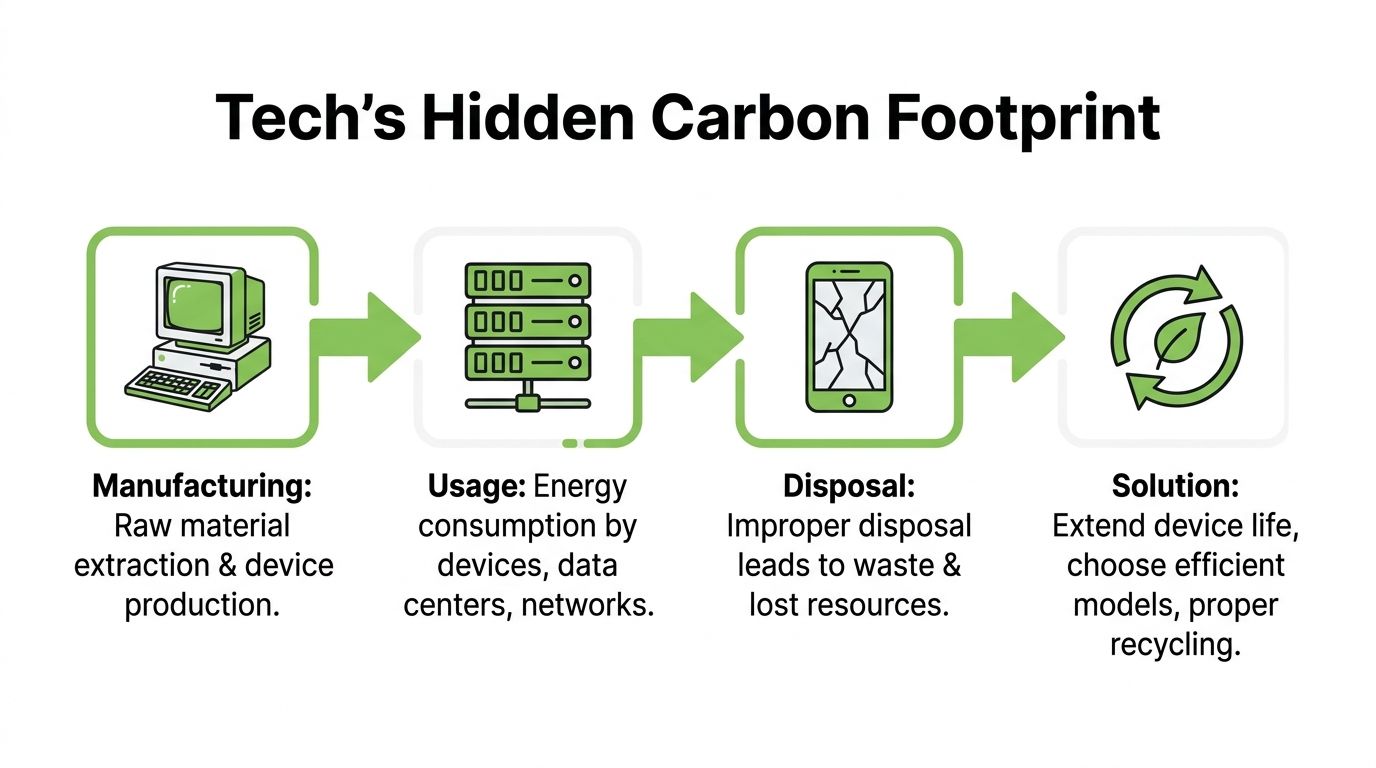
Technology has a hidden footprint long before you unbox it. Mining materials, manufacturing components, assembly, shipping, warehousing, and packaging all happen before the first charge cycle. That's why a new device can be a high-impact purchase even if it's energy efficient in use.
Why embedded carbon changes the conversation
Most Singaporean carbon footprint advice overlooks personal electronics. Yet, extending a device's life by just one year can reduce its annual carbon footprint by up to 30%, according to the Singapore carbon footprint gap analysis at Climate Change Tracker.
That single point changes how you should think about upgrades.
If your current laptop still handles email, browser tabs, spreadsheets, POS software, accounting tools, video calls, and basic creative work, replacing it too early may be a poor sustainability decision. The same goes for smartphones with healthy batteries and tablets used mainly for school, inventory, or fieldwork.
What actually works for households and SMEs
The strongest device-lifecycle decisions are usually the least flashy.
- Repair before replacing. Battery swaps, screen repairs, keyboard replacements, fan cleaning, storage upgrades, and fresh operating system setup often restore useful life at a lower cost than buying new.
- Buy refurbished when performance is still adequate. Students, families, startups, and SMEs don't always need the newest chipset. They need stable performance, predictable condition, and support.
- Match the device to the actual workload. Overspec buying is common. A machine chosen for rare peak usage usually sits underused while carrying a larger embodied footprint and higher purchase cost.
- Plan the end of life early. Trade-in, redeployment, parts harvesting, and responsible recycling should be considered before a device becomes junk in a drawer.
A practical example helps. A reception desk PC, classroom laptop, warehouse tablet, or work-from-home notebook usually has a narrower task profile than people assume. If the job is browser-based, cloud-based, or admin-heavy, lifecycle extension often beats full replacement.
A sustainable tech decision isn't “buy the cheapest” or “buy the newest”. It's “buy the longest useful life for the actual job”.
That's where lifecycle partners become more useful than pure retailers. When a provider can support repair, reuse, Certified ReLoved devices, Certified Surplus products, and responsible recycling, you get options instead of a forced upgrade path. For readers comparing practical refurbished-device considerations, this guide to refurbished laptop computers is a helpful starting point.
In Singapore, this is especially relevant because homes and offices are compact, budgets are watched closely, and tech replacement cycles can get compressed by habit rather than necessity. A phone upgrade every year or two may feel normal. It isn't always rational. The same applies to SME refresh cycles that replace every unit at once without checking whether roles, departments, or field teams need new hardware.
One option in this space is myhalo, which positions itself as a technology lifecycle partner rather than a simple seller. That includes Certified ReLoved and Certified Surplus devices, RescueAdvise support, mylo AI Assistant, transparent device grading and battery health disclosure, 30-point quality checks, and ISO 9001 Certified and ISO 27001 Certified processes. Those details matter because trust in refurbished technology depends on condition clarity, data handling discipline, and whether the device is fit for the intended workload.
Reduce Your Daily Energy and Transport Footprint
Tech choices deal with embedded carbon. Daily habits deal with recurring emissions and bills. For Singapore households, the useful question isn't whether small actions matter. It's which ones are easy enough to repeat every day without becoming a chore.
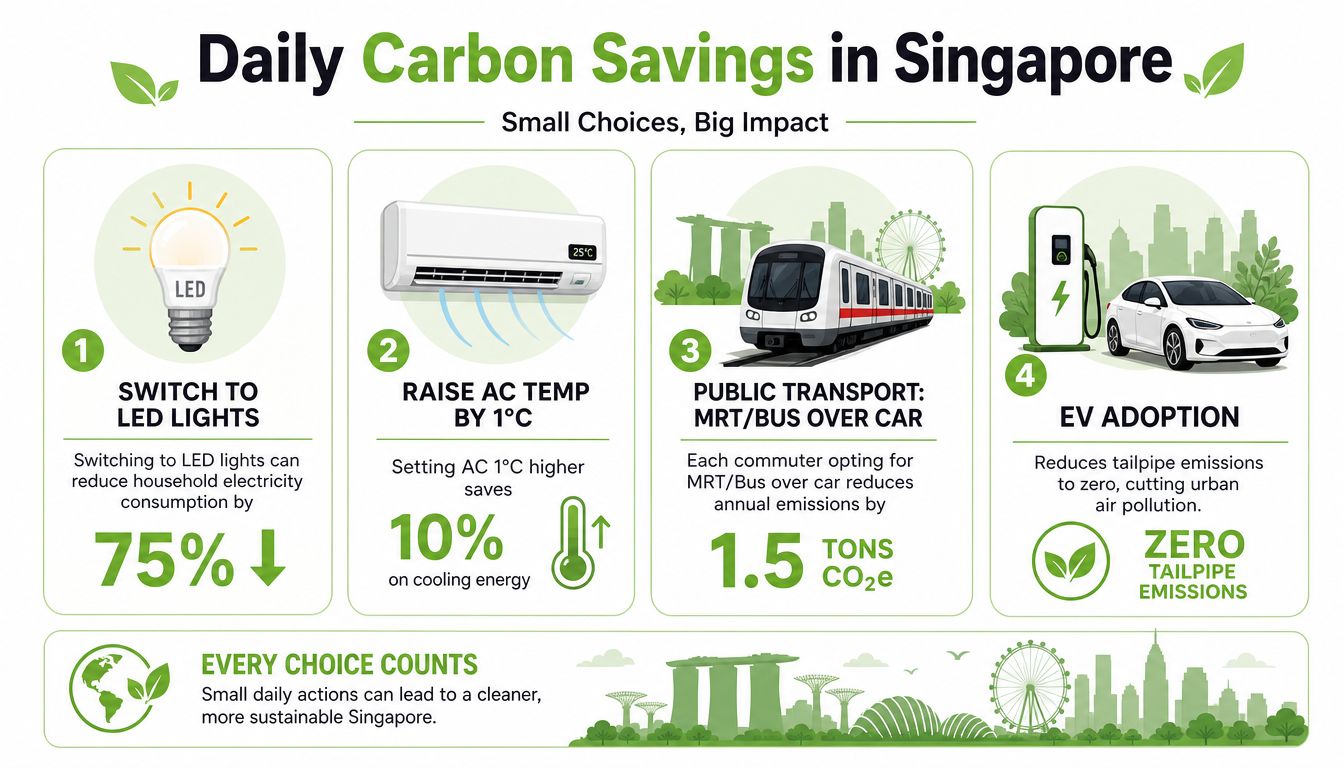
A broad lifestyle study found that adopting three choices in Singapore, prioritising a plant-based diet, consistently using mass public transport, and sourcing food regionally, can save approximately 2.38 tonnes of CO₂-equivalent per person annually, which is nearly 20% of the average resident's total carbon footprint, according to the NUS SGFIN white paper on household carbon choices.
The visual below summarises familiar daily actions. Treat it as a prompt, not a strict scorecard.
Home energy choices that are worth the effort
Most households don't need complicated systems. They need consistent habits tied to the biggest energy users.
Start with cooling. In many HDB flats and condos, air-con dominates comfort decisions. The practical goal is to reduce overcooling, keep filters clean, close doors and windows when cooling a room, and avoid running units in empty spaces. Pair that with fan use where appropriate, especially during transitional periods when full cooling isn't necessary.
Then look at device use patterns.
- Turn off idle equipment. Don't leave monitors, game consoles, chargers, and routers running without a reason.
- Maintain appliances. Poorly maintained units can run less efficiently, especially those with dust build-up or ageing components.
- Replace by condition, not impulse. If an appliance is still functioning well, use it fully. If it's deteriorating and inefficient, replace it deliberately rather than reactively.
Household shortcut: Your utility bill already tells you where to look. High-consumption months usually reflect cooling and usage behaviour before they reflect product labels.
Later in the evening, it's worth revisiting how digital habits affect electricity use at home.
Transport habits that hold up in Singapore
Transport advice often gets reduced to “drive less”. In Singapore, the better framing is “use the transport network you already have more deliberately”.
The MRT and bus network make daily carbon footprint reduction unusually realistic compared with many cities. If your commute is predictable, public transport is often the lowest-friction option. For hybrid workers, another strong move is trip consolidation. Schedule errands, meetings, collection runs, and family tasks together instead of taking multiple scattered car or ride-hail trips across the week.
A few realistic decision rules help.
- Use public transport for repeatable routes. Commuting, school runs with older children, and routine errands fit this best.
- Keep ride-hailing for exception cases. Heavy loads, mobility issues, tight timing, or poor route alignment are valid reasons.
- Question convenience drift. Many people shift from train to car not because they need to, but because the habit forms.
The same logic applies to food choices. Perfection isn't necessary. A more plant-forward routine and more regional sourcing can fit normal Singapore life without requiring an identity change or expensive specialty shopping.
Smart Consumption for Resilient Singaporean Businesses
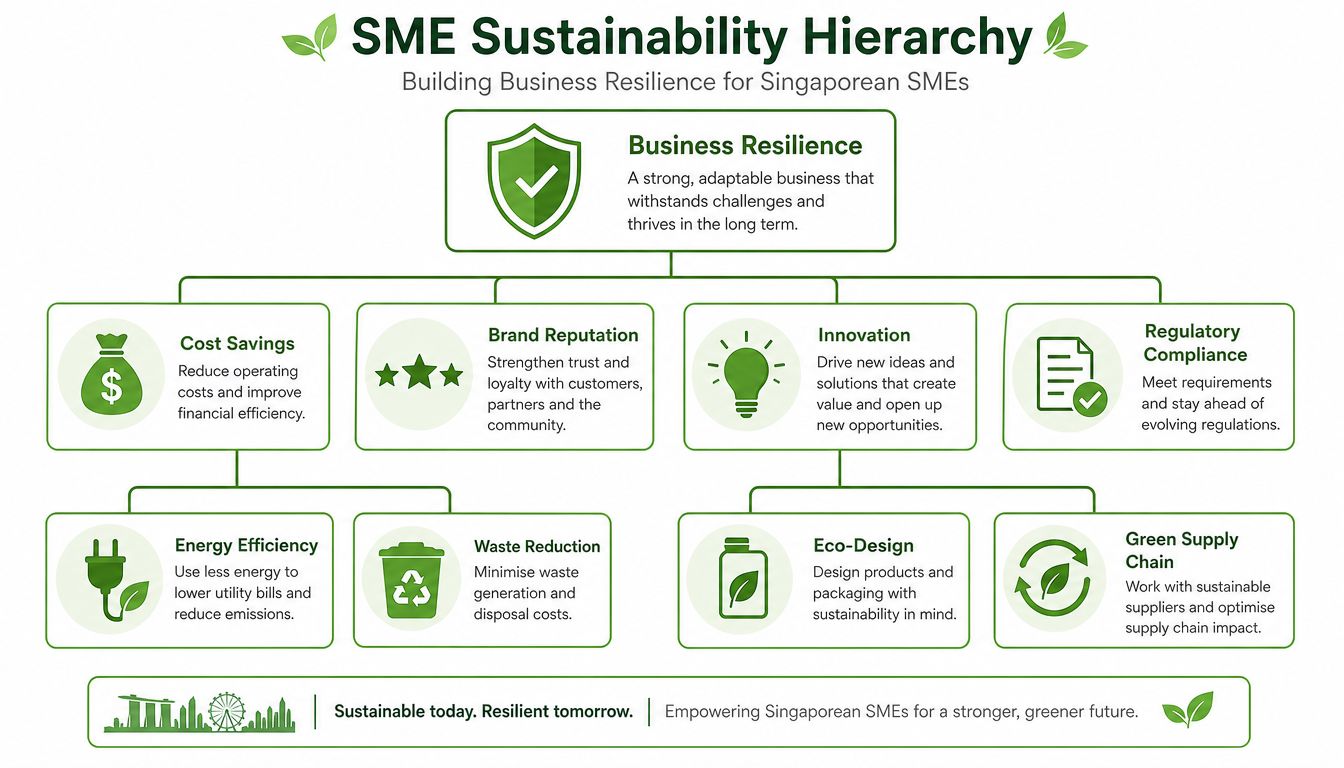
For SMEs, sustainability work only survives if it strengthens the business. It has to reduce waste, control cost, support compliance, or make procurement decisions smarter. Otherwise it gets parked until “later”, which usually means never.
That's why carbon footprint reduction should be treated as an operational discipline. Singapore's industry sector is the largest energy consumer, and the government supports efficiency improvements through schemes such as the Energy Efficiency Grant and the Enterprise Sustainability Programme, which help SMEs build capability and capture green growth opportunities, as outlined by the National Climate Change Secretariat on industry mitigation efforts.
Run a simple operational review
Don't begin with a formal sustainability deck. Begin with a room-by-room, process-by-process review.
Walk through your office, shop, clinic, studio, warehouse, or outlet and ask four questions.
| Question | What to check |
|---|---|
| What are we buying too often | Short-life supplies, low-durability equipment, frequent tech replacements |
| What are we running inefficiently | Cooling schedules, lighting in low-use areas, always-on equipment |
| What are we throwing away too early | Repairable devices, reusable packaging, furniture, peripherals |
| What creates admin burden later | Untracked assets, unclear disposal process, mixed procurement standards |
Sustainability becomes ordinary management. A procurement team that buys fewer low-grade accessories, a facilities team that controls unnecessary cooling, or an IT lead that redeploys laptops internally is reducing carbon and improving margin at the same time.
Treat procurement as a resilience decision
A resilient business buys for useful life, serviceability, and end-of-life handling. That applies to laptops, tablets, POS terminals, printers, networking hardware, and even packaging.
For food, retail, and hospitality operators with international customers or export ambitions, compliance thinking also matters. If your team is reviewing packaging choices or future-proofing material decisions, this overview of UK hospitality packaging compliance is a practical reference because it shows how packaging requirements increasingly intersect with operational standards and market access.
A similar mindset applies to electronics. If you don't have a documented path for reuse, redeployment, data wiping, resale, and responsible recycling, you're leaking value. The result is familiar. Cupboards full of obsolete devices, rushed disposal, and unnecessary new purchases because no one has visibility on what can still be used. For businesses looking to build better e-waste habits, this resource on a zero e-waste world and how you can help is useful for mapping responsible disposal into a broader asset lifecycle process.
The cheapest unit at purchase can become the most expensive unit over its full life if it fails early, can't be repaired, or creates disposal problems.
How to Measure and Track Your Impact
You don't need perfect carbon accounting to get started. You need a baseline that's simple enough to update. For individuals and businesses, that's the difference between good intentions and actual progress.
For households
Start with what you already have.
- Utility bills show recurring energy use patterns.
- Transport history shows where routine trips can change.
- Purchase history reveals how often you replace phones, laptops, appliances, and accessories.
- Food habits show whether your weekly routine is heavy on high-impact convenience choices.
Use an online calculator if it helps create a first estimate, but don't get stuck hunting for a perfect tool. The value is in trend tracking. If your next year includes fewer new devices, more repairs, fewer unnecessary car trips, and more efficient home energy habits, that's progress you can observe even before you formalise it.
For businesses
Carbon accounting becomes easier when you translate the language into plain operations.
- Scope 1 is what your business burns or emits directly.
- Scope 2 is the electricity you buy and use.
- Scope 3 is everything around your operations, such as purchased goods, logistics, waste, and supplier-related impacts.
For many SMEs, Scope 3 is where procurement decisions matter most. If your team buys durable equipment, extends device life, repairs instead of replacing, and chooses reused or refurbished assets where fit-for-purpose, you're making a real operational move to lower purchased-product impact.
A straightforward monthly tracker can include:
- Energy use trends from bills and site records.
- Transport and logistics patterns across staff movement and delivery arrangements.
- Asset lifecycle data such as repair count, replacement count, and redeployment rate.
- Waste handling notes covering electronics, packaging, paper, and consumables.
Some firms go further and explore digital record systems for environmental assets and credits. If that's relevant to your sector, it's worth understanding how platforms are being built by a carbon tokenization development company so you can separate useful infrastructure ideas from hype.
Measurement works best when it informs a decision. If you can't act on the number, simplify the tracking method.
Your Next Step Towards a Smaller Footprint
The smartest way to approach carbon footprint reduction in Singapore isn't to overhaul everything at once. Start where the waste is easiest to stop.
For many households, that means questioning the next phone or laptop upgrade, using appliances more carefully, and leaning harder on public transport where it already fits daily life. For SMEs, it means reviewing how equipment is procured, maintained, redeployed, and retired, then tightening the processes that drain both money and resources.
The useful mindset is simple. Buy less often. Use what you have properly. Repair what still has life. Replace only when the function gap is real.
That's also why lifecycle support matters more than one-off transactions. When you can check condition clearly, understand battery health, accurately assess grading, get repair guidance through RescueAdvise, and keep assets in circulation longer through Certified ReLoved and Certified Surplus options, sustainability becomes a practical operating model. Tools such as mylo AI Assistant can also help users make more informed fit-for-purpose choices instead of defaulting to overbuying.
If you want to make the next step tangible, pick one category this week.
- Home users can review every device that's due for upgrade and separate “want” from “need”.
- Parents and students can assess whether a repaired or refurbished device is enough for the school year.
- SME owners can review idle assets, repairable units, and devices suitable for redeployment before approving new purchases.
- Operations teams can map what happens to electronics after staff exits, outlet closures, or hardware refreshes.
The point isn't to become perfect. It's to make smarter long-term choices that reduce waste, control cost, and keep useful technology in service for longer. If you also want an incentive structure around that behaviour, explore Green Rewards as part of a broader effort to link everyday device decisions with more responsible consumption.
If you're ready to cut waste without sacrificing performance, myhalo can support the full device lifecycle, from repair and reuse to Certified ReLoved and Certified Surplus purchases, trade-ins, and responsible recycling. That makes carbon footprint reduction more practical for Singapore households and SMEs because the goal isn't just to buy differently once. It's to manage technology more intelligently over time.