




Refurbished iPhone XS Max: A Singapore Buyer Guide
You're on the MRT, comparing a newer iPhone with a refurbished iPhone XS Max listing that costs much less. The XS Max still looks premium, has a large OLED screen, and appears capable of handling everyday Singapore tasks. The sensible question isn't just whether it's cheap. It's whether the condition, battery, warranty and remaining usefulness make it a sound purchase.
A refurbished iPhone XS Max can still suit someone who wants a large display, reliable performance and a lower upfront cost. But “refurbished”, “used”, “pre-owned” and “certified” don't mean the same thing. The difference lies in what was tested, what was repaired, what's disclosed and what happens if something fails after purchase.
Table of Contents
- Why a Refurbished iPhone XS Max Still Makes Sense in 2026
- What Refurbished Actually Means in Singapore
- Understanding Grading Tiers and Warranty in Singapore
- How to Read a Refurbished iPhone XS Max Listing
- Singapore Price Benchmarks and How to Compare Value
- Common Pitfalls and How Certified Refurbishers Mitigate Them
- Lifecycle, Resale Value and the Bigger Picture
- Your Refurbished iPhone XS Max Buying Checklist
Why a Refurbished iPhone XS Max Still Makes Sense in 2026
The iPhone XS Max was a flagship model when it launched, and that matters more than its age alone. Its A12 Bionic chip remains capable of everyday work such as PayNow, banking apps, messaging, video streaming and web browsing. The 6.5-inch OLED display is also still a strong reason to choose it over a smaller budget phone.
For a Singapore commuter, the decision often comes down to priorities. If you mostly use Wi-Fi at home and work, stream Netflix, take photos and manage payments, the absence of 5G may not affect your routine. Singapore's mature connectivity infrastructure means many users can continue comfortably on 4G, provided the handset is free of carrier restrictions and in good condition.
Price creates the second argument. Local refurbished listings show the XS Max ranging from about S$209 for a hot-deal unit to S$270 for certified refurbished stock, while selected 256GB models are listed around S$258 to S$285 and 512GB versions can reach about S$308 in local refurbishment catalogues. These figures come from local refurbished iPhone XS Max listings. Storage, cosmetic grade, battery health and warranty can make two apparently similar phones very different purchases.
Practical rule: Treat the XS Max as a value phone with flagship hardware, not as a current flagship with the same software runway.
You'll encounter four labels while shopping:
- Used: Previously owned, often sold as-is with limited technical verification.
- Pre-owned: A softer marketplace term that may describe a traded-in or privately sold device.
- Refurbished: Previously used or returned, then inspected, cleaned and repaired where necessary.
- Certified: Refurbished under a documented quality process, normally with grading, testing and warranty information.
Independent buyer experiences can help you understand how sellers handle condition and after-sales support, so it's sensible to read customer feedback before paying. The sections ahead focus on the checks that matter most, from grading and battery health to total cost compared with newer refurbished iPhones.
What Refurbished Actually Means in Singapore
A refurbished phone has had a previous life. It may have been returned, traded in or used by an earlier owner. A professional refurbisher then inspects it, repairs faults, cleans the exterior, tests the functions and prepares it for resale.
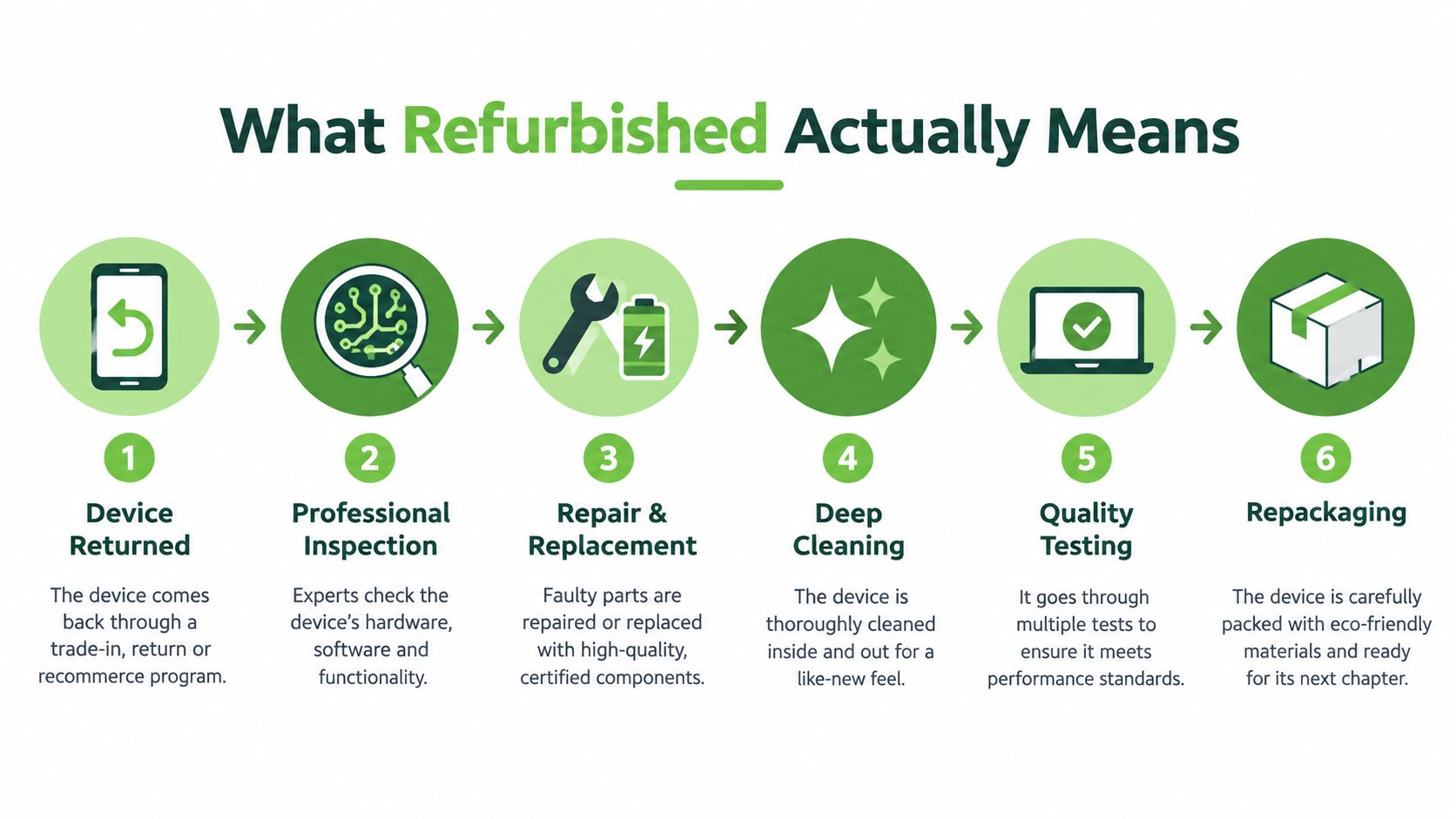
A used or pre-owned phone from a peer-to-peer listing may work perfectly, but the label alone doesn't tell you whether anyone checked Face ID, the charging port or the water-damage indicators. “Certified” adds process and accountability. You should expect documented testing, a stated grade, battery disclosure, a warranty and a way to trace the unit through the seller's records.
A proper 30-point quality check should cover more than turning the phone on. The exact checklist differs between businesses, but a serious inspection normally includes:
- Screen: Brightness, touch response, dead pixels and colour consistency.
- Battery: Reported maximum capacity and charging behaviour.
- Biometrics: Face ID enrolment and authentication.
- Audio: Microphone recording, earpiece and loudspeaker output.
- Power and charging: Buttons, Lightning port and cable connection.
- Cameras: Focus, flash, front camera and rear camera operation.
- Wireless functions: Wi-Fi, Bluetooth and mobile network connection.
- Motion sensors: Accelerometer and gyroscope response.
- Device history: Water-damage indicators and signs of serious internal damage.
- Ownership status: IMEI blacklist status and iCloud Activation Lock status.
The purpose isn't to make an old phone look new. It's to identify faults before the next owner receives it. A battery can be replaced, a damaged screen can be graded fairly, and a phone with an Activation Lock can be rejected before it reaches the shelf.
For a plain-language explanation of the process, myhalo's guide on what a refurbished phone means is a useful reference. The depth and consistency of the checklist remain the clearest signs that you're dealing with a refurbisher rather than a casual reseller.
Understanding Grading Tiers and Warranty in Singapore
A grade should answer two questions quickly: what will the phone look like, and what condition is the battery likely to be in? It shouldn't be a vague marketing phrase that changes from one listing to another.
The following tiers are commonly used as a practical buying framework. Exact terms vary between sellers, so always read the definition attached to the individual unit.
| Tier | Cosmetic Condition | Battery Health | Warranty | Box & Accessories |
|---|---|---|---|---|
| As-New | Looks untouched or nearly indistinguishable from new | 100% | Typically 12 months | May include compatible accessories, original box isn't guaranteed |
| Certified ReLoved Premium | Indistinguishable from new at arm's length | Above 95% | 12 months | Confirm whether the box, cable and charger are included |
| Certified ReLoved Excellent | Light marks that are difficult to see during normal use | Above 90% | 12 months | Accessories vary by listing |
| Certified ReLoved Value | Visible scratches or minor dents | Above 85% | Usually 6 to 12 months | Often supplied with compatible accessories |
| ReEco | Heavier cosmetic wear, while remaining functional | Above 80% | Often 6 months | Usually depends on available accessories |
| Sealed-new | Unopened retail stock | Factory condition | Depends on the seller's stated coverage | Retail packaging should be specified |
These aren't interchangeable grades. A Value device may be sensible for a work phone because a mark on the frame doesn't affect calls or banking. Premium makes more sense if you care about appearance or plan to resell it later.
Battery wording deserves careful attention. A Singapore refurbished-phone FAQ states that devices can be guaranteed with battery health ranging from 80% to 100%, as shown in local refurbished-phone battery guidance. Apple also states on its Singapore support page that battery service is provided at no extra charge when capacity falls below 80%, which makes that threshold useful when judging an older handset's battery condition. You can review the policy on Apple's Singapore iPhone service page.
Warranty length should appear on the listing and invoice. Ask whether it covers parts and labour, whether accidental damage is excluded, and where repairs take place. Original packaging, a charging cable and a power adapter are separate questions, not automatic inclusions.
How to Read a Refurbished iPhone XS Max Listing
Read a listing as if it were a compact spec sheet. Photos attract attention, but the written details determine whether the phone is comparable with another unit.
Start with the exact device
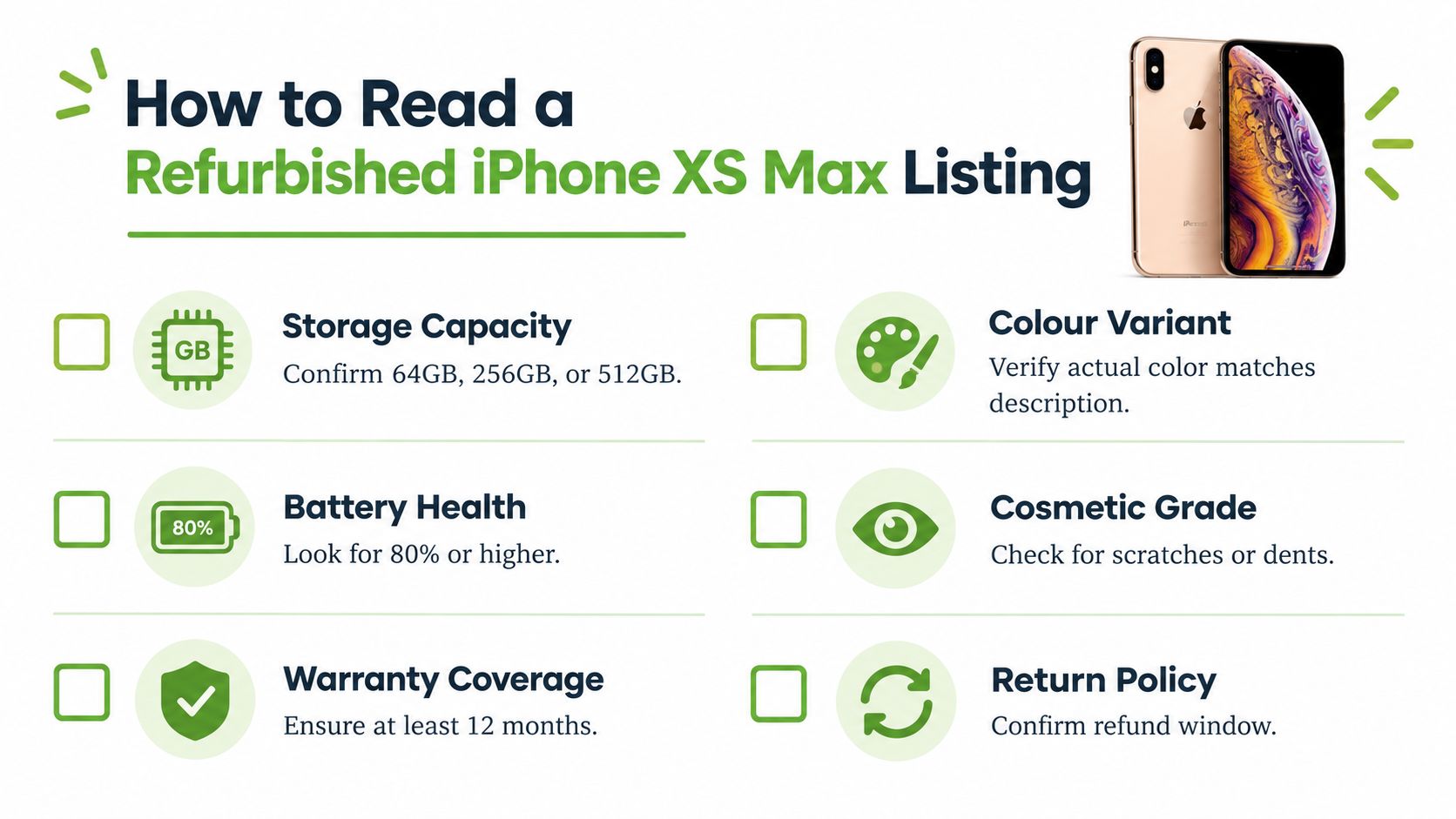
Confirm the storage capacity: 64GB, 256GB or 512GB. Storage affects both usability and resale, especially if you keep photos, offline video or large apps. Check the colour as well. Some sellers use stock images across several SKUs, so the photograph may not represent the exact unit.
Battery health should be visible in Settings > Battery > Battery Health. For demanding daily use, I'd want to see capacity above 85%. If it's lower, ask whether the phone has received a recent replacement battery and request the supporting documentation.
Test the functions that are expensive to overlook
Before accepting the phone, enrol your own face in Face ID. A phone that opens with a passcode but can't complete Face ID setup has a significant functional issue. Check True Tone in Display & Brightness too. If the setting is missing, the screen may have been replaced or configured incorrectly.
The seller should disable Find My iPhone and erase the phone properly. During setup, you shouldn't see an Activation Lock screen asking for another person's Apple Account. Don't accept a promise that the previous owner will remove it later.
Verify identity and ownership status
Check the IMEI or serial number against Apple's Coverage page and the relevant Singapore device records. Confirm the model number, such as an MWG02ZP/A-style identifier, and ask whether the phone works with any SIM card. If you're unsure what to look for, this guide explains how to find out if an iPhone is carrier-free.
Write down the charger, cable, return period and warranty length before paying. A listing that avoids all three is harder to trust because you can't compare the full package or enforce the promise later.
For a wider pre-purchase review, use myhalo's checklist on things to look out for before buying a refurbished phone.
Singapore Price Benchmarks and How to Compare Value
A S$232 XS Max with tired battery health and limited warranty can cost more over its useful life than a better-tested phone priced higher. Compare storage, grade, battery, warranty, accessories and expected ownership period as one package, not as separate line items.
Recent Singapore listings place refurbished XS Max units around S$232 to S$290, while refurbished iPhone 12 Pro units start at about S$270. Hot-deal XS Max units can begin near S$209, whereas certified stock with stronger battery health and warranty sits in the S$232 to S$290 band. The ranges describe different condition and service tiers, so compare like with like rather than treating the lowest headline price as the normal benchmark. Review the Singapore refurbished mobile listings to check the gap against newer models.
The iPhone 12 Pro costs more in some cases, but it adds 5G support and a longer software runway. That extra purchase cost may be reasonable if you expect to keep the phone longer or want stronger resale prospects.
| Model & Storage | As-New | ReLoved Excellent | Notes |
|---|---|---|---|
| iPhone XS Max 64GB | S$209–S$270 | S$232–S$290 | Entry storage, compare the saving against newer models |
| iPhone XS Max 256GB | S$209–S$270 | S$258–S$285 | More room for photos and apps, with storage affecting resale |
| iPhone XS Max 512GB | S$209–S$270 | S$258–S$285 | Highest storage tier, check whether the premium beats a newer generation |
These figures are benchmarks, not fixed prices for every listing. Certified refurbished stock sits above hot-deal pricing, and larger storage can command a premium. Check what each grade includes, especially battery condition, warranty coverage and return terms.
Singapore's trade-in ladder gives the purchase decision another reference point. Buyback quotes commonly place the XS Max at about S$130 for 64GB, S$150 for 256GB and S$170 for 512GB. Another retailer's used-phone table shows about S$160, S$190 and S$220 for those storage tiers. The figures appear in Singapore iPhone trade-in and buyback information. Storage and condition affect value twice, first at purchase and later at trade-in.
Calculate total cost by dividing the purchase price by the time you realistically expect to use the phone. A cheaper XS Max may offer weaker value if software compatibility, battery decline or limited resale demand makes you replace it sooner. A slightly more expensive iPhone 12 Pro may cost less per useful month if its newer hardware supports a longer ownership period.
Common Pitfalls and How Certified Refurbishers Mitigate Them
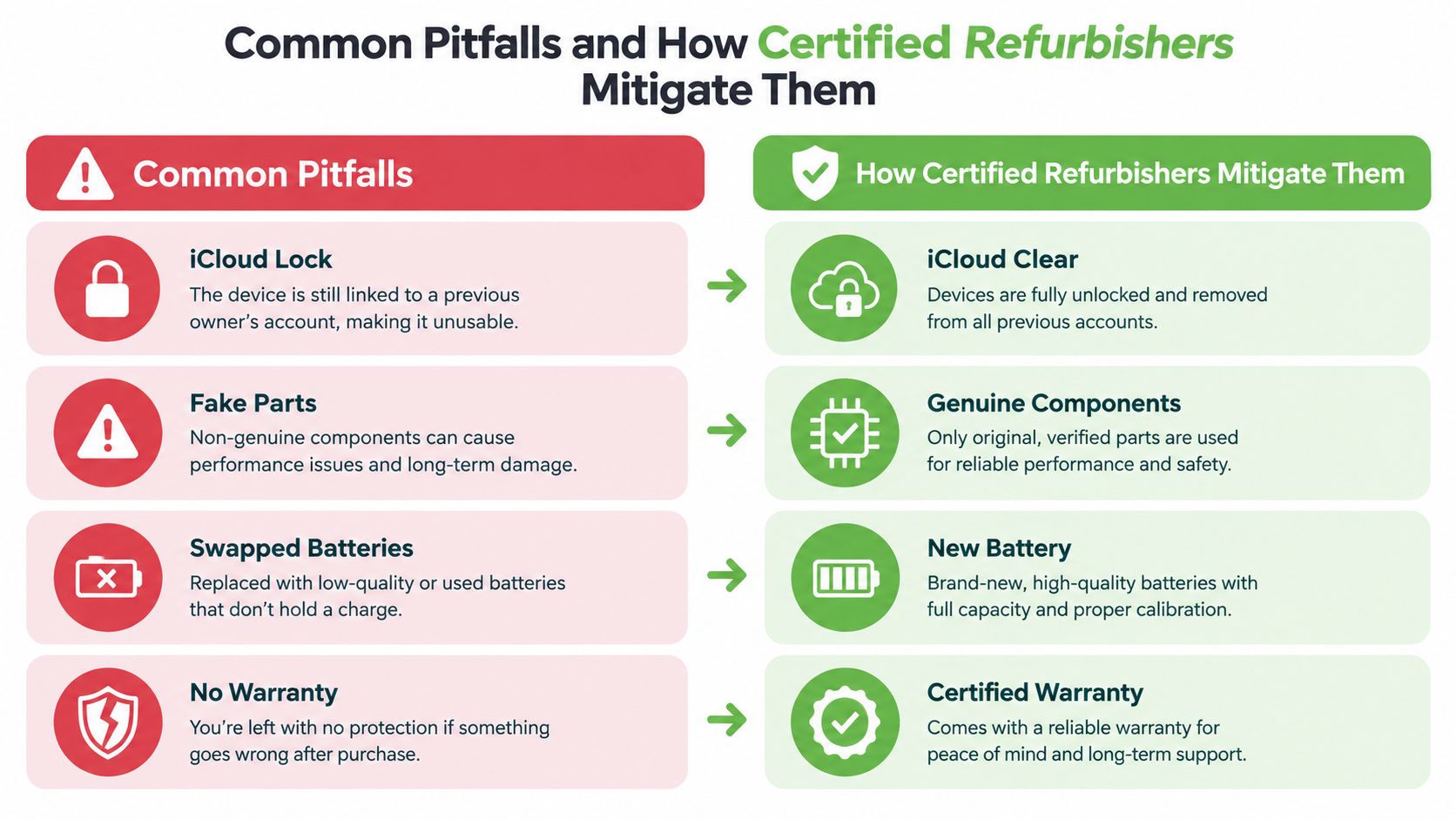
Four problems appear repeatedly in grey-market transactions, and most can be prevented before payment.
Activation Lock
An iCloud-locked XS Max may look normal until you reset it. Setup then asks for the previous owner's Apple Account, leaving you with a phone you can't activate. A proper refurbisher signs out of Find My, erases the device through Apple's normal process and checks that the next setup screen belongs to you.
Unclear replacement parts
Aftermarket displays and batteries may pass a quick visual check but behave differently later. Look for battery capacity disclosure, recorded testing and a clear statement about replacement parts. Face ID, True Tone and charging behaviour deserve hands-on testing because they can reveal work that isn't obvious from photographs.
Missing identity information
A seller who won't share a serial number or IMEI gives you no practical way to verify the device. Check the identifier before handing over money, then confirm that the phone isn't reported as blocked and that the ownership status is clean.
Weak after-sales support
A verbal promise is difficult to rely on when Face ID or the logic board fails months later. A Singapore-based warranty with written terms, a registered business and a physical service counter gives you a clearer route to diagnosis and repair.
The safest transaction is one where the seller can explain the phone's history, condition, battery and warranty without hesitation.
A professional lifecycle partner should also offer more than resale. myhalo combines Certified ReLoved, Certified Surplus, RescueAdvise and the mylo AI Assistant with documented quality processes, including ISO 9001 and ISO 27001 certifications, transparent grading and battery disclosure. That model supports repair, reuse and responsible recycling instead of treating every upgrade as a disposal event.
Lifecycle, Resale Value and the Bigger Picture
A refurbished XS Max is part of a longer device cycle. Someone traded it in, a refurbisher evaluated it, and another buyer can put it back into daily service. That sequence creates business value because repair and grading recover useful hardware that would otherwise leave the productive economy earlier.
Singapore generated an estimated 60,000 tonnes of e-waste a year, while the amount collected for recycling rose from 3,500 tonnes in February 2022 to more than 22,300 tonnes by September 2024, according to reported Singapore e-waste collection updates. Singapore's national waste dataset also provides annual waste-management and recycling figures in tonnes through data.gov.sg's waste dataset.
Those figures don't prove that every refurbished phone prevents a specific amount of waste. They do show why reuse, repair and organised recycling matter at a national level. For an SME, the same principle is operational: extending the useful life of equipment can reduce replacement pressure, simplify procurement and preserve value for future trade-in.
A battery replacement can be a practical lifecycle intervention. Local repair listings place iPhone XS Max battery replacement around S$48 to S$50 for OEM or A-grade replacement options, with some providers advertising Apple-certified parts and diagnostics in their Singapore iPhone battery-replacement services. That's a repair decision, not a promise that every battery issue can be solved cheaply.
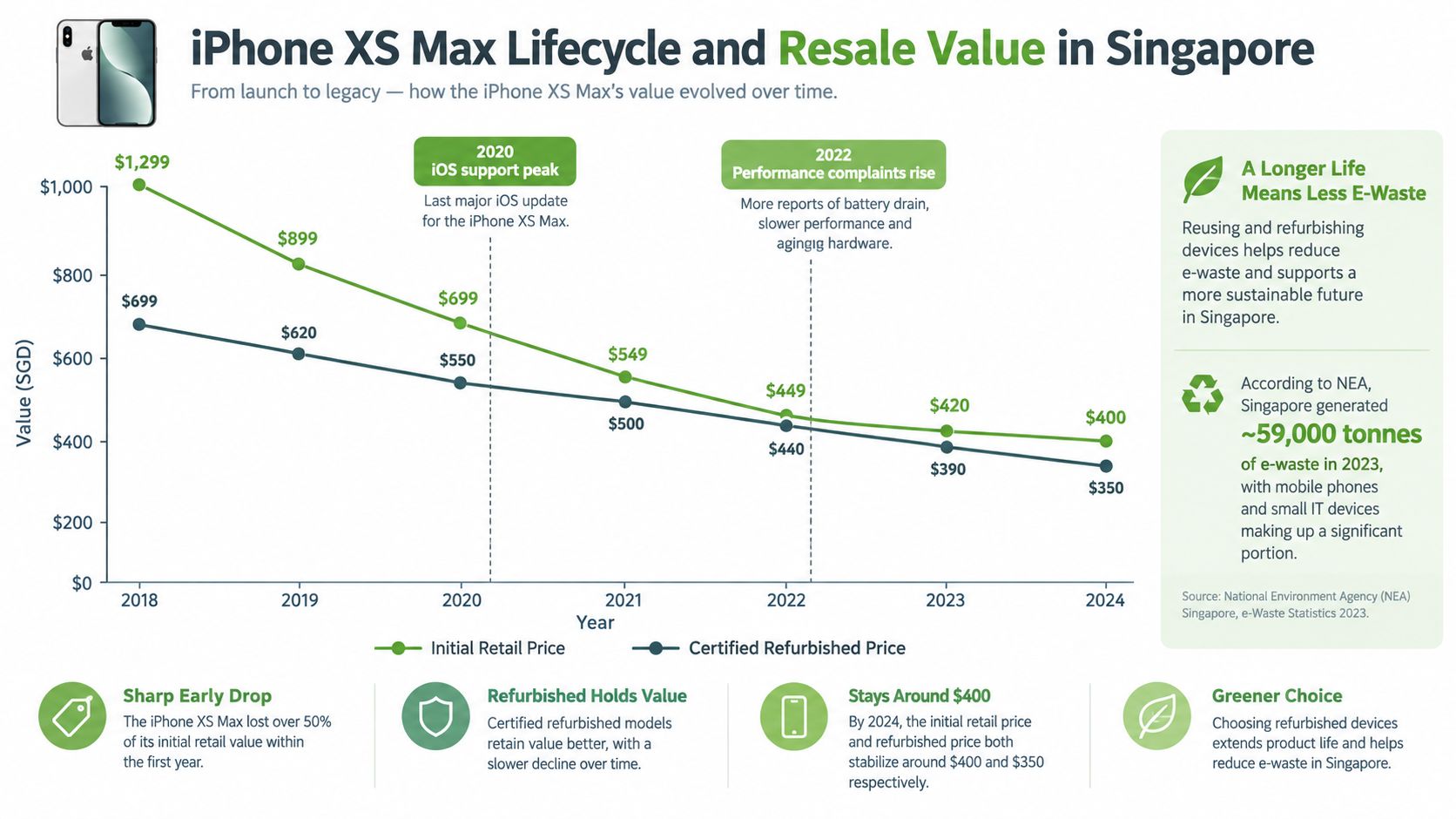
The strongest financial case is simple. Buy a well-graded device, keep the battery healthy, protect the screen and retain the invoice and warranty records. Those steps preserve options, whether you continue using the XS Max, repair it, trade it in or pass it to another owner.
Your Refurbished iPhone XS Max Buying Checklist
Use this checklist before you pay for any Singapore listing:
- Confirm the seller's process. Look for a published grading standard, testing method, battery policy and written warranty. “Checked” is not enough unless the seller explains what was checked.
- Identify the exact grade. Decide whether As-New, Certified ReLoved Premium, Excellent, Value or ReEco matches your tolerance for scratches and dents. Don't pay Premium pricing for a Value-grade phone.
- Request battery evidence. Ask for the battery health percentage and a screenshot from Settings. For heavy daily use, target above 85%. If the figure is lower, confirm whether a replacement battery is included and whether the invoice records it.
- Verify ownership and identity. Check the IMEI or serial number, confirm the model and network status, and make sure Find My iPhone is disabled. Apple's Coverage page can help verify the device record, while this IMEI number verification guide explains the basic checking process.
- Test the important hardware. Enrol Face ID, check True Tone, inspect the display, test the cameras, connect Wi-Fi and Bluetooth, make a call, record audio and plug in a charging cable.
- Put the commercial terms on the bill. Record storage, colour, cosmetic grade, battery health, included cable or charger, return window and warranty duration. Keep the seller's receipt and any repair documentation.
For buyers who want a managed route through this process, myhalo offers Certified ReLoved devices, trade-in support, battery checks and RescueAdvise for repair decisions. The broader lifecycle approach also includes Certified Surplus products, repair, reuse and responsible recycling, which can help consumers and SMEs keep usable technology in circulation for longer.
If you're comparing a refurbished iPhone XS Max in Singapore, review myhalo's Certified ReLoved options alongside the battery, grading and warranty points above. Visit myhalo to check available devices, arrange trade-in or get practical support before you commit.