





What Is Refurbished Phone? a Safe Buying Guide for 2026
A refurbished phone is a pre-owned device that has been professionally inspected, repaired if needed, and restored to full working condition through a structured quality process. In Singapore, the right refurbishment process also protects network compliance, data security, and day-to-day reliability, which makes it different from a simple second-hand sale.
You may be comparing a new phone with a cheaper marketplace listing, wondering whether the lower price is worth the uncertainty. The important question isn't only what the device costs today. It's whether the phone has been tested, whether its condition is accurately described, and whether someone will help if a fault appears after you bring it home.
For consumers and SMEs, refurbishment is best understood as device lifecycle management. A phone can be repaired, reused, redeployed, traded in, or recycled according to its condition. That approach helps owners retain more value from existing hardware instead of replacing devices before they need to leave circulation.
Table of Contents
- Understanding What a Refurbished Phone Really Is
- How the Refurbishment Process Works
- Device Grading Tiers and What They Mean
- Warranty Coverage and Return Policies That Protect You
- Cost Savings and Environmental Benefits of Choosing Refurbished
- Your Buying Checklist and Red Flags to Avoid
- How myhalo Extends Device Lifecycles Beyond the Purchase
Understanding What a Refurbished Phone Really Is
A refurbished phone is a previously owned or returned device that has gone through a controlled restoration process. A technician checks its hardware and software, repairs or replaces faulty parts where necessary, securely removes previous user data, and tests the finished unit before resale. The device may show cosmetic signs of use, but it should meet the seller's stated functional and quality requirements.
That definition matters because the word “used” describes ownership history, not quality. A second-hand phone sold through a private marketplace might work perfectly, but the buyer may have no evidence that the battery, charging port, cameras, radios, storage, or account locks were checked. A refurbished phone should come with clearer information about those areas, together with warranty or return support.
Refurbished and second-hand are not the same
Consider two listings for the same iPhone model. One seller says the phone is in “good condition” and provides a few photographs. The other gives a defined grade, battery-health information, a warranty, and a documented inspection process. The second listing gives you a basis for judging risk, even if the phone has visible marks.
Refurbishment also doesn't always mean the phone was badly damaged. Some units only need cleaning, software preparation, or minor cosmetic work. Others require component repairs before they can be offered for dependable use. What matters is the work completed and the evidence provided, not the assumption that every refurbished device has had the same history.
Practical rule: Treat “refurbished” as a process you should verify, not as a condition label you should accept without questions.
In Singapore, a refurbished device must also remain suitable for local use. IMDA's equipment registration framework explains that telecommunication equipment sold locally must meet standards specifying minimum technical requirements, and consumers can check registration status through IMDA's equipment search function. This is why a proper refurbishment process includes network, safety, radio-performance, and identity checks.
The simplest answer to what is refurbished phone is therefore: a pre-owned phone restored through professional inspection and repair, with its condition and support terms made clear before purchase.
How the Refurbishment Process Works
Professional refurbishment starts with evidence, not appearance. A phone that looks clean can still have an ageing battery, unstable charging, weak cellular reception, damaged storage, or an unauthorised device identity. A visual inspection alone won't reveal those problems.
Step 1, diagnostic assessment
Technicians examine the phone's major functions and safety risks. A Singapore refurbishment process documents checks covering battery capacity, battery health, swelling, cycle count, charging stability, display defects, touch responsiveness, operating-system update status, Wi-Fi, Bluetooth, cellular performance, GPS, NFC, cameras, storage health, carrier-lock status, IMEI authenticity, and data security. You can review the scope of this documented mobile-device inspection process to see why a thorough inspection goes far beyond checking whether the screen lights up.
The battery deserves particular attention. A phone can pass a quick demonstration while still shutting down unexpectedly or charging inconsistently. Checking battery condition and swelling helps identify faults that may become expensive or inconvenient after purchase.
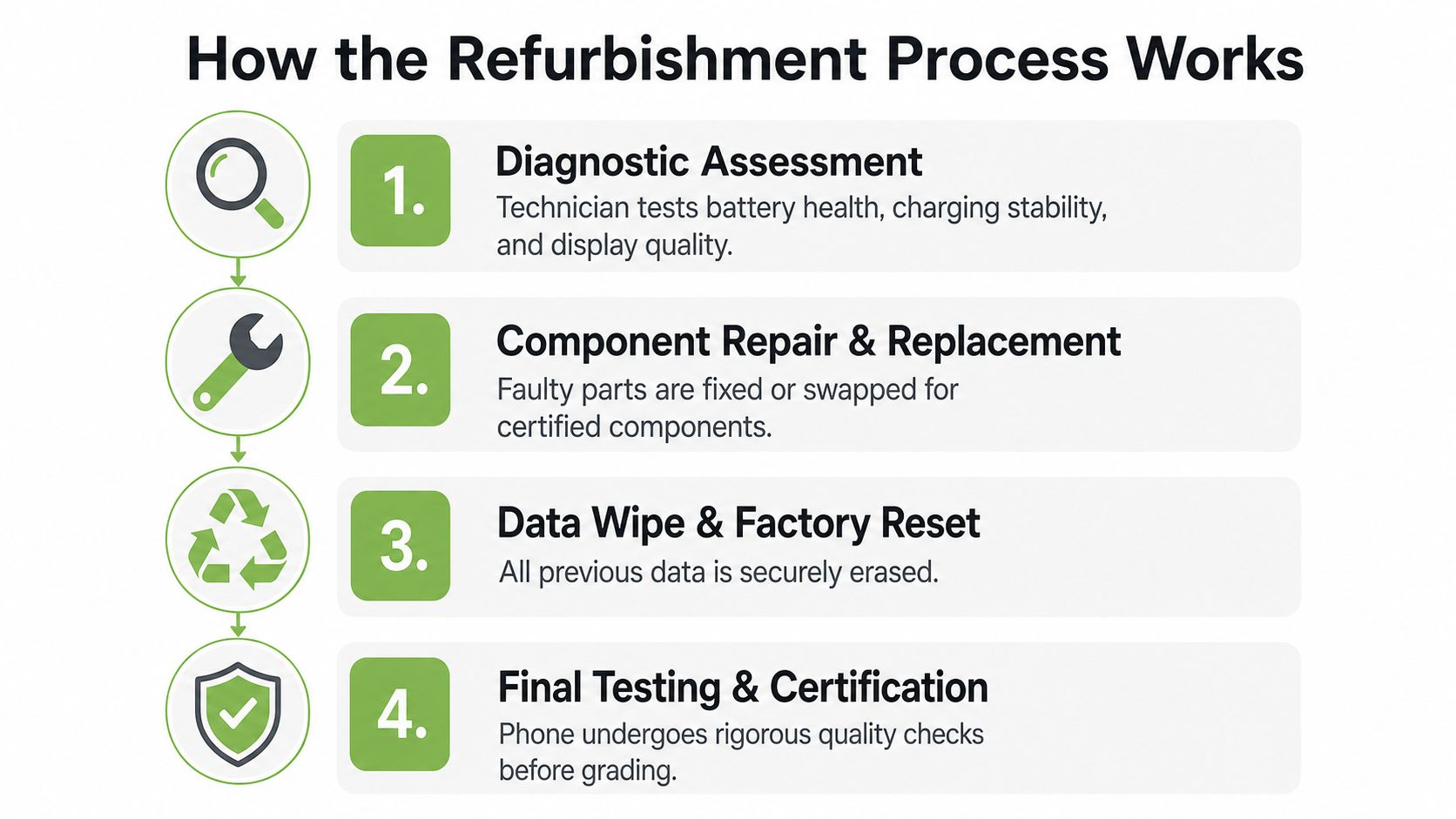
Step 2, repair and replacement
If testing identifies a problem, the technician repairs the affected part or replaces it with a suitable component. The purpose isn't to make every phone look factory-new. It is to restore dependable operation while recording any remaining cosmetic wear.
Charging stability, cameras, touch controls, wireless connections, and mobile-network performance all affect normal use. A phone that fails one of these functions may be frustrating even if it has an unmarked casing.
Step 3, secure data removal
The previous owner's information must be removed before resale. Data-security verification and a proper factory reset reduce the risk of leaving behind accounts, photographs, messages, or business information. SMEs should treat this as an asset-control requirement, especially when devices move between employees.
Step 4, final testing and certification
After repairs and data removal, the phone is tested again. The seller then records its grade, battery information, accessories, and warranty terms. This final review creates a traceable connection between the device's actual condition and the description shown to the buyer.
For a buyer, the difference between a quick check and a 30-point quality inspection is practical. More diagnostic coverage gives the seller more opportunities to find hidden faults before dispatch, which can reduce the chance of avoidable failures and returns. You can see how a seller may present its quality-check information before deciding whether the process is detailed enough for your needs.
Device Grading Tiers and What They Mean
A grade describes a phone's condition, but grades aren't universal across every seller. “Excellent” from one business may allow more marks than “Excellent” from another, so you should read the seller's definitions rather than comparing labels alone.
The useful distinction is between functionality and cosmetics. A Value device can work properly while showing noticeable scratches. An As-New device can have a cleaner exterior and a longer support period, but both still need clear battery and diagnostic information.
A practical comparison
| Grade | Cosmetic Condition | Warranty | Best For |
|---|---|---|---|
| As-New | Like-new appearance, with minimal visible evidence of previous use | 6 months | Buyers who want a near-new presentation and stronger warranty support |
| Premium | Very clean appearance with minimal cosmetic wear | 30 days | Users balancing appearance with a lower purchase cost |
| Excellent | Minor signs of use that aren't prominent during normal handling | 30 days | Everyday users who prioritise reliable function |
| Value | Visible cosmetic marks, while core functions remain operational | 30 days | Budget-conscious buyers who care more about performance than appearance |
| ReEco | Fully functional with noticeable wear | Warranty should be confirmed in the listing | Buyers comfortable with visible wear who want to keep hardware in use |
These tiers are useful only when the seller explains what each grade permits. Look for photographs or descriptions that identify scratches, dents, screen marks, casing wear, and included accessories. A vague term such as “good” doesn't tell you whether the marks are barely visible or prominent.
Battery health belongs beside the grade
Cosmetic grading shouldn't hide battery information. A transparent listing should disclose battery health or explain how the battery was assessed, because two phones with identical exterior grades can offer different practical experiences. Ask whether the stated battery information applies to the exact unit you're buying.
The ideal grade depends on the person using the phone. A student may accept visible casing marks to keep the purchase affordable. A client-facing business may choose a cleaner Premium or As-New unit for professional presentation. An SME deploying many phones may value consistent grading and support more than a uniform “like-new” appearance.
Before ordering, read the seller's mobile condition definitions. A clear grading framework helps you compare devices on meaningful terms instead of guessing from photographs.
Warranty Coverage and Return Policies That Protect You
A refurbished phone's warranty is part of its value. The device may cost less upfront than a new model, but a weak warranty can transfer all repair risk to you. A trustworthy seller explains what is covered, how long coverage lasts, and what happens if the phone cannot be repaired.
Warranty periods can vary by grade. For example, an As-New unit may carry a 6-month warranty, while ReLoved tiers may carry a 30-day warranty, according to the stated myhalo product structure. Check the actual listing because coverage can differ by product category and terms.
Read the exclusions before buying
A warranty should make clear whether it covers hardware faults, charging problems, display issues, battery-related concerns, and repair or replacement arrangements. It may exclude accidental damage, liquid damage, unauthorised repairs, or normal cosmetic wear. Those exclusions aren't automatically unreasonable, but you need to understand them before relying on the coverage.
A return or exchange policy gives you another layer of protection. A 14-day exchange window can help if the phone doesn't match its disclosed grade or develops an early issue, while local support makes the process more practical. Singapore buyers may also value a physical store and responsive WhatsApp assistance because they can explain a problem directly rather than relying only on a marketplace message thread.
Warranty test: Ask, “Who will handle this if the phone stops charging?” If the answer is unclear, the lower price may not represent lower total cost.
Marketplace listings can still include good devices, but a private seller may not provide diagnostics, formal warranty support, or a local repair route. Compare the complete buying experience, not just the number shown beside the phone. For a business, predictable support can protect staff productivity and reduce the disruption caused by a failed device.
Cost Savings and Environmental Benefits of Choosing Refurbished
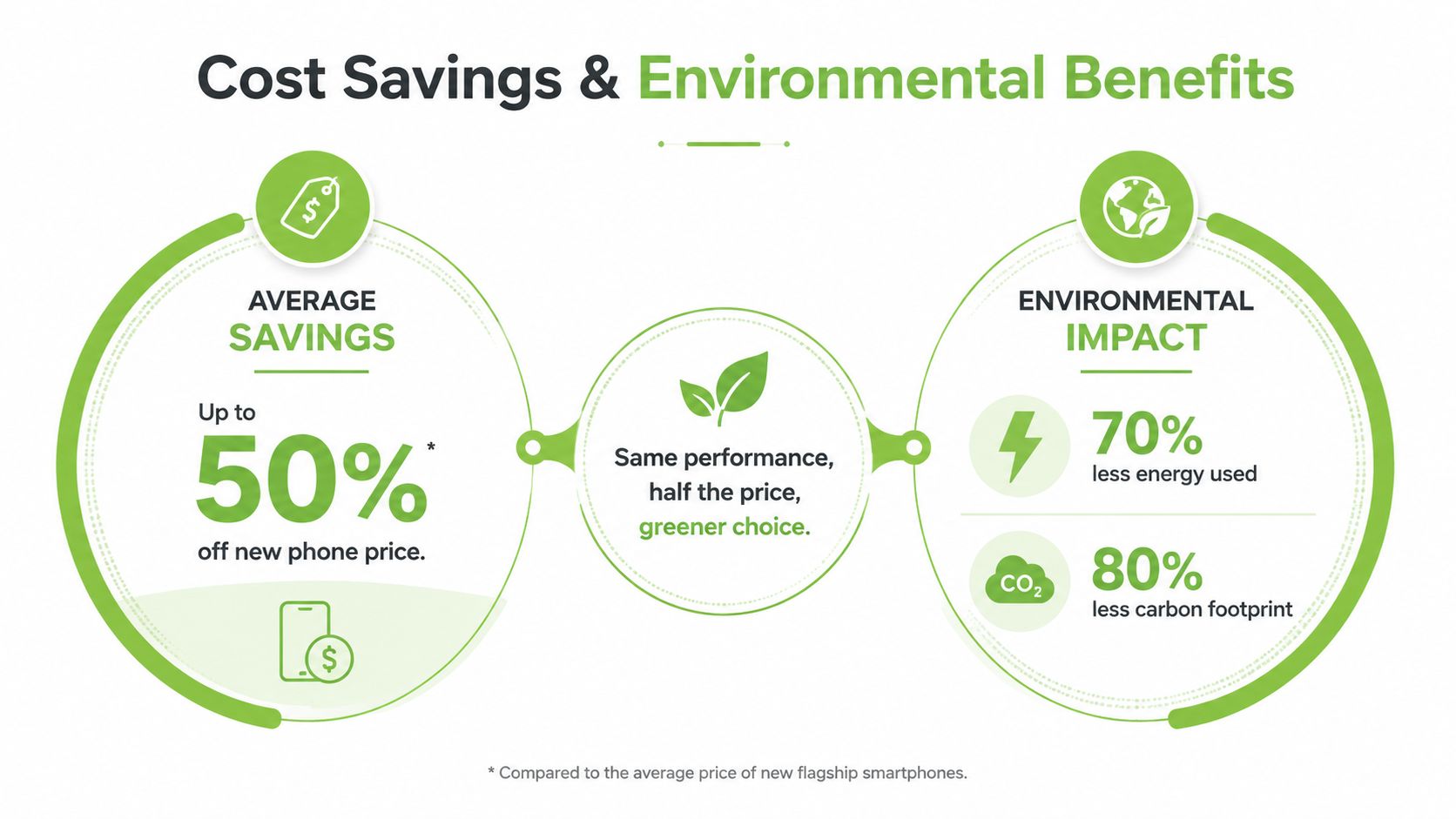
A refurbished phone can create value in two directions. It gives the buyer access to capable hardware without the full cost of a new model, while allowing an existing device to serve another owner instead of being discarded prematurely.
The Singapore market reflects more than a temporary bargain-hunting trend. One market study estimated the local refurbished and used mobile-phone market at USD 0.25 billion in 2025, with a projection of USD 0.58 billion by 2034 and a projected 9.84% CAGR from 2026 to 2034. The related refurbished-electronics market was estimated at USD 191.5 million in 2024 and projected to reach USD 338.23 million by 2033, with smartphones identified as its largest segment, according to Singapore refurbished-device market estimates. These are market projections, not a promise about any individual phone's resale price or savings.
Resource efficiency has a business dimension
The circular-tech case is also measurable. Singapore-focused reporting estimates that each refurbished smartphone avoids 25 kg of CO2, 77 kg of raw material extraction, and 56 g of e-waste, as described in Singapore's circular-tech discussion. Those figures help explain why extending device life is more than an environmental gesture.
For an individual, reuse can make a higher-specification phone more accessible. For an SME, it can stretch a device budget across more users, support planned redeployment, and preserve value when equipment reaches its first user's upgrade cycle. The decision still depends on warranty, battery condition, repairability, and expected support, but the financial and resource arguments often point in the same direction.
Singapore households replace smartphones every 2.7 years on average, compared with a global average of 3.5 years, according to the same Singapore consumer survey. That survey also estimated 2.9 million unused smartphones were sitting idle in Singapore homes, while 90% of Singaporeans surveyed would be open to reusing, recycling, or returning old devices if the process were simpler and more secure. These findings support a practical lifecycle choice: keep a dependable phone moving to its next user, then send it through an authorised recovery route when it can no longer be salvaged.
You can explore the practical principles behind a zero-e-waste world when considering what should happen to your current device after an upgrade.
Your Buying Checklist and Red Flags to Avoid
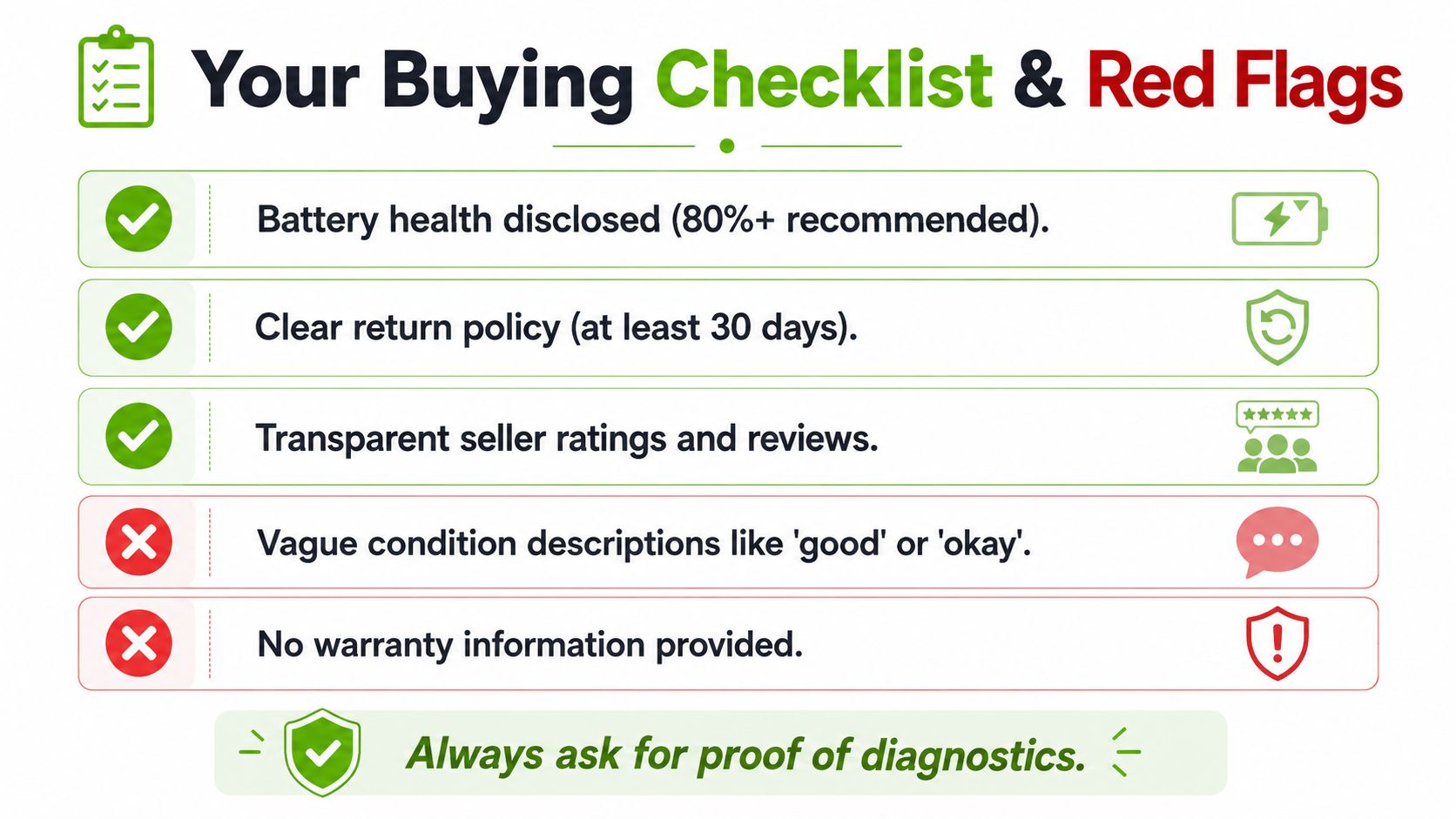
Use the listing as an evidence checklist. A reliable seller should make it possible for you to answer the following questions before payment:
- Battery health: Is battery information disclosed for the device, rather than hidden behind a general condition label?
- Inspection scope: Does the seller explain what was tested, including charging, display, cameras, connectivity, storage, and IMEI authenticity?
- Condition grade: Does “As-New”, “Premium”, “Excellent”, “Value”, or “ReEco” have a written definition?
- Warranty terms: How long does coverage last, and which faults or exclusions apply?
- Returns and exchanges: Can you request an exchange if the phone doesn't match its description?
- Local assistance: Is there a Singapore support channel, physical location, or clear repair process?
- Quality management: Can the seller explain certifications such as ISO 9001 and how those processes relate to device handling?
- Data security: Does the seller confirm that previous user data has been securely removed?
Red flags deserve more weight than a small discount
Be cautious if a listing refuses to share battery information, offers no written warranty, uses vague descriptions such as “okay” or “good”, or provides only polished stock photographs. A seller without local support can also leave you responsible for shipping, diagnosis, and repair discussions if something fails.
The same checks apply whether you're buying one phone for yourself or equipping an SME team. For a company, add an asset register, data-wipe confirmation, IMEI records, and a plan for redeployment or recycling at the end of use.
Test the phone promptly after delivery. Check the display, touch response, cameras, speakers, microphone, biometric functions, charging, buttons, mobile connection, Wi-Fi, Bluetooth, and account status. If the device doesn't match its description, contact the seller within the stated exchange period.
How myhalo Extends Device Lifecycles Beyond the Purchase
A refurbished purchase shouldn't be the end of a device's useful journey. A lifecycle partner helps decide what to do before purchase, during ownership, at upgrade, and when the hardware can no longer be safely reused.
myhalo offers Certified ReLoved devices across Premium, Excellent, and Value conditions, alongside Certified Surplus products and factory-sealed new models. Its stated process includes 30-point quality checks under an ISO 9001:2015-certified quality process, while ISO 27001 certification is relevant to information-security controls. Transparent grading and battery-health disclosure give buyers more information than a basic second-hand listing.
Ownership support can include repairs, data and device migration, trade-ins, and care programmes such as myhalo e-Xtender for proactive maintenance and myhalo Protect for accidental damage, liquid protection, and extended warranty. The mylo AI Assistant provides quick guidance, while the Bugis Junction store offers an in-person support option for customers who prefer face-to-face help.
When a phone reaches the end of its practical life, Singapore's NEA e-waste guidance recommends repair where feasible, reuse or donation for working items, and recycling through industry-led schemes. NEA lists mobile phones among accepted ICT equipment at authorised collection channels, including 3-in-1 bins, with small-device slots limited to 500 mm by 250 mm, as detailed in its e-waste collection guidance. A phone that can be restored belongs in the reuse pathway. One that cannot be salvaged should move to regulated recycling.
Choose a refurbished phone by reviewing its diagnostics, grade, battery disclosure, warranty, and support terms, rather than judging only the upfront price. Explore Certified ReLoved and Certified Surplus devices, lifecycle services, and responsible trade-in options at myhalo to make your next technology decision with clearer evidence and less avoidable risk.