




What Is ISO 9001 Certification: Benefits & Process 2026
You're comparing two laptops online. One says “ISO 9001 Certified”. The other doesn't. If you're a careful buyer, a few questions come up straight away.
Does that badge mean the laptop is better?
Does it mean the seller offers stronger warranty support?
Does it prove the device will last longer?
That label is often mistaken for a product promise. That's where confusion starts. ISO 9001 doesn't certify that one specific phone, tablet, or laptop is perfect. It certifies the system a company uses to deliver consistent quality.
That sounds abstract until you think about what usually goes wrong when buying tech. A device may be graded inconsistently. Battery health may be described vaguely. One staff member may follow a proper checklist while another skips steps. Returns may be handled well one week and poorly the next. A good product can still come from a weak process, but a weak process usually creates avoidable problems.
This matters even more in refurbished technology, where buyers need transparency, not slogans. A used iPhone, MacBook, or business laptop can be excellent value, but only if the seller has a disciplined way to inspect, test, grade, document, and support it. If you're buying second-hand tech, it also helps to review practical checks such as what to look out for before buying a refurbished phone.
A clearer way to read the badge is this: ISO 9001 tells you how seriously a company manages quality behind the scenes. It's less about a sticker on a box, and more about whether the business runs an organised, repeatable, audited operation.
Table of Contents
- What an ISO 9001 Badge Really Means on Your Tech Purchase
- A Simple Explanation of a Quality Management System
- The 7 Core Principles Driving Quality
- The Journey to Certification From A to Z
- Practical Benefits for Businesses and Buyers
- ISO 9001 in Action The myhalo 30-Point Check
- How to Quickly Verify an ISO 9001 Certificate
What an ISO 9001 Badge Really Means on Your Tech Purchase
A shopper sees an ISO 9001 badge and often assumes it works like a seal of product excellence. That's understandable. The wording sounds as if the item itself has been individually certified.
It usually means something narrower and more useful. The badge points to the company's quality management system, not a magical upgrade to the device itself. In plain language, it means the business should have documented processes for how it works, how it checks quality, how it handles problems, and how it improves over time.
What buyers often assume
When consumers see the badge on a listing for a refurbished Samsung Galaxy, Lenovo ThinkPad, or iPad, they may read it in one of these ways:
- “This unit is guaranteed to be flawless.” That's not what ISO 9001 means.
- “This is the same as a warranty.” It isn't. Warranty and certification are different things.
- “This proves the product will last like a brand-new item.” It doesn't certify lifespan.
What it actually signals
What it does suggest is that the seller should be operating with consistency. Staff should follow defined steps. Records should exist. Issues shouldn't be handled based on mood or memory.
Practical rule: Read ISO 9001 as a sign of process discipline, not as proof of perfection.
That distinction matters in technology purchases because many buyer frustrations don't come from the device model alone. They come from unclear grading, inconsistent testing, weak follow-up, or poor documentation. A serious quality system helps reduce those avoidable failures.
There's also a global reason the badge appears so often. ISO 9001:2015 is the current global standard for Quality Management Systems, first introduced in 1987 and revised five times. The 2015 version integrates risk-based thinking and a process approach according to this overview of the ISO standard in Singapore. That same source notes broad worldwide adoption of the standard across supply chains.
A Simple Explanation of a Quality Management System
A Quality Management System, or QMS, is the operating method a business uses to get consistent results. It sets out how work should be done, who is responsible, what records must be kept, how mistakes are handled, and how the team improves over time.
For ISO 9001, that point matters a lot. The certification looks at the system behind the work. It does not certify that every refurbished phone, laptop, or tablet will be flawless. It certifies that the business has a disciplined way to inspect, document, review, and improve how those products are handled.

A chef's kitchen is a useful comparison
In a well-run restaurant, the head chef does not leave quality to memory or luck. The kitchen follows written recipes, prep rules, storage temperatures, plating standards, and checks at each stage. If one dish goes wrong, the team can trace the cause. Was the ingredient stored badly? Was a step skipped? Was the timing off?
A QMS works in much the same way.
For a refurbished tech seller, the "recipe" is the set of repeatable steps used to receive, inspect, grade, clean, test, pack, and support devices. One technician should not grade a laptop one way while another uses a different standard the next day. Consistency comes from the system, not from hoping the right employee is on shift.
That distinction is what makes ISO 9001 easier to understand. The standard is about process quality. Product quality is the outcome the business is trying to improve through that process.
A practical example helps. A refurbished tablet may still show minor cosmetic wear because it is not a new product. ISO 9001 does not erase that reality. What it does support is a reliable method for checking battery health, confirming key functions, recording the condition accurately, and dealing with any issue in a controlled way.
What sits inside a QMS
A proper QMS shapes daily work. It is not just a folder of policies stored online.
Here's a simple view:
| Part of the system | What it means in daily work |
|---|---|
| Documented procedures | Staff know the approved way to do key tasks |
| Roles and responsibilities | People know who checks, approves, and resolves issues |
| Records and evidence | The company can prove checks were done |
| Internal reviews | Managers look at what's working and what isn't |
| Corrective action | Problems are investigated and fixed at the root |
A small business often feels the value of a QMS first when something goes wrong. Without a system, the team relies on memory, individual effort, and informal fixes. With a system, the business can identify what happened, correct it, and reduce the chance of the same problem reaching the next customer.
For companies in Singapore, the certification process commonly includes a documented QMS and a two-stage audit. The first stage reviews whether the organisation's system is defined and ready for assessment. The second checks whether people are following it in practice through records, interviews, and operational evidence, as outlined by Factocert's guide to ISO 9001 certification in Singapore.
The 7 Core Principles Driving Quality
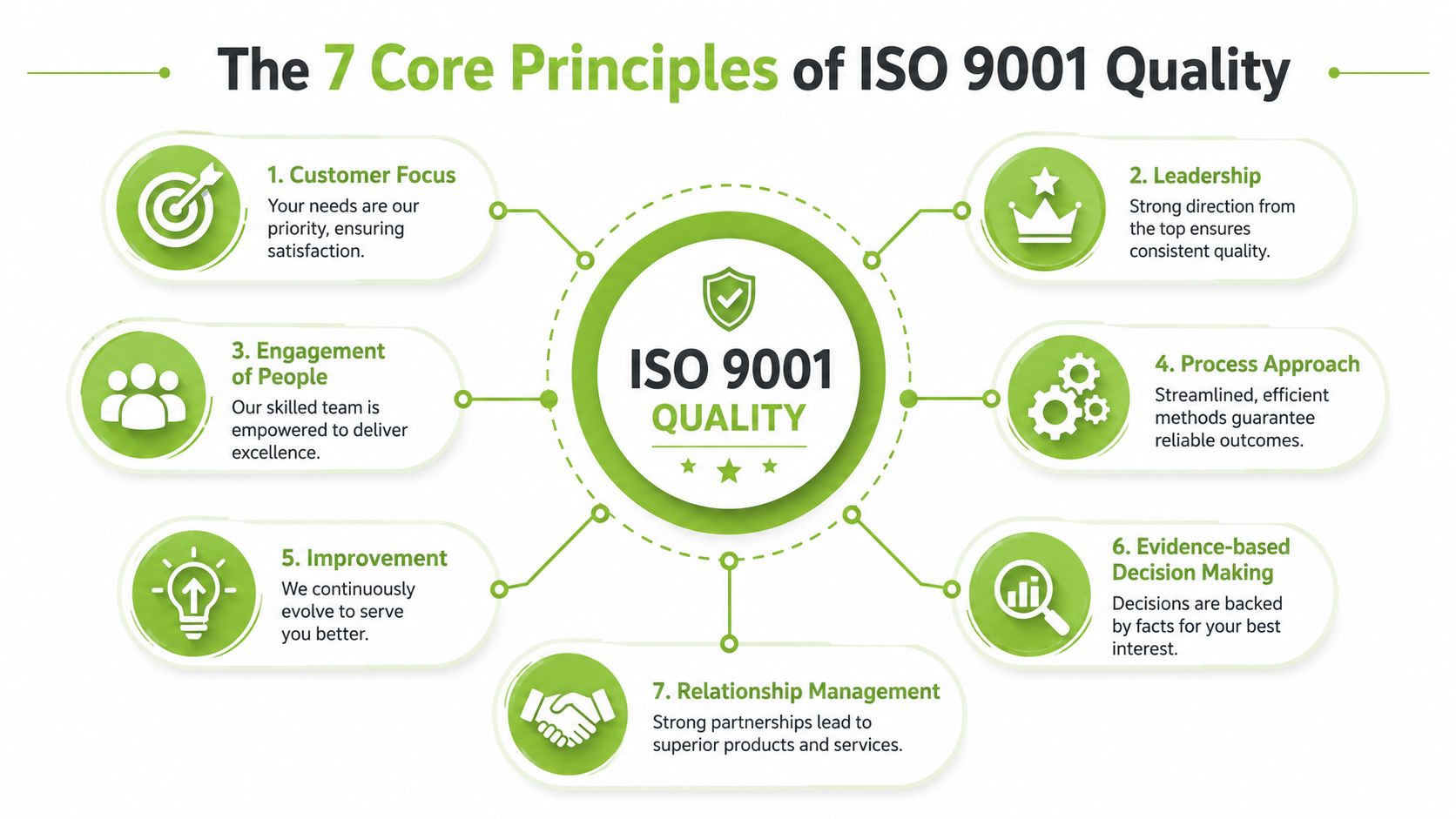
ISO 9001:2015 isn't just paperwork. It's built on a set of ideas about how a reliable organisation should run. The standard is explicitly built around seven quality management principles, replacing the eight principles used in the 2008 version and placing stronger emphasis on risk-based thinking, as outlined in this Singapore ISO 9001 guide.
What the principles mean in real life
The names can sound corporate, so it helps to translate them into customer terms.
- Customer focus means the company designs its work around what customers need. In tech, that may mean clearer grading, honest battery disclosure, and dependable after-sales support.
- Leadership means management sets the tone. If leaders care about proper checks, records, and accountability, staff are more likely to follow them.
- Engagement of people means quality isn't one manager's job. The technician, the sales adviser, the warehouse team, and customer service all affect the result.
- Process approach means work is treated as a sequence of connected steps, not isolated tasks. That reduces handover mistakes.
- Improvement means the company keeps refining its systems instead of repeating the same avoidable errors.
- Evidence-based decision making means decisions are based on records, data, and observed results rather than guesswork.
- Relationship management means suppliers and service partners matter too. Weak supplier control can undermine quality.
Why risk-based thinking matters
The strongest practical shift for many businesses is risk-based thinking. Instead of saying, “We've always done it this way,” the company asks, “Where could this go wrong, and how do we control it?”
For a tech business, that could include:
- Grading risk where one team labels a device “excellent” and another wouldn't
- Data handling risk where intake procedures are unclear
- Battery disclosure risk where customers don't receive enough information
- Repair risk where replacement parts or post-repair checks vary
Good quality management starts before the mistake happens. That's what risk-based thinking is for.
From a buyer's point of view, these principles matter because they shape the experience you receive. You may never see the internal documents, but you'll notice the effects when product descriptions are consistent, customer support is clear, and problems are handled methodically instead of defensively.
The Journey to Certification From A to Z
A refurbished laptop arrives looking fine on the surface, but the real question is what happened before it reached the box. Was it tested the same way every time? Did someone record the battery condition, check for hidden faults, and confirm that customer data was handled properly? ISO 9001 certification speaks to that chain of work. It does not certify that every single device is flawless or factory-new. It certifies that the business has a controlled, repeatable way of doing the job.
That distinction matters. Buyers often read an ISO 9001 badge as a promise about product perfection. The standard is about process discipline. A good process works like a master chef's written recipe. It does not guarantee every dish will taste identical in every kitchen, but it makes consistent results far more likely because the steps, checks, and corrections are defined.
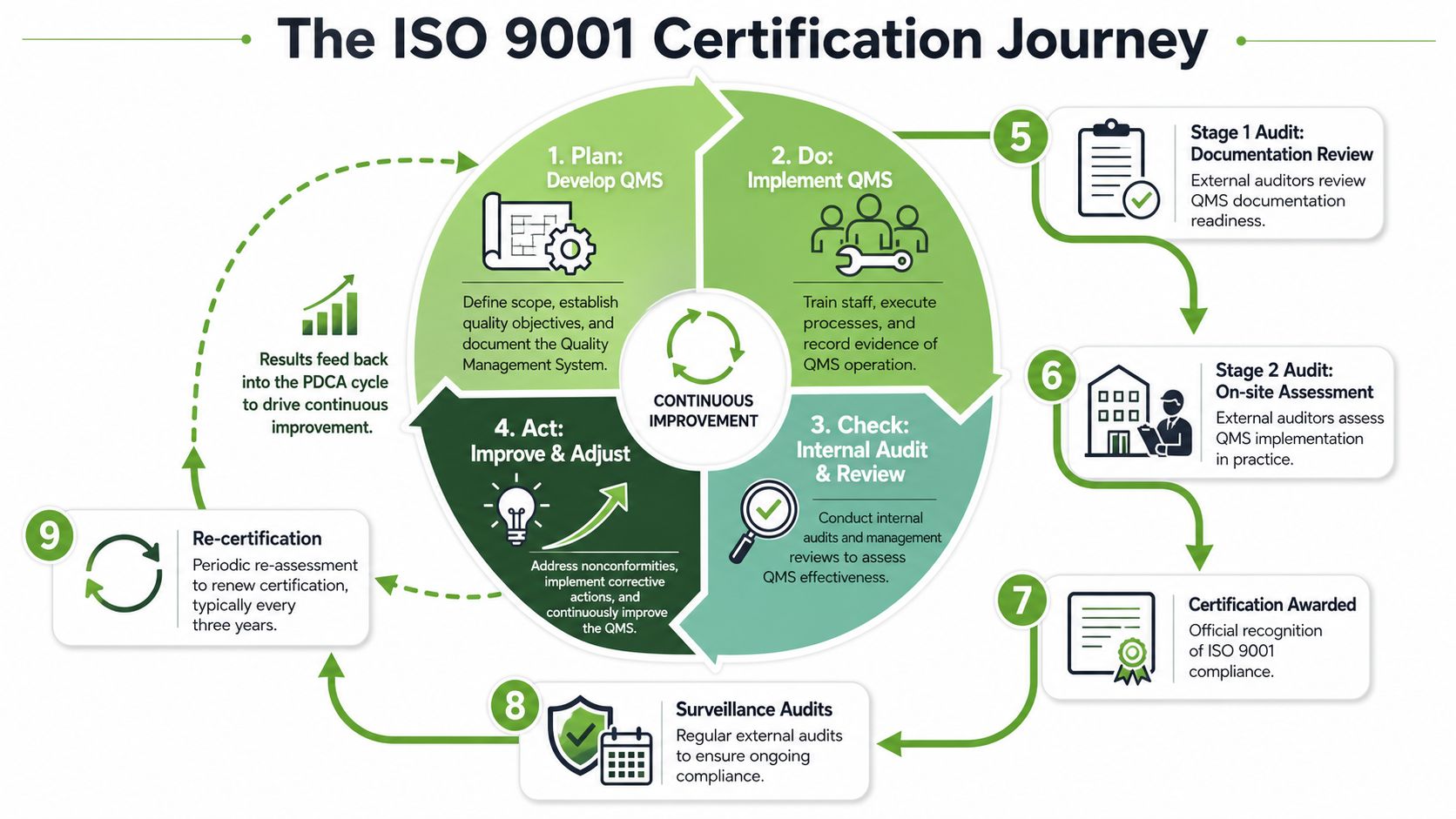
A useful way to understand the certification path is through Plan-Do-Check-Act, or PDCA. A company plans how quality will be controlled, does the work using those methods, checks whether the system is being followed, and acts on problems and trends. That cycle keeps the system alive instead of turning it into a folder of forgotten procedures.
What a company actually has to do
The path usually includes these stages:
- Define the scope. The business decides which activities the QMS covers, such as inspection, refurbishment, grading, packing, and after-sales support.
- Review the gaps. Current practices are compared against ISO 9001 requirements to find weak spots.
- Build documentation. Procedures, responsibilities, records, and controls are written down clearly enough for people to follow them consistently.
- Train the team. Staff need to know not just what to do, but why each step exists.
- Run the system. The company uses the process in day-to-day work and creates real records.
- Audit internally. The business checks its own system before inviting an external auditor in.
- Hold management review. Leaders examine results, complaints, recurring issues, and needed improvements.
- Complete the certification audit. An accredited certification body reviews documents, interviews people, and tests whether the system works in practice.
- Maintain and improve. The company keeps the system active, updates it, and corrects problems when they appear.
A short video can help make that path easier to visualise.
Why certification isn't a one-off event
External certification normally happens in two stages. First, the auditor reviews whether the scope, documentation, and readiness are in place. Then the auditor checks implementation by sampling records, speaking with employees, and looking for evidence that the system is being used. The ISO overview from BSI gives a helpful explanation of how certification fits into a functioning quality management system, and the ISO 9001 standard page from ISO explains the purpose of the standard itself.
Certification also expires. Companies are expected to go through surveillance audits and recertification reviews, so the badge keeps meaning something over time.
Buyer insight: A real certificate shows that a company has agreed to repeated outside checks on how it works. It does not mean every refurbished device will look or perform like a brand-new one.
For a seller of refurbished technology, that is the honest value of ISO 9001. It points to a reliable operating system behind the scenes. If you want to see how that kind of control translates into customer-facing safeguards, review myhalo's protection and quality assurance process.
Practical Benefits for Businesses and Buyers
A quality system only matters if it changes outcomes. ISO 9001 has stayed relevant because it affects how businesses work day to day. Better process control can reduce avoidable mistakes, improve handovers, clarify accountability, and make service more dependable.
For business owners, this often shows up first in operations. Teams spend less time firefighting because they've agreed on standard steps. Errors are easier to trace because records exist. Training becomes easier because the company isn't relying on tribal knowledge.
What businesses gain operationally
For Singapore-based organisations, the business case isn't just theoretical. Research on firms listed on the Singapore Stock Exchange found that ISO 9001 certification is associated with significantly better performance metrics, including profit margins, sales growth, and earnings per share through enhanced operational efficiencies, according to this summary of the Singapore research.
That doesn't mean certification acts like a shortcut to success. It means disciplined systems can support stronger performance when a company uses them seriously.
Businesses often see practical benefits such as:
- Clearer workflows that reduce inconsistency between staff members
- Better risk control because recurring issues are documented and addressed
- Stronger supplier credibility when serving corporate or procurement-driven clients
- Improved resilience because the company can keep operating even when key staff change
What buyers gain from that discipline
For consumers and SME buyers, the benefits feel more immediate.
| If the supplier has weak processes | If the supplier has disciplined processes |
|---|---|
| Product grading may be inconsistent | Grading criteria are more likely to be standardised |
| Service quality may depend on who handles the case | Staff follow clearer procedures |
| Problem resolution may be slow or vague | Issues are more likely to be logged and tracked |
| Claims may sound good but be hard to verify | Documentation supports the promises being made |
If you're equipping a team, process quality matters beyond the first purchase. You may need repairs, exchanges, migration help, lifecycle planning, or device protection. Support structures such as myhalo Protect for device care and coverage become more meaningful when the provider can manage them consistently.
The real benefit of ISO 9001 isn't glamour. It's fewer unpleasant surprises.
That's why the standard matters to both sides of a transaction. Businesses gain structure. Buyers gain confidence that the company isn't improvising.
ISO 9001 in Action The myhalo 30-Point Check
Refurbished technology is where many people misunderstand ISO 9001. A buyer sees a certified seller and assumes the certification proves the device will feel and perform exactly like a brand-new item. That isn't what the standard does.
The critical distinction is simple. ISO 9001 certifies the process, not the inherent lifespan or physical history of a second-hand device. In refurbished tech, that means the value of certification lies in consistent intake, testing, grading, repair controls, records, and final checks.
Process quality versus product condition
A refurbished MacBook Air or iPhone has already lived part of its life. Certification can't erase cosmetic wear, previous usage, or battery ageing. What it can do is require the company to manage those realities with consistency and evidence.
That's why process quality matters more than many buyers realise. If two used devices are both labelled “excellent”, the customer needs to trust that the label means the same thing each time. If battery health is disclosed, the method behind that disclosure should be repeatable. If a device passes testing, the seller should be able to show what was tested.
Here's the cleanest way to separate the two ideas:
- Product quality is the condition of the individual device in front of you
- Process quality is the system used to inspect, repair, grade, document, and support that device
A strong refurbishment business needs both. But ISO 9001 speaks directly to the second one.
How a repeatable refurbishment system builds trust
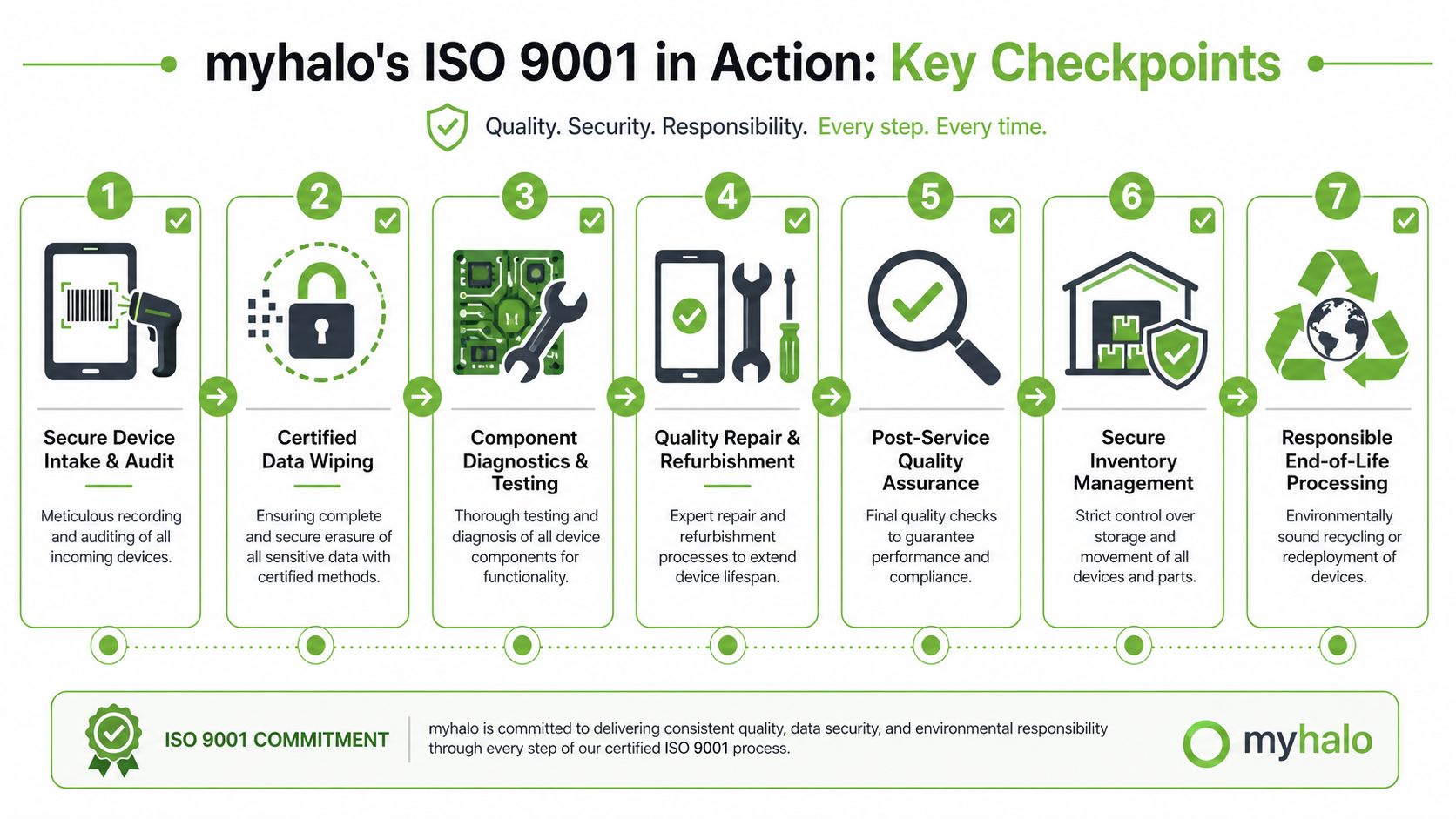
A lifecycle partner stands apart from a basic retailer. The work isn't limited to selling a handset and moving on. It includes intake, diagnostics, repair, secure data handling, grading, after-sales support, reuse, and responsible end-of-life processing.
For example, a provider may offer Certified ReLoved devices for dependable refurbished options, Certified Surplus products for excess or redeployed stock, and services that help customers extend useful life through repair, reuse, and responsible recycling. The same discipline can also support advisory services like RescueAdvise, digital assistance through mylo AI Assistant, and security-minded operations backed by both ISO 9001 Certified and ISO 27001 Certified practices.
A practical refurbishment workflow often includes:
- 30-point quality checks to assess function in a repeatable way
- Transparent device grading and battery health disclosure so buyers know what they're getting
- Documented repair controls so replacement and testing steps aren't improvised
- Secure handling of customer data during intake, transfer, or disposal
- Responsible recycling when a unit can't be economically restored
You can see how that idea is presented in myhalo's quality checks process.
A certified process doesn't promise “new-like perfection”. It promises that the business uses a disciplined, auditable method to assess and present the device honestly.
That's especially valuable for SMEs buying laptops in batches. They don't just need a low purchase price. They need predictable condition, clear records, supportability, and a partner that can help them stretch technology budgets without creating hidden operational risk.
When sustainability is framed properly, this is also where the business case becomes clearer. Extending a device's life through refurbishment, repair, redeployment, or secure recycling isn't only about environmental language. It supports smarter resource utilisation, value creation, and cost control. A company that manages those steps well can help customers get more useful work out of existing hardware while reducing wasteful replacement cycles.
How to Quickly Verify an ISO 9001 Certificate
A supplier says, "We're ISO 9001 certified," and the claim sounds reassuring. The useful next question is much simpler. Certified for what, exactly?
That question matters because ISO 9001 does not certify that every refurbished laptop, phone, or tablet will look new or perform perfectly forever. It certifies that the business runs its work through a documented, audited system. The easiest way to verify the claim is to check whether that system is real, current, and relevant to the service you are buying.
A certificate should be traceable through the issuing certification body, and it should show a defined validity period with ongoing oversight during the certification cycle. If a seller cannot provide basic certificate details, you should treat the ISO claim with caution.
A quick buyer checklist
Use this checklist when reviewing a supplier:
- Ask for the certificate number and the legal company name shown on the certificate.
- Ask which certification body issued it. A genuine supplier should be able to name the issuer clearly.
- Read the scope statement. This is the part buyers often skip. If you are buying refurbished technology, the scope should relate to refurbishment, repair, quality control, distribution, or the relevant operational activities. A certificate for an unrelated function does not tell you much about the product you are purchasing.
- Check the expiry date and whether the certificate is still current.
- Verify it with the issuer or through the certification body's public directory, if one is available. The IAF CertSearch database is one place to start because it helps buyers look up accredited management system certifications.
- Ask one practical follow-up question: "How does this certified process affect the device I receive?" A serious supplier should be able to explain its intake checks, testing steps, grading method, records, and corrective actions in plain language.
A good way to read a certificate is to treat it like a master chef's written recipe. The certificate does not promise that every plate will match your personal taste. It shows that the kitchen follows a controlled method, measures results, fixes mistakes, and trains people to repeat the process properly.
That distinction is especially useful in refurbished tech. Buyers often assume the badge means product perfection. What it really supports is process consistency, which is what gives you a better chance of receiving honest grading, repeatable testing, and fewer unpleasant surprises.
If a seller becomes evasive when you ask to verify the certificate, the scope, or the issuing body, that is a practical warning sign. A company with a real quality system should be comfortable showing how its process works.
If you're looking for a Singapore technology lifecycle partner that supports repair, reuse, Certified ReLoved devices, Certified Surplus products, responsible recycling, and transparent quality practices, explore myhalo. A careful buying decision isn't just about the lowest price. It's about choosing a provider with systems that help you extend device value, manage risk, and make smarter long-term technology choices.