





Singapore Mobile Price Guide 2026: Find Your Perfect Phone
Budget phones in Singapore are usually under S$300, mid-range models mostly sit around S$300 to S$800, and flagship phones generally start from S$900 and can stretch past S$1,600. If you're trying to figure out the total Singapore mobile price you should pay, the smart move isn't chasing the lowest sticker price. It's comparing total ownership cost across new, factory-sealed, and refurbished options.
You often hit this question at the same moment. Your current phone battery is fading, storage is full, the camera has started lagging, and every new launch suddenly looks “necessary”. Then you check prices and realise the gap between a sensible upgrade and an expensive impulse buy is huge.
That gap matters more in Singapore than many buyers realise. This is a mature phone market, not a first-time-buy market. Smartphone ownership is common, so the decision is usually about replacing, stretching value, or avoiding an overpriced upgrade. That's why a proper Singapore mobile price guide has to go beyond retail listings. You need to know what drives the cost up, when used makes more sense than new, and where aftercare can save you money later.
Table of Contents
- The State of Singapore's Mobile Phone Market in 2026
- What Really Drives Mobile Phone Prices in Singapore
- New, Refurbished, or Factory-Sealed Which Is Best for You
- Smart Strategies for Saving on Your Next Mobile Phone
- Protecting Your Investment With Aftercare and Repairs
- Frequently Asked Questions About Buying a Mobile Phone in Singapore
The State of Singapore's Mobile Phone Market in 2026
You walk into a shop planning to spend S$500, then see a "better" model at S$799, a flagship at S$1,299, and a trade-in offer that changes the numbers again. That is how phone pricing works in Singapore now. The key question is not what a phone costs on the shelf. It is what you end up paying over two or three years after storage upgrades, accessories, repairs, battery wear, and resale value.
Singapore is already a replacement market. Nearly everyone who needs a smartphone already has one, so buyers are not entering the category for the first time. They are replacing an old device, switching from one brand to another, or deciding whether to stretch the life of a current phone. That changes how prices behave. Sellers compete hard at the entry and mid-range end, while premium brands push buyers toward higher-margin storage tiers, newer camera systems, and bundled trade-in deals.

Why the price gap feels so big
A phone in Singapore can still cost a few hundred dollars, or well above S$1,000, even when both handle WhatsApp, Grab, banking, and video streaming just fine. The wide spread comes from more than branding. Buyers pay extra for newer chips, stronger cameras, brighter screens, better build quality, larger storage, and longer software support. Some of those upgrades matter. Some are expensive nice-to-haves.
A practical way to read the market is to split it into three buying bands:
- Under S$300. Good enough for calls, messages, QR payments, basic apps, and light video. The usual compromises are weaker cameras, less storage, slower performance after a year or two, and shorter update support.
- S$300 to S$800. This is where value is usually strongest for Singapore buyers. You get a phone that feels fast enough for daily use, handles 5G, runs work and banking apps comfortably, and does not force too many compromises.
- S$900 and up. This is the premium zone. You are paying for better cameras, faster processors, brighter displays, stronger materials, and often much larger storage options.
Sticker price is only the starting point
The cheapest phone to buy is often not the cheapest phone to own.
A budget device can look like good value at checkout, then become expensive if it runs out of storage quickly, needs a battery replacement early, or has poor resale value. A flagship can look overpriced, yet work out reasonably if you keep it for four years, get strong software support, and recover a decent amount through trade-in. Refurbished and factory-sealed older models sit in the middle. They often give the best cost-to-performance ratio if the condition, battery health, and warranty terms are clear.
That is the part many buyers miss. In Singapore, smart buying is less about chasing the lowest tag and more about calculating total cost of ownership.
What each price band usually means in real use
For everyday users, the mid-range segment is often the sweet spot. It covers messaging, navigation, mobile banking, social apps, streaming, food delivery, work chat, and casual photography without forcing flagship spending. Paying more only makes sense if the phone does a heavier job every week, such as gaming for long sessions, shooting lots of video, editing content, or replacing a laptop for part of your work.
Budget phones still have a place. They suit students, parents who want something simple, backup devices, or buyers who care more about low replacement cost than premium features.
The expensive mistake is not always buying a flagship. It is buying the wrong version. A small jump in storage or a "Pro" label can add a few hundred dollars without changing your daily experience much. That is where Singapore mobile price comparisons get distorted. The base model looks affordable, but the version people buy can cost far more.
What Really Drives Mobile Phone Prices in Singapore
Sticker price starts with hardware, but it doesn't end there. A phone can look similar on paper and still cost much more because one part of the specification drives a chain of extra costs.
Storage and memory change the bill fast
Storage and RAM are the cleanest example. Samsung's premium Android pricing in Singapore shows this clearly. The Galaxy S25 series is listed in the S$1,238 to S$1,678 range, and Samsung's Singapore positioning for the Galaxy S26 Ultra reflects top-end configurations from 12GB+256GB through 16GB+1TB, with pricing around S$1,348 to S$1,868 depending on storage (Singapore flagship 5G pricing examples).
That matters because storage and memory aren't cosmetic upsells. They affect how long the phone stays comfortable to use, how many large apps you can keep locally, how much photo and video headroom you have, and how much multitasking strain the phone can handle without slowing down.
If you're choosing between 256GB and 1TB, ask one blunt question. Are you going to fill it? Many buyers in Singapore pay a large premium to avoid cleaning up old videos twice a year. That's an expensive habit.
More storage is only good value when it removes a real pain point. Otherwise, it's one of the easiest ways to overspend on a phone.
Specs matter, but support matters too
Chipsets, camera hardware, display quality, and battery size all move price. Premium phones tend to carry faster processors, better heat management, brighter screens, and stronger camera systems. Those differences are real, especially if you game, shoot often at night, or keep many apps open all day.
But part of the Singapore mobile price equation has nothing to do with the spec sheet:
- Brand positioning. Some brands charge a premium because their resale demand stays strong.
- Software support window. A phone that receives updates for longer can cost more upfront but stay useful longer.
- Warranty quality. Official local coverage has value. So does a reliable retailer warranty if you're not buying brand new.
- Seller channel. Unofficial imports sometimes look cheaper until support, compatibility, or claims become messy.
A lot of buyers focus on benchmark-style thinking and ignore lifespan thinking. That's backwards. The more expensive the phone, the more important it is to understand how long you'll keep it, what support comes with it, and whether repairability is realistic.
Here's a simple filter I use when helping someone compare phones:
- Start with use case. Daily apps only, or gaming, content creation, and heavy work use?
- Choose storage based on behaviour. Cloud-heavy users can buy lower. Offline video hoarders shouldn't.
- Check support before paying. Warranty terms matter more when the upfront price rises.
- Compare resale logic. A pricier phone with strong demand later can make more sense than a cheaper phone nobody wants second-hand.
That brings us to the decision that usually saves the most money. Condition.
New, Refurbished, or Factory-Sealed Which Is Best for You
The smartest Singapore mobile price decision often isn't “which model”. It's “which condition”.
Singapore has a very strong second-hand opportunity because Apple holds 47.22% and Samsung 19.91% of mobile vendor share over Apr 2025 to Apr 2026. That installed base means a lot of desirable devices circulate through the market, and it helps explain why warranty-backed refurbished phones can be a serious alternative to buying new (Singapore mobile vendor share).
The real trade-offs between the three
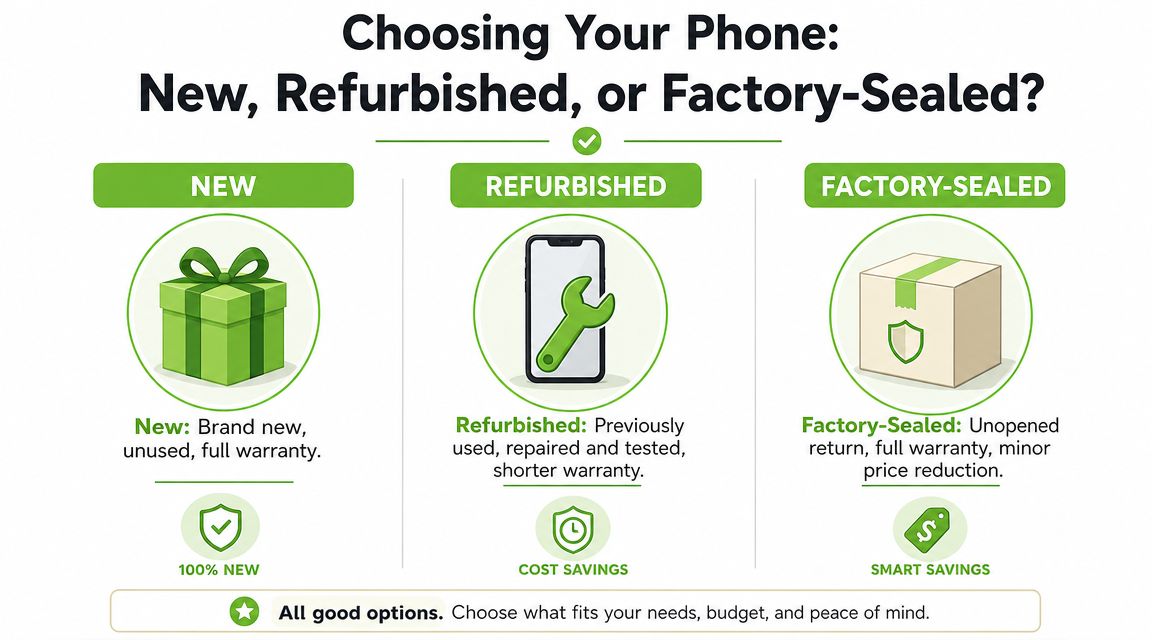
Brand new from official retail is the safest and simplest route. You get untouched hardware, standard manufacturer coverage, and fewer questions about history. The downside is obvious. You usually pay the steepest premium, especially near launch.
Factory-sealed from a parallel importer can look attractive because the box is unopened and the price may be lower than official retail. But buyers need to be careful about what “sealed” means in practice. A sealed box doesn't automatically mean the same support path, service experience, or regional assurance as an official local set.
Professionally refurbished is where value often gets interesting. A good refurbisher tests the phone properly, grades cosmetic condition clearly, and backs the sale with a written warranty. That gives you a very different risk profile from buying off a peer-to-peer listing where “working well” can mean almost anything.
If you're comparing options, don't lump all used phones into one bucket. There's a major difference between:
- Peer-to-peer used with unknown battery health, unclear repair history, and no practical recourse
- Professionally refurbished with checks, grading, and retailer-backed support
- Factory-sealed parallel import with unused hardware but a different support trade-off from official local stock
For buyers who want a checklist before committing, this guide on what to look out for before buying a refurbished phone is useful because it focuses on inspection points that directly affect ownership, not just cosmetics.
Phone condition comparison
| Attribute | Brand New (Official) | Professionally Refurbished (e.g., myhalo) | Factory-Sealed (Parallel Import) |
|---|---|---|---|
| Upfront price | Highest | Usually lower than official new | Often between refurbished and official new |
| Cosmetic condition | Unused | Varies by grade, should be stated clearly | Unused |
| Functional testing | Factory standard | Depends on seller process, should be documented | Factory standard |
| Warranty path | Manufacturer and official retail route | Retailer-backed warranty varies by seller | Depends on importer and local support arrangement |
| Best for | Buyers who want maximum simplicity | Buyers who want value with lower risk than peer-to-peer | Buyers chasing unopened stock at a discount |
| Main risk | Paying too much for small gains | Choosing a seller with weak testing or vague grading | Assuming sealed means identical support to official local stock |
A professionally refurbished flagship can beat a new mid-range phone when you care about camera quality, screen quality, or premium build, but don't want to absorb the new-device premium. A new mid-range phone still makes sense if battery freshness, latest release cycle, and simple warranty handling matter more to you than top-end hardware.
Smart Strategies for Saving on Your Next Mobile Phone
A common Singapore buying mistake goes like this. Someone pays top dollar at launch, adds a new charger, case, screen protector, and higher storage tier, then sells the phone two years later for far less than expected. The sticker price was only part of the bill.
The smarter move is to buy with resale, battery life, accessories, and repair risk in mind from day one. That is how you lower total ownership cost, not just checkout cost.
How to cut your upfront cost without buying rubbish
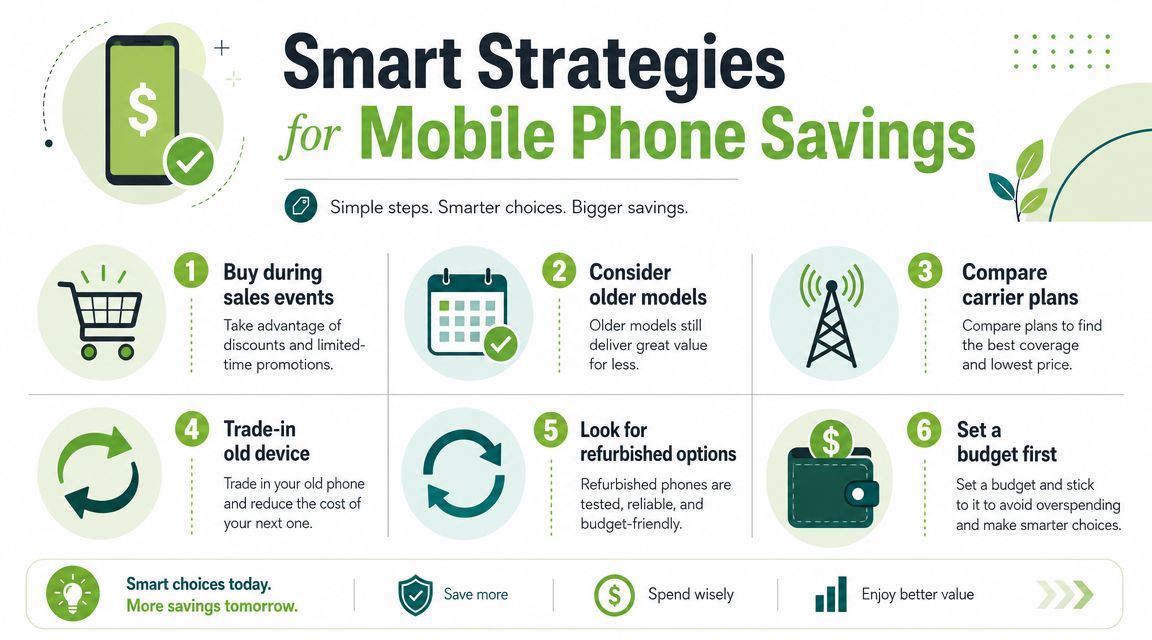
Price drops usually come from timing and discipline, not luck. In Singapore, where many phone purchases are upgrades rather than first-time buys, the best savings often come from avoiding poor-value configurations and selling your current device before its value slides.
These tactics work consistently:
- Trade in while your current phone still has clean resale value. A working phone with decent battery health and no major cracks gives you more room to offset the next purchase. Wait too long, and the drop can be steep.
- Buy one generation behind. This is still one of the safest ways to avoid launch premiums while keeping strong cameras, performance, and software support.
- Compare total value, not category labels. A refurbished flagship can make more sense than a brand-new lower-tier model if you care about screen quality, camera results, or longer-term usability. For more budget buying routes, myhalo's guide to cheap mobile phones in Singapore is a useful reference.
- Treat instalment plans as cash-flow tools, not savings tools. Zero-interest plans can help spread payments, but the phone still needs to be worth the final amount paid.
- Budget for accessories before you commit. The total spend often rises after purchase, especially if the box no longer includes what you need. If you're in Apple's ecosystem, a curated range of Best Apple Accessories can help you avoid low-grade add-ons that fail early and need replacing.
One practical rule helps here. Skip storage upgrades unless your usage clearly justifies them. Many buyers pay extra for capacity they never fill, then recover little of that premium at resale.
Overspending usually happens in two places. Launch pricing and storage upgrades.
A quick video can help if you're comparing budget-saving routes and ownership logic:
How to avoid paying extra after checkout
A cheap listing can still be an expensive phone over 18 to 24 months. Check the costs that show up later:
- Accessories. Some models need immediate spending on chargers, cables, cases, or adapters.
- Warranty quality. Lower prices lose their appeal fast if support is vague or claims are hard to process.
- Battery timing. An older device can still be a good buy, but only if you accept the possibility of paying for a replacement sooner.
- Telco bundle lock-in. The handset discount may look attractive until you add up the full plan cost across the contract.
The best savings strategy is boring, but it works. Buy the phone that fits your actual usage, avoid launch hype, and compare full ownership cost before you compare colours.
Protecting Your Investment With Aftercare and Repairs
A phone's price tag matters. Its survival cost matters more.
Singapore's mobile data pricing has fallen dramatically under heavy telco competition. NTU highlighted a shift from about S$4/GB in 2017 to roughly 6 cents/GB in the Gomo example, alongside a broader affordability context that included an average cost of US$0.63 per 1 GB across the 2023 analysis. When data gets that cheap, people use their phones more heavily for streaming, gaming, navigation, work, and hotspot duty, which makes repairs, warranty support, and device protection much more important (NTU on Singapore's mobile data price war).
Cheap phones become expensive when support is weak
A budget buy with no reliable warranty can turn into a bad-value phone the moment the battery weakens or the screen cracks. The same applies to unofficial imports with unclear service channels. You save at purchase, then lose flexibility when something goes wrong.
Good aftercare gives you predictability. That matters because repair costs are rarely convenient, and phone failures never happen on a relaxed schedule. What you want is clarity on three things:
- Who handles the warranty claim
- What damage is covered
- How quickly the phone can be assessed or repaired
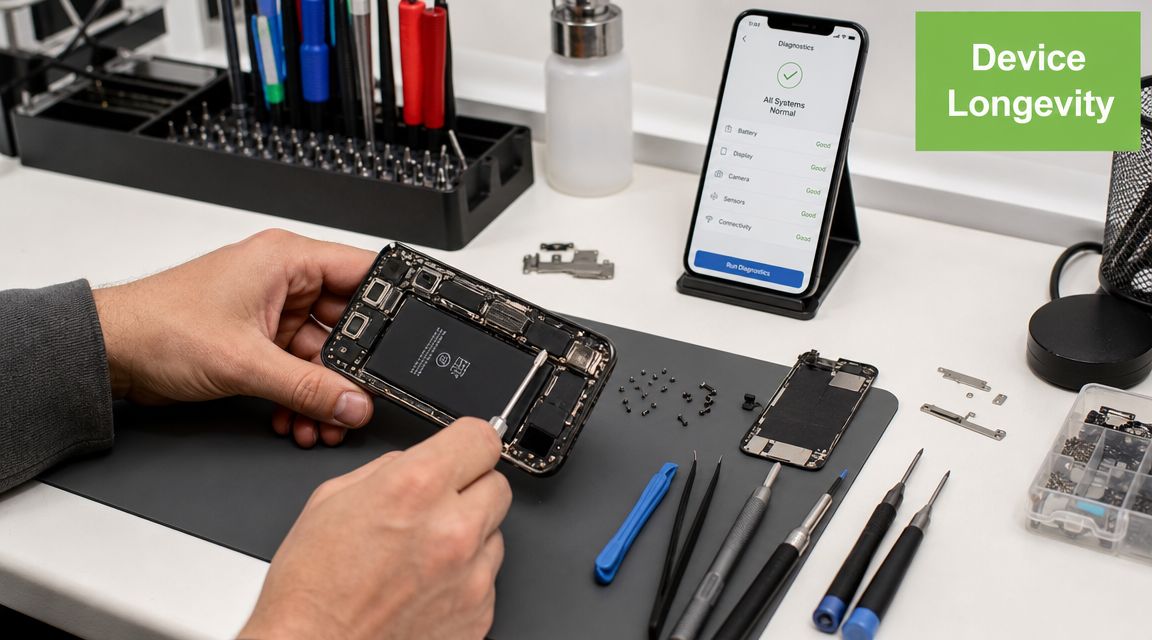
A strong repair ecosystem also changes the maths on refurbished and older flagships. If battery swaps, screen repairs, and diagnostics are realistically available, an older premium device becomes much easier to justify.
What good aftercare actually looks like
Look for sellers and service providers that can explain their process without fluff. Written warranty terms, clear grading, visible repair capability, and straightforward support channels matter more than dramatic discount labels.
If you need a practical overview of local repair considerations, this guide to mobile phone repair in Singapore is a useful starting point.
A phone is only “cheap” if you can keep it working without pain. Otherwise, you're just prepaying for future hassle.
Protection plans also make sense for specific buyers. If you commute heavily, travel often, hand your phone to kids, or depend on it for work, accidental damage cover and maintenance support can stabilise long-term cost. That's not glamorous, but it's often the difference between a manageable ownership cycle and an expensive disruption.
Frequently Asked Questions About Buying a Mobile Phone in Singapore
Are telco contract phones really cheaper
Sometimes, but not automatically. The handset discount can be offset by the plan commitment. If you already need a higher-tier plan, the bundle may be fine. If you only chose that plan to “get the phone cheaper”, check the total cost over the full contract period.
Is an older flagship better than a new mid-range phone
Often, yes, if condition and warranty are solid. Older flagships usually give you better cameras, better screens, stronger build quality, and a more premium feel. A new mid-range phone can still be the smarter buy if you want fresh battery life, a simpler warranty path, and no uncertainty over prior use.
What should you watch for on peer-to-peer platforms
Three things cause the most trouble:
- Unclear device history. Previous repairs, parts swaps, or water exposure may not be disclosed.
- Battery uncertainty. A phone can “work fine” and still need a battery replacement soon.
- No fallback. If a problem appears after payment, you may have little practical recourse.
Meet in a safe place, test everything you can, and don't let a low price distract you from basic verification.
How much trade-in value can you expect
It depends on brand, age, storage tier, condition, and whether the phone is still desirable in the resale market. Apple and Samsung models usually have stronger resale demand because their installed base is large in Singapore. Trade-in is best treated as a way to reduce your next purchase cost, not as a guaranteed windfall.
The better your phone's condition and completeness, the easier it is to turn old hardware into useful credit. Keep the device functional, don't ignore battery issues for too long, and avoid delaying the trade until obvious wear drags value down.
If you're comparing new, refurbished, or factory-sealed phones and want a practical local option, myhalo is worth a look for its mix of devices, transparent grading, warranty-backed refurbished stock, trade-in support, and repair services.