





Samsung Phone Trade in Value
You're holding a Samsung Galaxy that still works, but the battery no longer gets you comfortably through the day. App updates feel heavier, a newer Galaxy launch is filling your feed, and a carrier promotion makes upgrading look easier than deciding what to do with your current phone. Then the question appears: what is my Samsung phone trade-in value in Singapore today?
There isn't one permanent answer. Your payout depends on when you exit, which model and storage tier you own, the device's condition, and the channel you choose. Samsung's own launch-window programme can offer a guaranteed residual value of up to 50% of regular retail price in specific circumstances, while independent Singapore quotes can range from S$70 to S$1,670, with some buyback pages listing Samsung trade-ins up to S$1,720 (Samsung Singapore trade-in programme, Singapore Samsung buyback listings).
This guide gives you a practical way to decide when to leave your current Galaxy, what affects the quote, whether private selling makes sense, how to prepare the phone safely, and where a lifecycle partner such as myhalo fits into the decision. The objective isn't a magic number. It's a clear exit plan.
Table of Contents
- When a Galaxy Starts Feeling Replaceable
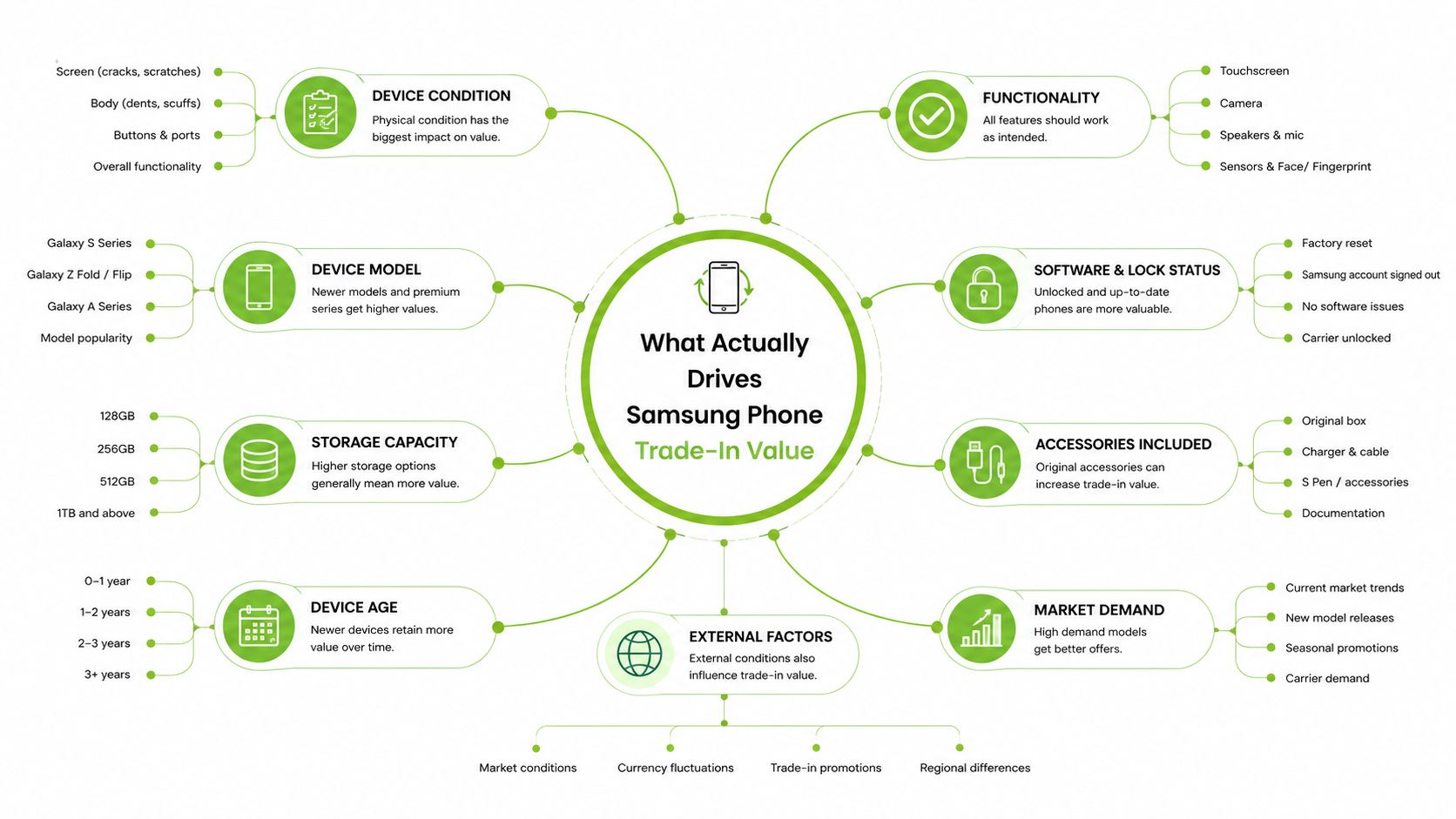
- What Actually Drives Samsung Phone Trade-In Value
- How Model, Storage and Condition Move the Number
- Trade In, Sell Privately or Keep the Device
- Preparing Your Samsung for the Highest Payout
- Where to Trade In Your Samsung in Singapore
- Your Samsung Trade-In Playbook for 2026
When a Galaxy Starts Feeling Replaceable
A Singapore user with a two- or three-year-old Galaxy often reaches the same awkward point. The phone still handles WhatsApp, banking, maps and streaming, yet the battery drops faster, newer app versions feel less comfortable, and the next flagship launch creates upgrade pressure. You might notice the change while scrolling through a carrier promotion, watching a colleague unbox a new Galaxy, or checking a resale listing and realising the ceiling has moved lower again.
That moment creates three choices. You can trade the phone in against a new purchase, sell it yourself, or keep it as a backup or family device. The phone's value is often treated as a fixed figure, but Singapore buyers and trade-in operators price it according to timing, condition, model, storage and channel.
Practical rule: Don't ask only, “What is my phone worth?” Ask, “What is the best exit for this phone at this point in its lifecycle?”
Samsung's official programme illustrates why timing matters. During a pre-order or launch period, Samsung Singapore can guarantee up to 50% of a qualifying device's RRP as residual value when the owner buys a new flagship under the programme terms. A Galaxy S24 Ultra, for example, can qualify for a guaranteed residual value of 50% of its RRP when traded for a new Galaxy S25-series device under those terms (Samsung Singapore trade-in details).
That benefit isn't the same as unrestricted cash. Samsung says the trade-in value and applicable bonus are deducted from the price of the new device, and the programme is limited to eligible purchases from the Samsung Online Store for Singapore residents aged 18 years and above (Samsung Singapore programme eligibility, Samsung Online Store trade-in FAQ). You need to decide whether the upgrade itself makes sense before treating the credit as savings.
A sensible decision starts with five questions:
- When should you exit the current Galaxy?
- Which defects or specifications will affect the quote most?
- Is convenience worth more than a private-sale premium?
- Can you prepare the device without risking personal data?
- Would a reuse-focused route, including Certified ReLoved devices, create better value than replacing everything?
The answer changes from one owner to another. A yearly flagship upgrader should think differently from a family passing an older A-series phone to a child, and both should think differently from someone whose Galaxy still meets every daily need.
What Actually Drives Samsung Phone Trade-In Value
A trade-in quote starts with the device identity, not the colour of the case or the fact that it's a Samsung. Use this simple sequence: model and age first, then condition, battery and storage.
Model and age establish the starting band
A Galaxy S Ultra sits in a different value category from a Galaxy A-series phone. Independent Singapore listings show that a Galaxy S24 Ultra 5G can be quoted at S$930 for 256GB, S$1,100 for 512GB and S$1,300 for 1TB, while a Galaxy S24 5G can be quoted at S$675 for 256GB and S$775 for 512GB (Singapore Samsung trade-in price examples).
Age should be understood as time since launch, not the calendar year printed on your receipt. A phone that has just been replaced by a newer flagship normally faces more comparison from buyers, even if its hardware remains capable. That's why launch-cycle timing belongs in the valuation conversation.
Condition changes the quote after inspection
A clean screen, straight frame and properly functioning cameras help the device clear a higher grade. Cracks, deep scratches, dents, water damage, charging faults and display problems can move it into a lower category. Singapore buyback data also shows that missing accessories, screen wear and functional faults can create substantial deductions between otherwise similar phones (CTDI Singapore buyback valuations).
Don't confuse a preliminary online quote with the final value. Samsung Singapore says customers answer a diagnostic questionnaire about the device's condition, after which the trade-in value is determined and deducted from the new device price (Samsung Singapore diagnostic FAQ).
Battery and storage refine the residual demand
Battery health affects how confidently a reseller can place the phone with its next owner. Check battery information through Samsung Members where available, and use a tool such as AccuBattery for an additional indication. Storage matters because buyers who store large photo libraries, games and offline media often seek higher-capacity versions.
A Galaxy S21 in excellent condition can attract stronger interest than a battered Galaxy S23 because buyers and refurbishers must account for repair work, presentation and resale risk. The newer model starts with an advantage, but damage can erase much of it.
Treat “excellent condition” as a demanding grade, not casual praise. It generally assumes a pristine-looking screen and a healthy battery, while automated checks can penalise defects that seem minor during a quick handover. The next step is to see how these factors appear in real Singapore quote bands.
How Model, Storage and Condition Move the Number
Storage and condition can change a Galaxy's trade-in value even when the model stays the same. Singapore buyback tables list the S24 Ultra 256GB at S$840 for minor scratches and S$980 in like-new condition, while the 1TB version reaches S$1,010 to S$1,230 depending on condition (CTDI Singapore device valuation table).
The table below shows how published Singapore figures are spaced across storage and condition. Treat these as reference bands, not guaranteed quotes. Each counter applies its own inspection rules, timing and programme terms.
Illustrative Galaxy S24 Ultra 256GB Trade-In Bands in Singapore
| Scenario | Storage | Condition | Timing | Indicative SGD Range |
|---|---|---|---|---|
| Minor-scratch unit | 256GB | Minor scratches | Independent buyback quote | S$840 |
| Like-new unit | 256GB | Like-new | Independent buyback quote | S$980 |
| Higher-capacity comparison | 512GB | Varies by inspection | Independent Singapore listing | S$1,100 |
| Higher-capacity comparison | 1TB | Varies by inspection | Independent Singapore listing | S$1,300 |
Samsung's launch programme can change the timing decision. As covered earlier, Samsung's launch programme can offer this residual credit during qualifying periods. The same phone can therefore produce a different economic outcome if you exit before the next launch, during its promotion, or after the offer expires. Check the applicable terms before treating the promotional value as part of your expected payout.
Storage has a clear resale advantage. Higher-capacity versions suit buyers who keep large photo libraries, games and offline media. Condition determines how much of that advantage survives inspection. A cracked back glass or visibly worn screen may leave the phone functional, but repair, testing and warranty risk reduce what a buyer can offer.
Small cosmetic defects matter most when they push a phone below a grading threshold. The deduction isn't always proportional to how small the mark looks to you.
Buyback grading often works in tiers. A device either meets the requirements for a higher grade or falls into the next one, so a small defect can have a larger financial effect than expected. Protect the phone, charge it carefully and choose your exit before a major launch changes demand. That timing decision often matters more than marketing claims attached to the newer model.
Trade In, Sell Privately or Keep the Device
There are three sensible exit paths, and each solves a different problem. Trade-in optimises convenience, private sale targets the highest possible proceeds, and keeping the phone protects its remaining utility.
| Factor | Trade-In | Sell Privately | Keep Device |
|---|---|---|---|
| Convenience | High, especially with a new purchase | Lower, requires listing and replies | Highest if you do nothing |
| Payment format | Usually credit or buyback payment, depending on channel | Direct payment from buyer | No immediate payment |
| Pricing control | Limited after inspection | You set the asking price | No resale exposure yet |
| Handover risk | Lower through an established programme | Meet-up and payment risk | None |
| Best fit | Regular upgraders | Owners with desirable variants | Users whose phone still meets their needs |
Choose trade-in for a clean, predictable upgrade
Trade-in suits people who replace a flagship every couple of years and already intend to buy a new Samsung. Samsung's Singapore programme can apply the trade-in value and any applicable bonus directly against the new device, while launch-window terms can provide a guaranteed residual value under qualifying conditions (Samsung Singapore upgrade programme).
You give up some control over the final valuation, but you avoid listing photos, negotiation and meet-ups at places such as Bugis Junction or outside an MRT station. For a family cycling devices between parents and children, this simplicity can matter more than squeezing out the last dollar.
Sell privately when the specification has a clear audience
Private selling can work well for a high-storage Ultra, a boxed unit, or a foldable such as the Galaxy Z Flip5. A buyer may pay more for a specific colour, storage tier or complete set, but you'll handle messages, price negotiation, appointment safety and payment verification yourself. Owners comparing direct-selling options across different devices may also find this guide useful: compare MacBook selling platforms.
If the phone is older and the offer is negligible, keeping it may be the rational choice. Use it as a backup, dedicated navigation device, child's phone or test handset. A functioning device can create more value in your household than a low quote creates in cash.
For Singapore-specific selling considerations, see this practical guide to selling a phone in Singapore. The correct comparison is not only the headline price. Include your time, travel, risk and the replacement cost of a temporary device.
Preparing Your Samsung for the Highest Payout
Preparation is the most effective part of the process that you control. It protects your personal information, prevents account-lock problems and gives the inspector a clean, verifiable device.
Back up before you sign out
Start with a complete backup to Samsung Cloud or a Windows PC. Use Samsung Smart Switch to move contacts, photos, messages and WhatsApp chats to the replacement Galaxy or to a temporary backup location. Open the important files on the destination device before wiping the old one.
A rushed transfer creates more risk than a small cosmetic mark. Check your photos, contacts, authenticator access, notes and WhatsApp history while the old device is still available.
Remove accounts and connected devices
Sign out of the Samsung account and Google account before the factory reset. Disable or unpair Galaxy Watch and Galaxy Buds, then remove the device from your account dashboards where relevant. This helps prevent the next owner from encountering Samsung or Google activation protection, commonly known as an FRP lock.
Sign out of banking applications, Samsung Pass and Secure Folder as well. Delete eSIM profiles if you're transferring your mobile service, and remove your physical SIM before handover.
Inspect, reset and record
Clean the phone with a suitable soft cloth, paying attention to the screen, camera glass and ports. Fold and Flip owners should inspect the hinge, inner display and protective screen area without pressing debris into the fold.
Run a quick sanity check on the display, cameras, speakers, microphones, charging port and battery behaviour. Then perform the factory reset, and photograph the phone's condition, IMEI details where appropriate, and included accessories for your records.
Before arranging a handover, consider whether a professional repair is economically sensible. A repair may extend the device's useful life or improve its next-owner value, but the repair cost must be compared with the likely increase in the offer. myhalo's guide to mobile phone repair in Singapore is a useful starting point for that decision.
Where to Trade In Your Samsung in Singapore
The right trade-in channel depends on your exit plan. Samsung's programme suits an owner buying another Galaxy immediately. Carrier schemes can work when the device upgrade is tied to a mobile plan. Independent buyback services make more sense when you want cash or purchase credit without committing to a replacement phone.
Samsung's launch programme details, including the 50% of RRP as a guaranteed residual value, are outlined above. Check the current Samsung Singapore trade-in terms before ordering, because eligibility, timing and credit conditions determine whether the headline value applies to your device. The credit is linked to an eligible Samsung Online Store purchase, so it does not function like unrestricted cash.
Singtel, StarHub and M1 may offer separate trade-up schemes with their own bundling and contract rules. Compare the final benefit, not just the advertised credit. A larger figure can come with a plan commitment that reduces your flexibility at the next upgrade.
Independent buyback routes suit owners who want to exit a phone without purchasing another one at the same time. myhalo's Certified ReLoved process is one reuse-oriented option. Inspected devices return to circulation alongside Certified Surplus products, while grading and battery health disclosure give buyers clearer information about the phone's condition. For businesses, this approach can support planned refreshes, steadier device costs and longer use across the lifecycle.
Your timing matters. A phone still in strong demand can produce a better offer before a newer generation shifts buyer attention, while a credit-only launch deal may be worthwhile if you already planned to upgrade.
Channel test: Choose a credit-based Samsung offer when you are buying during the relevant launch period and the conditions improve your effective purchase price. Choose an independent buyer when liquidity and flexibility matter more.
Samsung Trade-In Channels in Singapore Compared
| Channel | Payout Speed | Indicative S23 Ultra 256GB Band (SGD) | Main Trade-Off |
|---|---|---|---|
| Samsung launch programme | Tied to purchase and programme processing | Not stated in the verified Singapore data | Potentially strong residual credit, but limited timing and eligibility |
| Carrier programme | Depends on carrier process | Not stated in the verified Singapore data | May involve plan or bundling conditions |
| Independent buyback | Varies by inspection and payment method | Not stated in the verified Singapore data | More liquidity, but quote depends on market demand and condition |
There is no verified S23 Ultra 256GB band to use as a reliable benchmark. Request a live quote, confirm whether payment comes as cash, bank transfer or credit, and ask which inspection findings can reduce the offer.
Retail operators also need clear answers for questions about trade-in eligibility, device condition and account status. An AI chatbot for electronics Shopify can handle routine enquiries for an online shop, but it cannot replace physical inspection or a written valuation.
For a Singapore-focused route, review the Samsung trade-in process and compare its conditions with Samsung and carrier offers. Use Samsung when launch credit lowers the replacement cost, an independent buyer when you want a cleaner exit, and continued use when the phone still meets your needs. The best trade-in decision is the one that matches the device's lifecycle and your next purchase, not the one with the loudest headline value.
Your Samsung Trade-In Playbook for 2026
Run this checklist before accepting any quote. It keeps the decision focused on residual value instead of launch-day excitement.
- Check the battery first. Use Samsung Members and inspect real-world battery behaviour. A phone that needs frequent charging is harder to position as a premium used device.
- Time the exit around the S-series launch window. Samsung's Singapore programme has historically tied its strongest guaranteed residual structure to pre-order or launch periods, so check the current terms before waiting.
- Gather the original accessories. Find the box, cable and other included items. They may matter more in a private sale than in a formal trade-in, but a complete set makes the listing easier to trust.
- Transfer data with Smart Switch. Confirm that contacts, photos and WhatsApp chats are available on the replacement device before removing accounts or resetting the old one.
- Request more than one quote. Compare at least two Singapore buyback services, then check whether each offer is cash, bank transfer or purchase credit and whether the quoted amount depends on inspection.
Two mistakes cause avoidable trouble. Handing over a phone that remains signed into personal accounts can create privacy and activation problems, while accepting the first instant quote during a launch promotion can leave value on the table. Preparation and comparison can materially improve the outcome, but no verified data supports a universal percentage uplift, so judge each offer against the device's model, condition and programme terms.
The aim is simple: exit at the phone's peak residual value, not merely at the point of maximum convenience.
myhalo helps Singapore customers extend device lifecycles through Samsung trade-ins, repairs, data migration and professionally assessed Certified ReLoved and Certified Surplus devices. Visit myhalo to check your Samsung's trade-in route, compare a practical upgrade option and keep more working technology in circulation.