





Samsung Phone Cost: Your 2026 Guide to SG Prices
You’re probably doing the same mental maths many Singaporeans do. You walk past a Samsung display at Bugis, Sim Lim, Challenger or a telco shop, pick up the latest Galaxy, like the screen, like the camera, then see the price and think, “Can, but should I really pay that much?”
That reaction is rational. Samsung phones are good, but samsung phone cost in Singapore is rarely just the sticker price. The complete bill includes GST, storage upgrades, accessories, repairs, depreciation, and the amount you lose when you sell or trade in later. If you ignore those, you can overpay badly.
A smarter buy isn’t always the cheapest phone. It’s the phone that gives you the most useful life, the least regret, and the best resale outcome.
Navigating the Samsung Phone Cost Maze in Singapore
You see a Samsung phone in a shop, check the tag, and feel tempted to decide on the spot. Bad move. In Singapore, the smarter question is how much that phone will cost you across the next two to four years, not what it costs today.

Sticker price is only the entry fee. Your real bill includes how quickly the phone loses resale value, whether you overpaid for storage you will never fill, what you spend on protection and repairs, and how much you can recover later through trade-in or resale.
That is why two buyers can pay the same amount upfront and still end up with very different outcomes. One keeps a model with weak resale demand and absorbs a big loss. The other buys more carefully, keeps the phone in good condition, and exits with a much lower total cost of ownership.
Why the headline price misleads
A Samsung phone can look affordable if you only focus on monthly instalments or a telco bundle. That is exactly how people overspend. Small monthly numbers hide the full commitment, especially once you add accessories, insurance, battery wear, and the lower resale value that often hits brand-new models hardest in the first year.
Use a simple filter instead. Ask:
- How long will I realistically keep it?
- What will it likely be worth when I sell or trade it in?
- Am I paying extra for specs I will barely use?
- Would a certified refurbished set cut my loss without hurting day-to-day use?
Practical rule: Buy the Samsung model that still makes financial sense on the day you stop using it.
In Singapore, buyers have options. That can get expensive fast
Singapore is full of places to buy a Galaxy phone. Samsung stores, telcos, electronics chains, marketplaces, and refurbished sellers all compete for your money. More choice sounds good, but it also makes it easier to mistake convenience for value.
Telco plans often blur the actual device cost. Launch-period hype pushes people toward the newest release when last year's model is usually the better buy. Refurbished phones also get dismissed too quickly, even though a properly checked unit can reduce your upfront spend and your depreciation hit at the same time.
If you want a cleaner benchmark before you buy, compare current Samsung phone listings on myhalo's store. It helps you judge the market based on actual available models, not just launch marketing.
The buyers who save the most are not chasing the lowest price. They are controlling depreciation, avoiding unnecessary upgrades, and choosing a phone with a resale path that still looks decent later.
Understanding Samsung's Price Tiers from Flagship to Budget
You walk into a shop planning to buy "a Samsung", then get hit with S, Z, and A models that all look good under bright lights. That is how people in Singapore overspend. The smarter move is to sort Samsung’s lineup by ownership cost first, then decide how much phone you need.
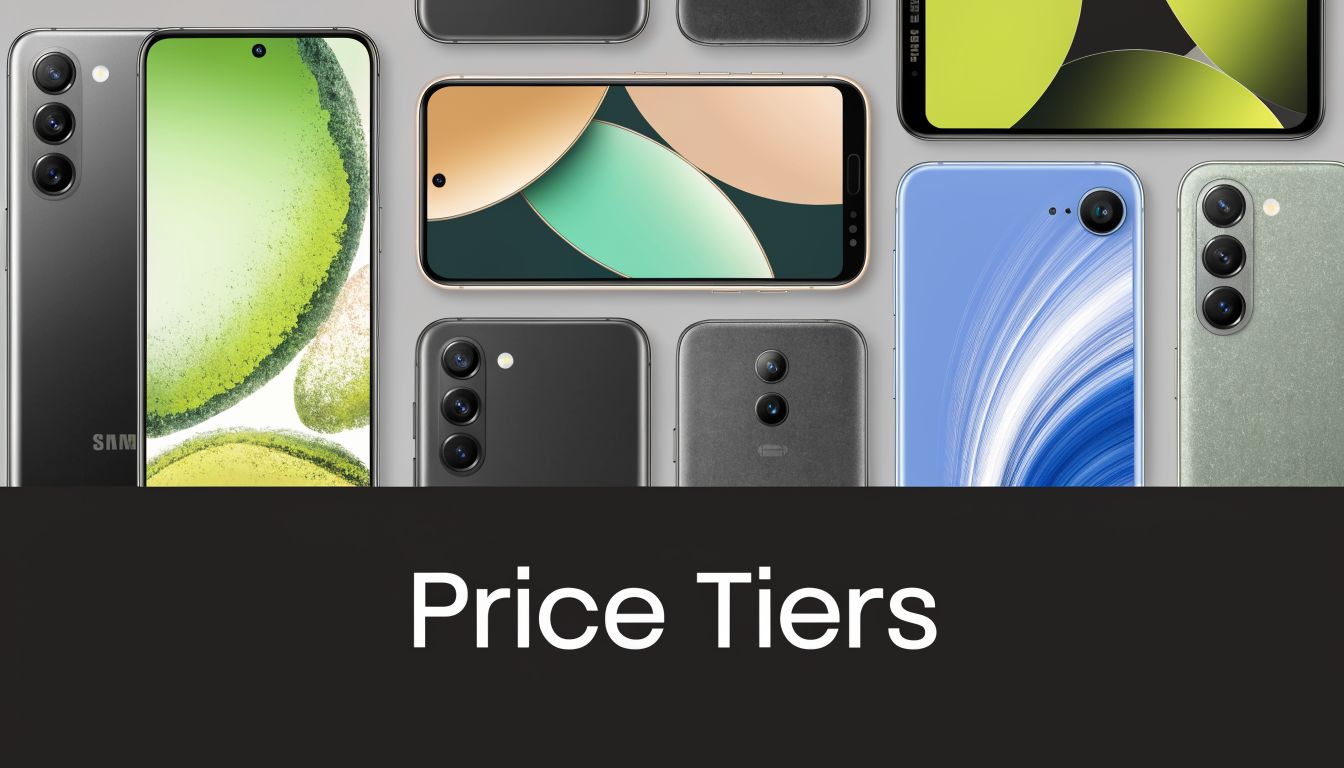
Galaxy S series
The Galaxy S line is the standard premium choice. You get Samsung’s strongest mix of screen quality, cameras, chipset performance, and software support without paying foldable prices.
It is also the tier where buyers most often pay more than they need to. New S models carry the biggest launch premium, and that matters if you plan to upgrade again in two or three years. The phone may still be excellent, but your depreciation bill can be ugly.
For Singapore buyers who want flagship performance without wasting money, compare current Samsung phone listings at myhalo against new retail pricing before committing. In this tier, last year's S model or a certified refurbished unit is often the better financial decision.
Galaxy Z series
The Z line is Samsung’s foldable range. It is built for buyers who care about design, novelty, and the larger-screen experience in a smaller footprint.
Be blunt about this category. Foldables are rarely the best value on total cost of ownership. The upfront price is higher, resale can be less predictable, and repairs outside warranty can hurt. Buy a Z series phone because you specifically want a foldable. Do not buy one expecting it to be the sensible money-saving option.
Galaxy A series
The Galaxy A line is where practical buyers should start. These phones cover the basics well. Messaging, banking, maps, streaming, school, work apps, and casual photos are all fine on the right A model.
This tier usually gives the cleanest balance between upfront spend and usable lifespan. You are not paying for premium branding or niche features you may never touch. If your goal is to keep costs under control and still get a dependable Samsung, A series deserves your first look.
A simple mental map
Use this as your filter:
| Series | Who it suits | Cost mindset |
|---|---|---|
| Galaxy S | Buyers who want premium performance and better cameras | High upfront cost, decent long-term value if bought at the right price |
| Galaxy Z | Buyers who specifically want a foldable form factor | Highest upfront cost, weakest value case for cost-conscious buyers |
| Galaxy A | Buyers who want reliable daily use without overspending | Lowest entry cost, usually the safest value pick |
A simple rule helps. Buy A for value, buy S for premium features you will use, and buy Z only if the fold matters enough to justify the extra cost.
The Three Key Factors That Determine Final Price
The model name is only the start. The final samsung phone cost changes based on three things that buyers often underestimate. It's comparable to ordering cai fan. The tray looks simple until every add-on starts pushing the total up.
Model generation
This is the biggest one. Newest-generation phones always carry the launch premium. The older model usually drops into a much better value zone once the replacement arrives.
That doesn’t mean every previous generation is the right buy. It means you should ask whether the newer device gives you enough extra to justify the price jump. For most users, the answer is no. If you mainly use your phone for photos, messaging, maps, banking, video and work apps, a recent prior-generation Samsung is often the smarter buy.
Storage and RAM
Samsung pricing often becomes quite subtle. Buyers see a jump from one storage tier to another and assume it’s just a simple upgrade. It isn’t. Memory cost has become a major driver of phone pricing.
Samsung’s semiconductor division has significantly increased LPDDR5X memory prices for its own smartphone division, and the production cost of a Galaxy S20 Ultra 256GB was listed at $528.50, according to this report on memory-driven device cost pressure. That helps explain why bigger storage options command disproportionately high prices.
Here’s the practical takeaway:
- Light users: Don’t pay extra for storage you won’t fill.
- Photo and video heavy users: Storage matters, but compare the upgrade premium against cloud storage or external workflow habits.
- Resale-minded buyers: Higher storage can help value retention, but only if the upfront jump isn’t absurd.
Promotions and payment structure
A “deal” can still be expensive. Telco bundles, checkout add-ons, launch gifts, and instalment plans change how the price feels, not always how much you pay.
What you should check:
- Upfront versus total spend: Monthly payments can make a phone feel cheap when it isn’t.
- Bundle relevance: Freebies only matter if you’d buy them anyway.
- Trade-in effect: A good trade-in can change the equation fast.
This walkthrough gives a useful visual summary of how specs and variants affect pricing:
Quick buying filter
Before paying more, ask yourself these three questions:
- Am I paying for “latest” or for a feature I’ll use every day?
- Will I benefit from the storage jump?
- Is this promo reducing total cost, or just making the spending easier to swallow?
If you can’t answer clearly, hold the purchase.
New vs Refurbished vs myhalo Certified A Value Comparison
The comparison often narrows to just two options. New or used. That’s too simplistic and it leads to bad decisions.
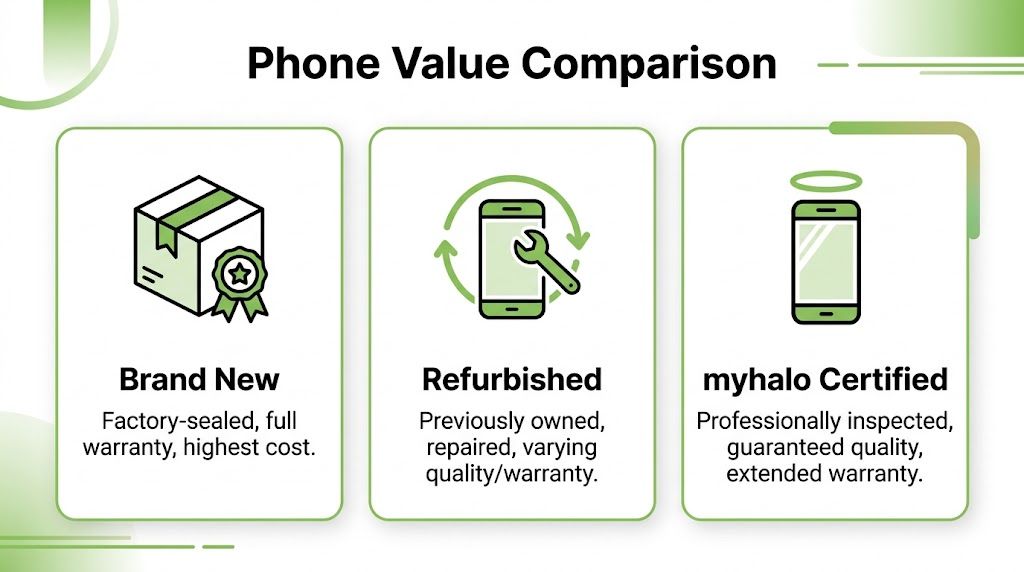
A better comparison is this: brand new, generic refurbished, and certified refurbished with clear grading and warranty support. That’s the actual buying choice.
Brand new
This is the easy option. Factory-sealed, clean box, full confidence, highest cost.
You’re paying for first ownership and zero usage history. That feels good, but the financial downside is brutal. Samsung flagship devices lose 30 to 40% of their value within the first year and around 60% by the end of year two, according to this refurbished value analysis. The same source notes a Galaxy S23 Ultra that retailed for $1,199 can be found refurbished for around $800, a 33% discount, while still retaining over 95% of its functional capability.
So yes, new is clean and convenient. It’s also where you absorb the biggest value loss.
Generic refurbished
This is the risky middle. The term “refurbished” sounds reassuring, but it can mean almost anything. One seller may test thoroughly and replace weak parts. Another may wipe the phone, polish the casing, and call it done.
That’s why buyers get nervous. The label itself doesn’t guarantee much.
Typical weak points include:
- Unclear battery condition
- Vague cosmetic grading
- Short or confusing warranty terms
- No obvious support if something goes wrong
If you’re buying generic refurbished, read a practical checklist first. This guide on what to look out for before buying a refurbished phone is a good place to start because it forces you to check the boring stuff that is important.
“Refurbished” is not a standard. It’s a category. The seller’s process matters more than the word.
Certified refurbished from a local provider
This is usually the sweet spot if you care about value and don’t want nonsense.
The useful way to think about it is like buying a car:
| Option | Phone equivalent | Main trade-off |
|---|---|---|
| Brand new car | Factory-sealed phone | Highest spend, biggest early depreciation |
| Used car from random seller | Generic refurbished | Lower price, more uncertainty |
| Certified pre-owned from dealer | Professionally graded refurbished | Better balance of price and assurance |
A structured grading system matters because it tells you what you’re paying for. With a provider like myhalo, the categories are straightforward:
- As-New gives you a near-pristine device with a 6-month warranty
- ReLoved focuses on strong function with minor cosmetic wear and a 30-day warranty
- ReEco gives you the lowest price if you don’t care about visible wear
That’s useful because not every buyer has the same priorities. Some people want a phone that looks untouched. Some just want something reliable and cheap enough to survive two years of daily use.
My advice
If you upgrade often and hate cosmetic marks, buy certified As-New.
If you want the strongest value, buy a recent certified refurbished unit in a lower grade and ignore tiny scuffs.
If you’re still buying factory-sealed every cycle without checking depreciation first, you’re paying a convenience tax.
Smart Strategies to Lower Your Samsung Phone Cost Today
You don’t need to wait for some miracle sale. There are a few moves that cut samsung phone cost right now if you’re disciplined about how you buy.
Stop focusing only on upfront price
The biggest trap with Samsung phones is treating the shelf price as the full story. For a mid-range Galaxy A-series device in Singapore, the upfront cost might be around S$600, but 9% GST and average annual repair costs of S$150 raise the true ownership bill, according to this TCO-focused breakdown. The same source notes many buyers ignore trade-in values that can average S$200 for an older A-series phone.
That’s why some “affordable” phones stop being affordable after a year.
Use trade-ins properly
Trade-in is one of the easiest ways to stop dead money sitting in your drawer. If your old phone still works, convert it into a discount instead of hoarding it as a backup you’ll never charge.
A simple rule:
- If your old phone is functional, check trade-in before buying anything new.
- If the trade-in offer is weak, compare it against direct resale.
- If you’re buying for a family member, one old phone can offset part of the next device.
Most people don’t overspend because Samsung is too expensive. They overspend because they fail to subtract the value of what they already own.
Use instalments only if your budget is organised
Instalments aren’t bad. Undisciplined instalments are bad.
The same TCO source notes that 0% instalments can reduce monthly cost to as low as S$50. That’s useful if you’re spreading cash flow without interest. It’s dangerous if it tricks you into buying a model you couldn’t justify in one payment.
If you need a simple framework to plan device spending alongside rent, transport, food and family costs, use a guide like this to create a comprehensive household budget. A phone purchase should fit your budget. Your budget shouldn’t bend around a phone.
Don’t ignore price protection and support terms
Two deals can look identical but have very different real value. Check for:
- Trade-in support: Faster, easier value recovery from your current device
- 0% instalment availability: Better cash-flow control if you already budget properly
- Post-purchase protection: Some sellers offer price-drop refunds or exchange windows, which reduce buyer’s remorse
That’s where service matters almost as much as price. A lower listed price isn’t automatically the better deal if the support is weak or the buying terms are messy.
Beyond the Purchase How myhalo Reduces Long-Term Costs
The cheapest buying decision can become the most expensive ownership decision. That’s the whole point of TCO.
A phone that’s slightly cheaper upfront but hard to repair, annoying to maintain, or poorly protected will cost you more over time. That’s why ownership support matters.
Long-term cost isn’t just repair cost
What drives long-term cost is downtime, maintenance, and whether the phone stays in good enough condition to keep working well or hold trade-in value. Services like repairs and data migration help because they reduce the friction of keeping a device in use instead of replacing it too early.
If you’re looking at protection plans, myhalo Protect covers accidental damage, liquid protection, and extended warranty support. That matters because one accident can turn a “cheap” phone into an unexpectedly expensive one.
A longer phone life is a better financial outcome
There’s also a sustainability angle here, but even if you only care about money, the logic still holds. Extending the usable life of a phone reduces replacement pressure and cuts avoidable waste.
That’s why care programmes and maintenance services are worth paying attention to. They’re not glamorous, but they can keep your phone in service longer and lower the cost of ownership across the full lifecycle.
Your Final Verdict on Samsung Phone Cost
If you only look at retail price, you’ll probably make the wrong call.
The right way to judge samsung phone cost in Singapore is to look at the full chain. Purchase price, storage premium, GST, repair risk, depreciation, and resale or trade-in value. Once you do that, the answer gets clearer.
New Samsung phones make sense for some buyers. Not for everyone. If you need the newest release on day one and you’re fine paying for that privilege, go ahead. But if you want strong value, the smarter move is usually a recent device with lower depreciation and proper quality checks behind it.
The best buy is the one that balances performance, warranty cover, support, and future value. Not the one with the flashiest launch campaign.
Buy with your calculator on, not your ego.
Frequently Asked Questions About Samsung Phone Costs
Are refurbished Samsung phones in Singapore actually worth it?
Yes, if they’re properly checked and clearly graded. The problem isn’t refurbished phones. The problem is vague sellers.
In Singapore, the refurbished market grew 25% in 2025, yet 65% of consumers express distrust because there aren’t enough local benchmarks, according to Samsung Certified Re-Newed background data. That same source notes a myhalo ReLoved phone undergoes 30 ISO 9001 checks, maintenance plans can prevent 80% of common failures, a new phone can depreciate 50% in one year, and a refurbished model often retains 70% of its purchase value for future trade-ins.
What’s the difference between As-New, ReLoved and ReEco?
The short answer is cosmetic condition and warranty terms.
- As-New suits buyers who want a phone that looks close to brand new and comes with more warranty cover.
- ReLoved suits buyers who care more about function than tiny cosmetic marks.
- ReEco suits buyers who want the lowest price and don’t mind visible wear.
If your priority is value, ReLoved is often the practical middle ground. If appearance matters a lot, pay more for As-New.
Is buying new ever the better choice?
Yes, sometimes. Buy new if you need the latest release immediately, want a factory-sealed device, or have a very strong launch offer with trade-in. Otherwise, many buyers are just paying extra to absorb the first wave of depreciation.
Should I get more storage?
Only if you know why. Don’t buy a bigger storage tier because the salesperson says it’s “more future-proof”. Buy it if your actual usage needs it. If not, keep the money.
Is trade-in only for old Samsung phones?
No. Trade-in options often include other brands as well, but you need to check the current device eligibility and quoted value before checkout.
If you want a practical way to compare Samsung options without guessing, browse myhalo and filter by condition, warranty, and price instead of fixating on launch hype. That’s the easiest way to find a phone that fits your budget, lowers waste, and doesn’t leave you overpaying for features you won’t use.