




Grab Pay Later Singapore: Complete 2026 Guide
You've probably seen the Grab app sitting on your phone while a checkout screen asks whether you want to pay now or split the bill. Maybe it's a new laptop, a refurbished phone, or just the week's rides and meals adding up faster than you expected. Grab PayLater Singapore sits right in that moment, and the key question isn't whether it looks convenient, it's whether it fits the way you spend.
Table of Contents
- What Grab PayLater Actually Is and How It Works
- Eligibility Requirements and Activation Process
- Understanding the True Cost Structure and Fees
- How Grab PayLater Compares to Other Payment Options
- Where You Can Use Grab PayLater in Singapore
- Common Pitfalls and Consumer Protection Gaps
- Practical Tips for Responsible PayLater Usage
What Grab PayLater Actually Is and How It Works
A Singapore user looking at a refurbished laptop or a month of Grab rides will usually see the same basic idea, pay later instead of paying everything upfront. Grab launched Grab PayLater in Singapore in 2019 as part of its digital payments expansion, with two separate credit services, a post-paid option for Grab services due at the end of the month and an instalment product that spreads purchases across four interest-free payments. Singapore was the initial market for the post-paid service, which matters because the feature was built around local spending habits rather than copied wholesale from elsewhere. The service now sits inside a broader BNPL market that consumers in Singapore used for S$3.4 billion of online and in-store spending in 2023, according to the cited market coverage on the launch and ecosystem context Smart City government coverage.
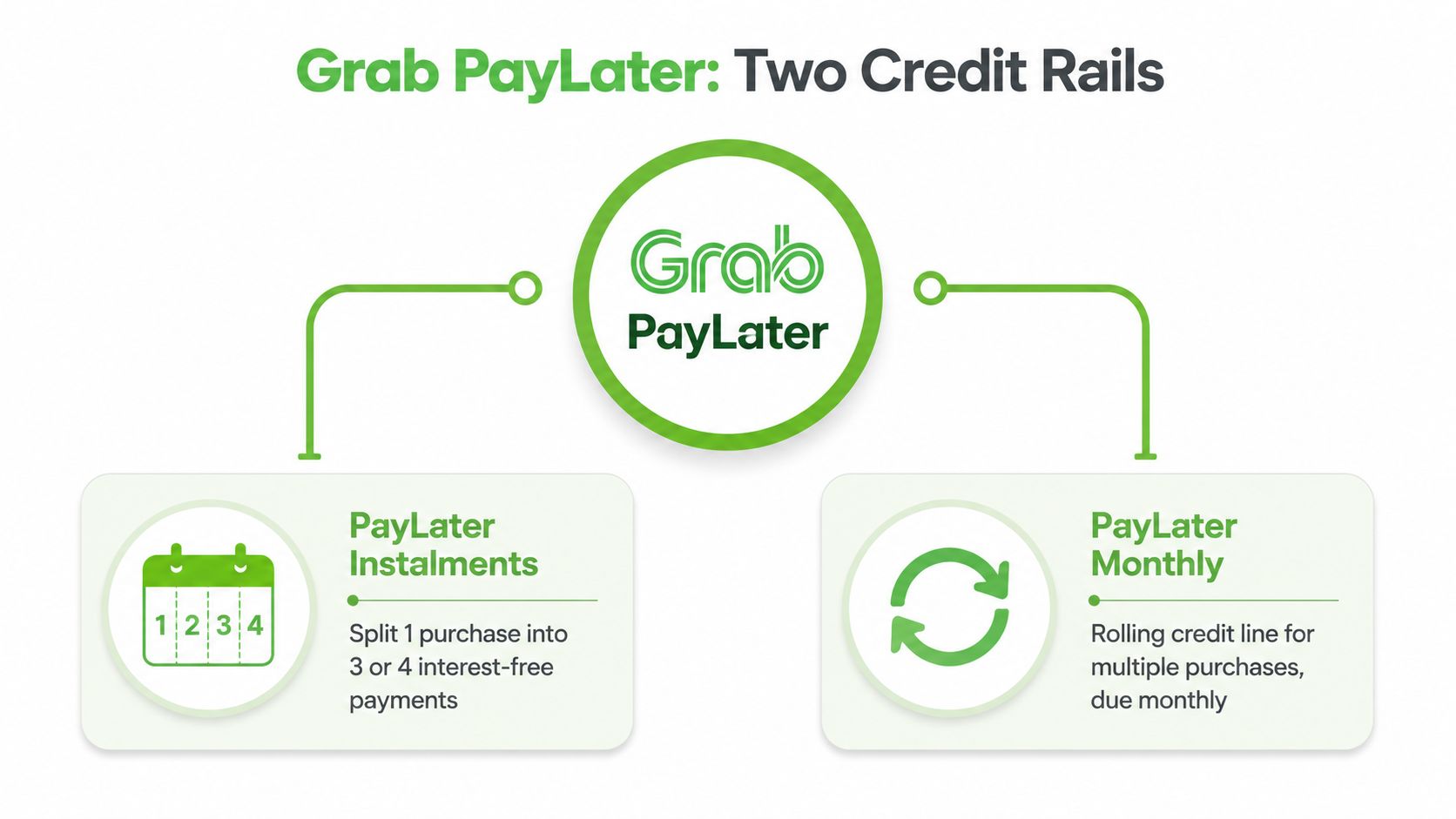
Two rails, two different spending jobs
PayLater Instalments is for a single purchase. In Singapore, Grab's current help page says PayLater Instalments splits a purchase into one upfront payment plus three monthly instalments, and both PayLater Instalments and PayLater Postpaid are advertised as 0% interest when paid on time Grab Help Centre. If you buy a refurbished device, that means you're not paying the whole bill at checkout, you're committing to a set repayment schedule.
PayLater Postpaid works differently. It bundles eligible Grab spending into one bill due the following month, which is useful for recurring services like rides or food orders. That design is easier to understand if you think of it as a short billing window, not a long loan. If you want a useful explanation of why BNPL can increase conversion at checkout, this e-commerce breakdown is a practical read because it shows the merchant-side logic behind deferred payment.
Practical rule: if the purchase is a one-off item, look at instalments. If the spending is already happening inside Grab's ecosystem, Postpaid may be the cleaner fit.
The key takeaway is simple. Interest-free doesn't mean cost-free, and the later sections matter because the fee structure, eligibility rules, and payment discipline decide whether PayLater feels helpful or expensive.
Eligibility Requirements and Activation Process
Grab PayLater doesn't open the same way for everyone. You can be a regular Grab user and still not qualify, because the product is gated by usage history and account profile rather than by app download alone. That surprises people who assume a transport or food-delivery account automatically grants access to every financial feature.
Who can actually activate it
Grab states that users must be at least 21, be a Platinum, Gold, or Silver GrabRewards tier member, and have completed at least three Grab transactions by card or debit card in the recent month before PayLater can be activated Singsaver's summary of Grab's stated criteria. Those gates show a behaviour-based underwriting model, which means the app looks at recent transaction habits and loyalty tier as signals of account standing instead of relying only on a traditional loan application.
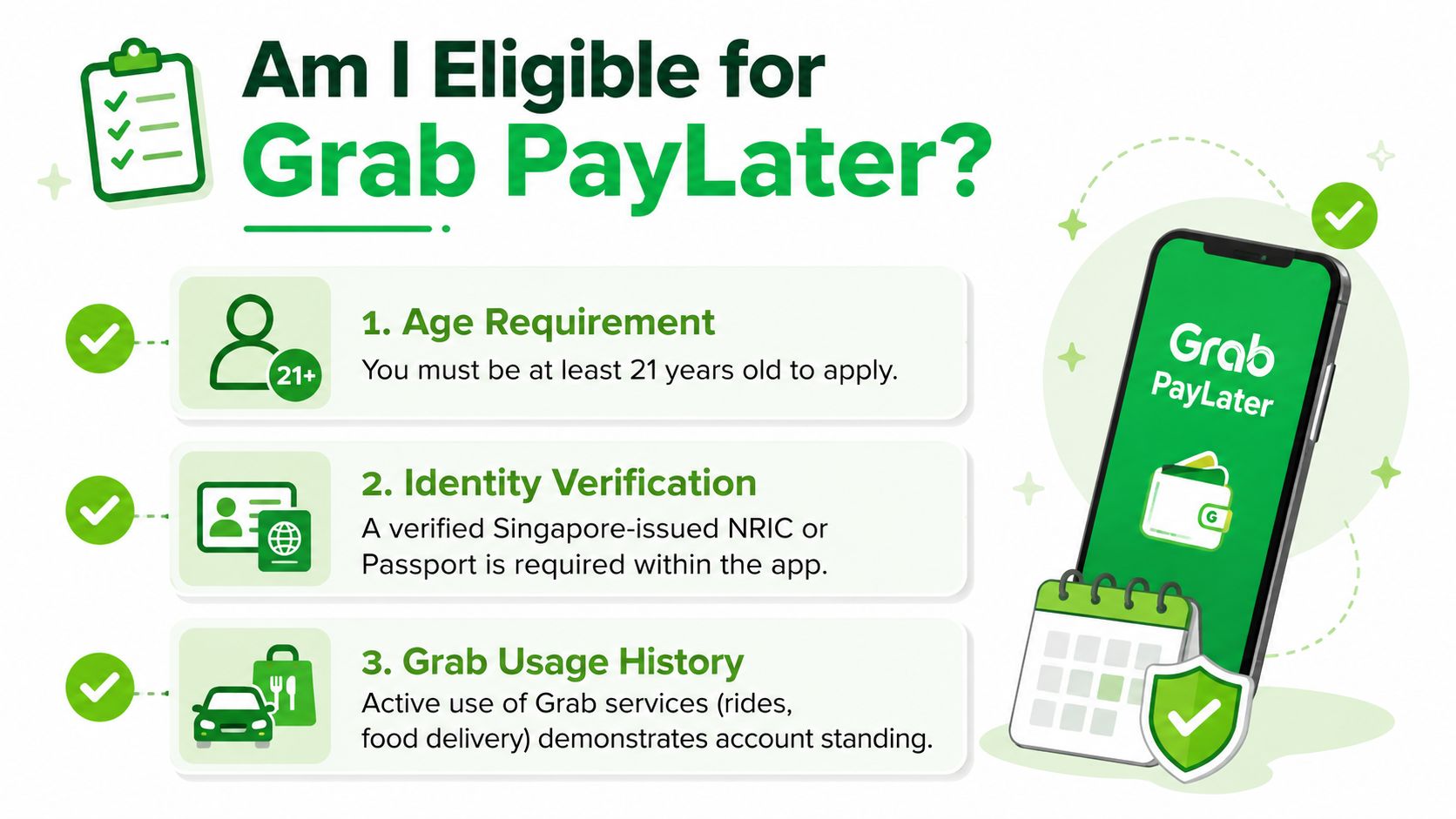
The logic is easy to understand. Someone who pays through the app regularly, keeps a healthy account profile, and uses card or debit card payment methods gives the system more behaviour to assess than someone who mostly transacts outside the Grab ecosystem. If your habits are mostly cash, bank transfer, or PayNow, you may still use Grab every week and yet remain outside the eligible pool.
How to think about activation
The practical route is straightforward.
- Check your account age and tier. If you're below 21, you won't qualify. If your rewards tier hasn't reached the required level, the feature won't activate yet.
- Use card or debit card payment inside Grab. The recent transaction rule matters because it gives Grab the activity history it uses for eligibility.
- Look for the PayLater prompt in-app. If the account meets the rules, the feature appears as an option during checkout or payment setup.
- Treat the feature activation as conditional, not permanent. Behaviour-based products can be sensitive to account changes, so the feature is tied to how you use the app over time.
If you don't qualify yet, the best move is to build normal transaction history rather than forcing a workaround. A user who relies mainly on cash or direct transfers may still get more predictable results from budgeting or debit spending until the app recognises enough activity.
Understanding the True Cost Structure and Fees
“0% interest” sounds simple, but that phrase only covers part of the cost. The amount you end up paying depends on the repayment track you pick, how long you stretch the balance over, and whether you miss a payment. That is where many first-time users get caught, because the cost of convenience often sits in the repayment setup rather than in the headline wording.
What the fee schedule really says
Grab's Singapore fee structure is clear enough to compare. PayLater Postpaid and Pay-in-4 carry no fees, while Pay-in-8 and Pay-in-12 charge 0.75% of the total transaction amount per instalment Grab's fee page. Grab's Help Centre also says each missed payment attracts an admin fee of S$15 inclusive of GST.
A simple way to read that is that the shorter plans are fee-free, while the longer plans trade flexibility for a visible cost. Some payment tools look cheap at first, then become expensive once the repayment timeline stretches out. If you want to compare that kind of small charge across ordinary transfers, the guide to avoiding bank transfer fees helps show how minor costs can build up over routine payments.
| Purchase Amount | Pay-in-4 Total Fee | Pay-in-8 Total Fee | Pay-in-12 Total Fee |
|---|---|---|---|
| S$800 | No fee | Fee applies, based on 0.75% per instalment | Fee applies, based on 0.75% per instalment |
| S$1,500 | No fee | Fee applies, based on 0.75% per instalment | Fee applies, based on 0.75% per instalment |
Why the repayment length matters
A longer plan may feel easier because each payment is smaller, but choosing Pay-in-8 or Pay-in-12 means accepting more fee-bearing instalments. The decision is not just, “Can I handle the monthly amount?” It is also, “Is the extra flexibility worth paying for?”
For a larger electronics purchase, it helps to compare the full repayment path before you confirm. The checkout discussion in myhalo's instalment plan guide is useful for that kind of review, especially if the item is a want rather than a need. If the purchase only works after you stretch it over a longer plan, it is worth checking whether it really belongs in this month's budget.
Useful habit: if a purchase only works when stretched over a longer plan, pause and test whether it belongs in this month's budget at all.
Missed payments matter too. A fee of S$15 may not sound large on its own, but it changes the economics of a “free” plan quickly if you slip more than once. The practical rule is simple, use the fee-free plans when possible, and treat the longer plans as a deliberate financing choice rather than an automatic checkout default.
How Grab PayLater Compares to Other Payment Options
The most helpful way to judge Grab PayLater is to compare it against the tools you already know. A payment method isn't good or bad in the abstract, it's better or worse depending on whether you need flexibility, whether you can clear the balance quickly, and whether you already have cheaper options sitting in your wallet or bank app.
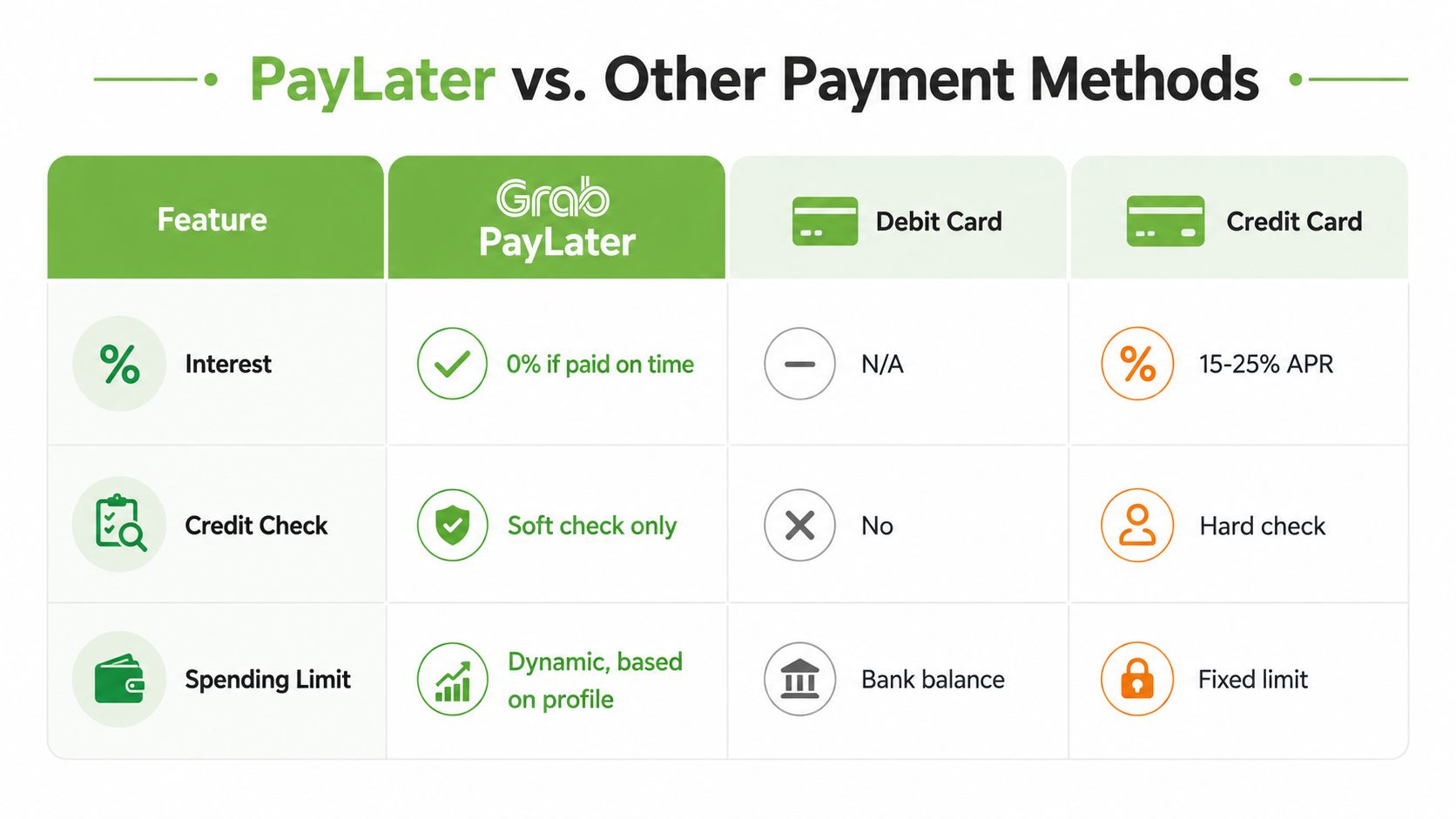
PayLater versus debit cards and savings
A debit card pulls from money you already have, so it keeps spending tied to cash in the bank. That's the main advantage for households that want to avoid debt altogether. If you're buying a laptop from a merchant like myhalo, paying from savings or a debit card is usually the cleanest option when the purchase won't strain your account.
Grab PayLater can still make sense if you need to time the cash outflow around salary day or upcoming expenses. But the benefit only exists if you can comfortably repay on schedule. If not, the flexibility becomes a liability.
PayLater versus credit cards
A credit card may offer broader consumer protections and a fixed card limit, but many users do not want to use their card for every purchase. Grab's Singapore PayLater format is designed around its own ecosystem and merchant acceptance, while credit cards generally work wherever card payments are accepted. That makes PayLater narrower in reach, but sometimes simpler for users who are already in the Grab app.
The key decision point is cost discipline. If you're good at clearing balances, a credit card with a sensible payment habit can be more predictable than extending a BNPL plan. If you're not, PayLater's fixed instalment structure may feel clearer, but only if you keep the number of active plans small.
When PayLater fits and when it doesn't
Grab PayLater is most defensible for planned purchases, such as a device you already intended to buy, or for recurring Grab spending that lands neatly in the next billing cycle. It's a weaker fit for impulse purchases, because deferred payment makes those feel smaller than they really are. For readers comparing instalment options for Apple devices, this iPhone instalment guide is a useful reference point because it encourages you to think about repayment before checkout, not after.
If you prefer video explanations, this walkthrough is a good visual companion to the comparison above.
Where You Can Use Grab PayLater in Singapore
A useful way to judge Grab PayLater is to start with the merchant, not the app. If a store accepts it and the purchase already fits your budget, the tool can work like a payment split that matches your cash flow. If the store does not accept it, or the item was never part of your plan, the feature adds friction without adding real value.
In Singapore, tracked data shows 201 stores using the service, which represents 65.47% of the tracked merchant stores, and estimated monthly sales of US$203.92 million from Singapore merchants, or 99.59% of total tracked sales. That concentration says a lot. Singapore is the core place where Grab PayLater is being used, so it makes sense to treat merchant acceptance as the first filter before anything else.
Merchant acceptance changes how useful the tool feels
For phones, laptops, or accessories, PayLater fits better when you were already planning the purchase. A checkout option does not make a device more necessary, it only changes how you pay for it. That distinction matters, especially for shoppers comparing a newer replacement with a refurbished option, or deciding whether to spread out the cost of a purchase that was already in the budget.
At myhalo, for example, shoppers may see PayLater at checkout while choosing between Certified ReLoved devices, Certified Surplus products, repairs, reuse, or responsible recycling. The partial payment policy matters here because it helps you judge whether splitting the bill still leaves enough room in your monthly spending plan. That kind of checkout only makes sense if the payment plan supports a purchase that already fits your budget and your device needs.
You usually get more out of PayLater when the item is durable, the timing is intentional, and the repayment period lines up with your income cycle. A refurbished laptop for work, a reliable phone for school, or accessories for a team setup can fit that pattern better than a spontaneous buy. The payment tool does not decide whether the item is worthwhile, it only changes when the money leaves your account.
How to spot a better-fit purchase
Look for three signs before you choose it.
- You were already budgeting for it. If the item was on your list before checkout, instalments are more likely to help than hurt.
- The device will be used often. A laptop for classes or work earns its place faster than a novelty buy.
- The merchant gives clear quality information. Transparent grading, battery health disclosure, and warranty terms make it easier to judge whether spreading payment is reasonable.
A payment plan should support the purchase decision, not replace it.
A simple test helps here. If you would still buy the item with a debit card or from savings, and the payment split only makes timing easier, PayLater may fit your spending pattern. If you would hesitate without the instalment option, that is a warning sign that the item may be too easy to justify at checkout.
Consumer behaviour matters too. The Singapore BNPL market is familiar to younger users, with more than 70% of Gen Z people using BNPL in 2024, compared with 47% of millennials, 28% of Gen X, and 13% of baby boomers, as cited in the market coverage used for this brief. That helps explain why PayLater feels normal for some shoppers and unfamiliar for others. The useful question is not whether the feature is popular, but whether it suits your own spending rhythm.
Common Pitfalls and Consumer Protection Gaps
The biggest mistake people make with BNPL is treating it like a convenience layer instead of debt. The payment feels lighter because the amount is split, but the obligation is still real, and it can sit across several purchases at once. That is where users can run into trouble, especially when each checkout screen looks harmless on its own.
The traps that catch users first
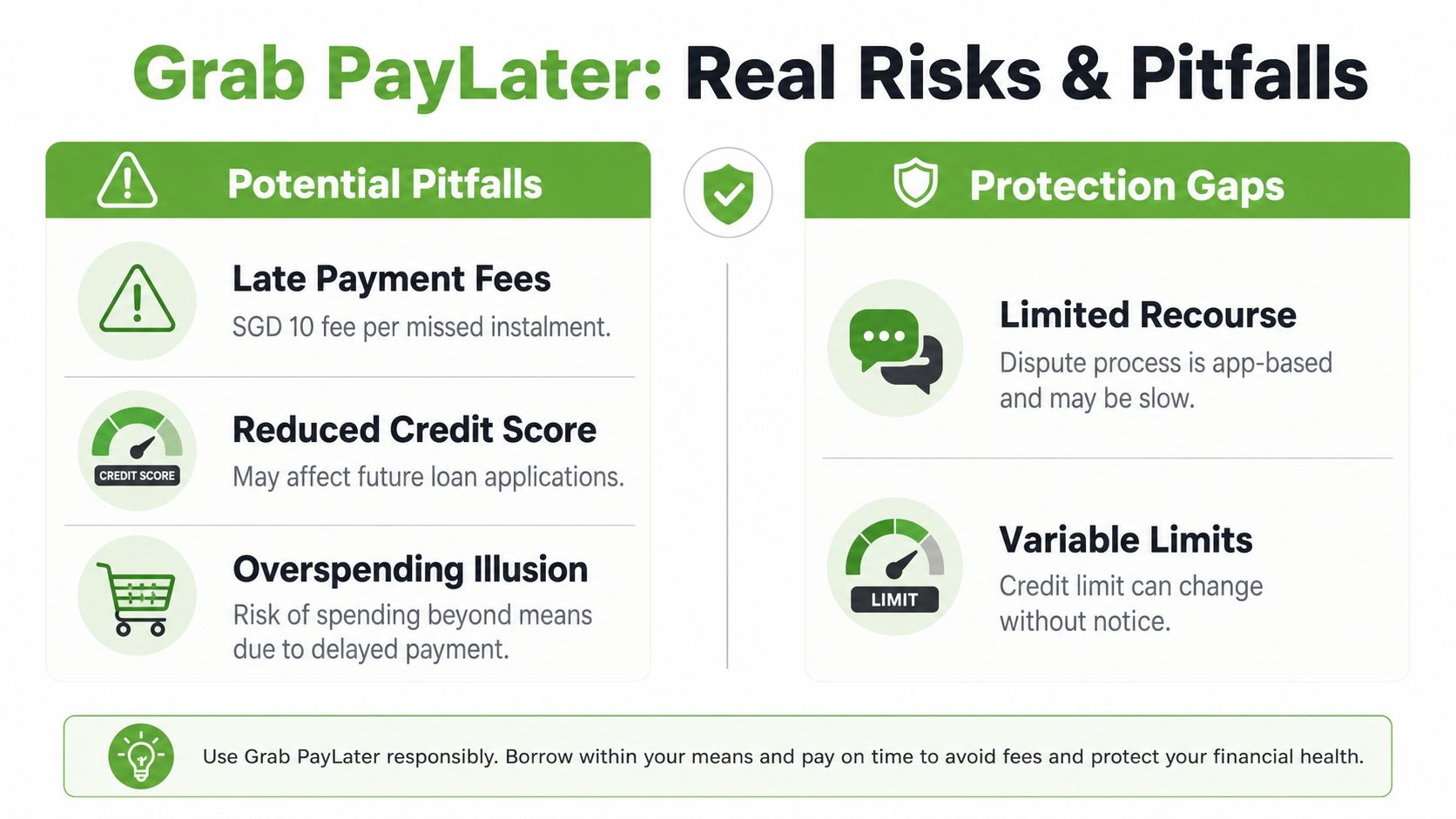
One risk is basic arithmetic. If a payment is missed, the admin fee can quickly make a small purchase more expensive than it looked at checkout. Another risk is behavioural, because splitting several purchases can make monthly commitments harder to track. By the time the second or third instalment arrives, the original item may already feel paid off in your head, even though your bank balance says otherwise.
There is also a protection gap compared with some traditional payment tools. BNPL dispute handling usually sits inside the app and the merchant process, so it can feel less direct than the chargeback flow many card users know. That matters if an item arrives faulty, the billing details do not match, or you need time to sort out a return. In those situations, the path to a fix may depend more on the platform's rules than on the payment method itself. For sellers that spell out how partial payments are handled, myhalo's partial payment policy is a useful reference before you commit to a device purchase.
When to stop using it
If you are using PayLater to bridge ordinary spending instead of to manage a planned purchase, that is a warning sign. If a new instalment plan only works because another payment is due next week, the structure has stopped helping and started adding pressure. The safer move is to slow down, clear the active balance, and buy the next item only when it fits the cash you already have.
For buyers who want to understand how repayment rules affect their options, it helps to read the policy details before committing. Clear terms make it easier to compare whether a split payment is better than paying with a debit card, a credit card, or savings, especially for purchases where timing matters more than the item itself.
Bottom line: delayed payment is still payment. If you would not buy the item with cash today, instalments probably will not change the real affordability.
Practical Tips for Responsible PayLater Usage
The safest way to use Grab PayLater is to treat it like a budgeting tool, not a spending boost. Start with the repayment date, then check whether your next salary, savings buffer, or existing obligations can cover it without stress. If you can't see the money leaving your account twice, the plan is probably too tight already.
A simple decision rule
Before you confirm any PayLater purchase, ask three questions.
- Would I still buy this if instalments weren't available? If the answer is no, pause.
- Can I cover every scheduled payment without dipping into emergency savings? If the answer is uncertain, choose a smaller purchase or skip it.
- Does the repayment period match the item's useful life? A device you'll use for work or study can justify a clearer financing plan than a short-lived impulse buy.
If you're weighing a tech purchase, consider merchants that support repair, reuse, Certified ReLoved devices, Certified Surplus products, and responsible recycling. That approach extends device lifespan, keeps value circulating longer, and helps you use your budget more efficiently over time. For SMEs and households alike, the practical benefit is better resource use, lower replacement pressure, and fewer rushed upgrades.
Keep one rule in mind, instalments should make a planned purchase manageable, not turn a small gap into a rolling habit.
A final check helps too. If your income varies month to month, keep a buffer for at least one scheduled payment before taking on another plan. If you already have several commitments running, pay the existing ones down first. The goal is not to avoid every flexible payment tool, it's to use them only when they support a clear plan.
If you're comparing tech purchases and want a clearer view of device condition, warranty, and repayment-friendly options, visit myhalo to explore refurbished and surplus devices with transparent product information. It's a practical way to match the right device with the right payment approach, without taking on more cost than you intended.