




Apple Refurbished iPhone: SG Buyer's Guide 2026
You're probably in the same position as many buyers in Singapore right now. You want an iPhone, but the jump from “I need a phone” to “I'm about to pay flagship money” feels hard to justify, especially when a lot of daily use is the same: messaging, banking, photos, maps, work apps, and the occasional battery anxiety at the wrong time.
That's where the apple refurbished iphone conversation gets interesting. For local buyers, this isn't just about spending less. It's about getting into the Apple ecosystem with less risk than a random second-hand deal, while still keeping standards around reliability, support, and day-to-day usability. The details matter more in Singapore because buyers here tend to compare carefully, move fast on deals, and expect the device to work properly from day one.
Table of Contents
- The Smart Way to Own an iPhone in Singapore
- What Does Refurbished iPhone Really Mean
- Apple Certified vs Third-Party Refurbished A Comparison
- Decoding Refurbished iPhone Grades in Singapore
- Choosing the Right Refurbished iPhone Model
- Your Pre-Purchase and Setup Checklist
- Why Choose myhalo for Your Refurbished iPhone
The Smart Way to Own an iPhone in Singapore
A lot of people start with the same assumption. If a new iPhone costs more than they're comfortable paying, the only alternatives are to settle for an older used phone from a marketplace seller or give up on Apple entirely.
That's too narrow a view.
A refurbished iPhone sits in the middle. It gives you a lower-cost route into the Apple ecosystem without forcing you into the uncertainty that comes with a purely person-to-person sale. That matters because Apple's refurbished iPhone business isn't an afterthought. Harvard Business School Working Knowledge notes that refurbished iPhones help open lower-priced entry points into Apple's ecosystem, especially for buyers who may not purchase a new flagship, while also creating a second path for Apple to monetise services such as music, news, and gaming through those devices. You can read that context in Harvard Business School's discussion of Apple's refurbished iPhone strategy.
In practical terms, that means refurbished iPhones are part of a real market with real demand. They aren't just leftovers. Buyers in Singapore feel that immediately because the local market is crowded with options: official refurbished stock, used sets from individuals, retailer-refurbished units, and trade-in devices that re-enter circulation after inspection. If you're upgrading from an older iPhone, it's also worth understanding your current device's value before you buy. A quick read on how iPhone trade-ins work in Singapore can help you offset the cost of the next phone.
Why refurbished makes sense locally
Singapore buyers usually care about three things at once:
- Price discipline: You want savings, but not if the phone becomes a headache a week later.
- Low friction: Delivery, warranty, exchange policy, and setup support matter more than many people admit.
- Resale awareness: Many buyers already think one upgrade ahead.
That's why refurbished often works well here. It's not just the sticker price. It's the balance between spend and certainty.
Practical rule: If the deal only looks good because key details are missing, it isn't a good deal.
What usually goes wrong
The biggest mistakes are predictable. Buyers chase the lowest listing, ignore battery condition, assume “used” and “refurbished” mean the same thing, and only ask about warranty after payment. A cheaper phone can still cost more if you need repairs, a replacement battery, or time spent dealing with a seller who disappears.
The smart move is simpler. Decide your budget first, then compare based on condition, support, and model generation. That's how you save money without buying trouble.
What Does Refurbished iPhone Really Mean
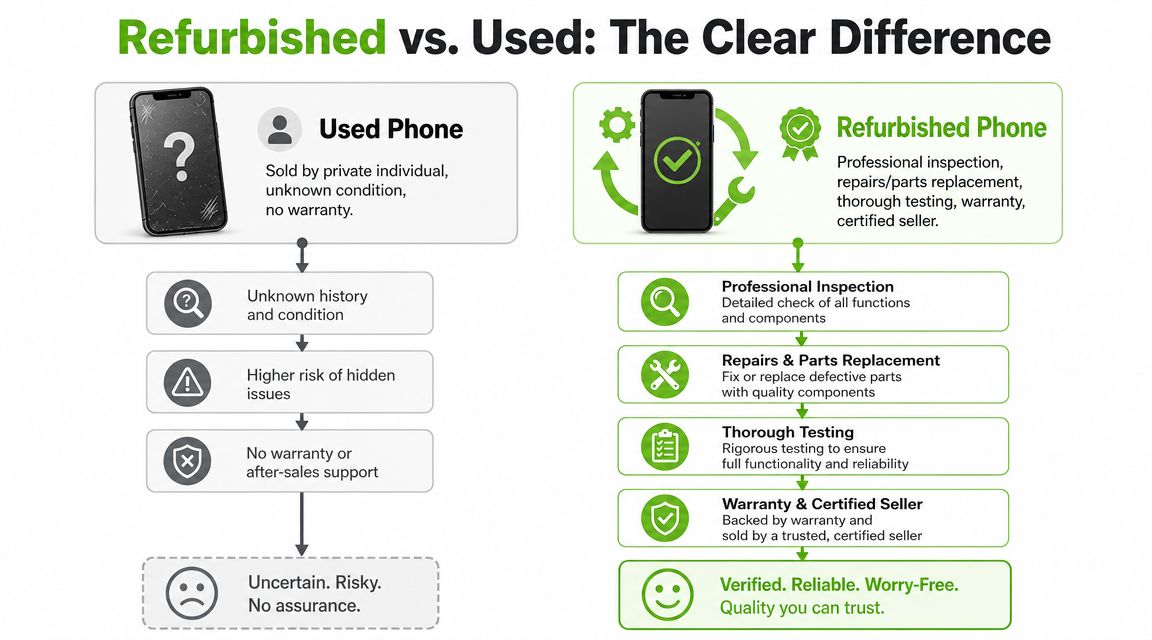
A used iPhone and a refurbished iPhone can look similar in a listing photo, but they're not the same product.
The easiest way to think about it is a certified pre-owned car versus a car sold by a private owner. Both may drive. Only one usually comes with an inspection standard, documented checks, and some form of after-sales protection. That same distinction matters when you're shopping for an apple refurbished iphone in Singapore.
Used is not the same as refurbished
A used phone sold by a private individual usually comes with limited visibility. You might get a decent device from a careful owner. You might also get a phone with hidden issues, weak battery life, replacement parts of unclear quality, or activation problems that only appear later.
A refurbished phone should mean the seller has already done the verification work for you.
That includes checks on functionality, condition, and readiness for the next owner. A proper refurbisher doesn't just wipe the phone and relist it. The whole point is to reduce uncertainty before the phone reaches you.
Later in the buying process, the difference becomes even clearer:
- With a used phone: You often inherit the seller's habits, wear, and unresolved issues.
- With a refurbished phone: You're paying for process, screening, and accountability.
- With a poor-quality “refurbished” phone: You get marketplace risk with retailer pricing.
What a proper refurbishment process should include
The exact workflow varies by seller, but the standard should be easy to understand. At minimum, look for these signs:
- Functional testing: The seller should verify the core hardware works properly, including screen response, cameras, speakers, charging, buttons, and connectivity.
- Cleaning and reset: The phone should be professionally cleaned, securely wiped, and prepared for a new user.
- Repairs where needed: If a part needs replacement, the seller should be clear about that and stand behind the device after sale.
- Warranty or exchange support: This is what separates a retail transaction from a gamble.
A short visual helps if you're comparing options side by side.
Buying refurbished should remove guesswork. If the seller can't explain their process plainly, assume the process isn't strong enough.
The term “refurbished” gets overused in online listings. Some sellers use it to mean “we cleaned it”. That isn't enough. In Singapore, where buyers often compare listings across marketplaces, social sellers, and retail stores in the same afternoon, you need to read beyond the headline and look at the standards behind the phone.
Apple Certified vs Third-Party Refurbished A Comparison
This is the fork in the road for most buyers. Do you buy from Apple's official refurbished channel, or do you buy from a third-party retailer in Singapore?
Apple's programme is the benchmark because Apple defines exactly what its certified refurbished products include. Apple says every Apple Certified Refurbished product goes through full functional testing, uses genuine Apple parts where needed, and for iOS devices includes a new battery and a new outer shell. Apple also says these products are packaged in a new white box and come with a one-year warranty, which you can verify on Apple's explanation of its certified refurbished standards.
What Apple sets as the benchmark
Apple's offer is straightforward. You get strong process control, a warranty-backed purchase, and clarity around what “refurbished” means under Apple's own system.
That's valuable for buyers who want the official route and don't mind paying closer to Apple-level pricing. It's also useful if you care a lot about original presentation, official packaging, and knowing the refurbishment standard came directly from the manufacturer.
But there are trade-offs. Apple's refurbished range can be limited by model and stock, and its pricing doesn't always create a large gap versus buying new. In practice, many Singapore buyers compare official refurbished pricing against local retailer stock and decide the small difference isn't enough to justify the narrower selection.
Where local third-party sellers fit
Third-party refurbished is a wide category. Some sellers are careful and transparent. Others are just moving inventory.
A reliable local retailer should close the gap between low-trust marketplaces and higher-priced official stock. That means clear grading, written warranty terms, visible return or exchange policies, and a consistent inspection process. In Singapore, that often makes more sense than chasing the official label alone.
One local example is myhalo, which sells professionally refurbished iPhones with transparent grading, warranty coverage, a hassle-free exchange policy, and a stated quality-check process. That kind of structure matters more than marketing language because it gives buyers something concrete to verify.
| Attribute | Apple Certified Refurbished | myhalo (Trusted Retailer) | Marketplace Seller (e.g. Carousell) |
|---|---|---|---|
| Refurbishment standard | Defined by Apple | Defined by retailer and should be stated clearly | Usually unclear or varies by individual |
| Battery and exterior reset | Apple states iOS devices include a new battery and outer shell | Depends on seller policy and listing transparency | Usually no standard promise |
| Warranty | Apple states a one-year warranty | Depends on retailer's written terms | Often none or informal |
| Cosmetic grading | Usually less of a buyer-facing issue because Apple standardises presentation | Often an important part of the buying decision | Usually subjective |
| Model availability | Can be limited by stock | Often broader in local resale cycles | Wide, but inconsistent |
| Buying risk | Lower | Moderate to low if seller is transparent | Higher |
Pay attention to what's written before payment. A trustworthy seller doesn't hide behind vague terms like “good condition” or “tested okay”.
If you want the safest official route, Apple's programme is the reference point. If you want stronger local value, the answer usually depends on the retailer's transparency, not the word “refurbished” alone.
Decoding Refurbished iPhone Grades in Singapore
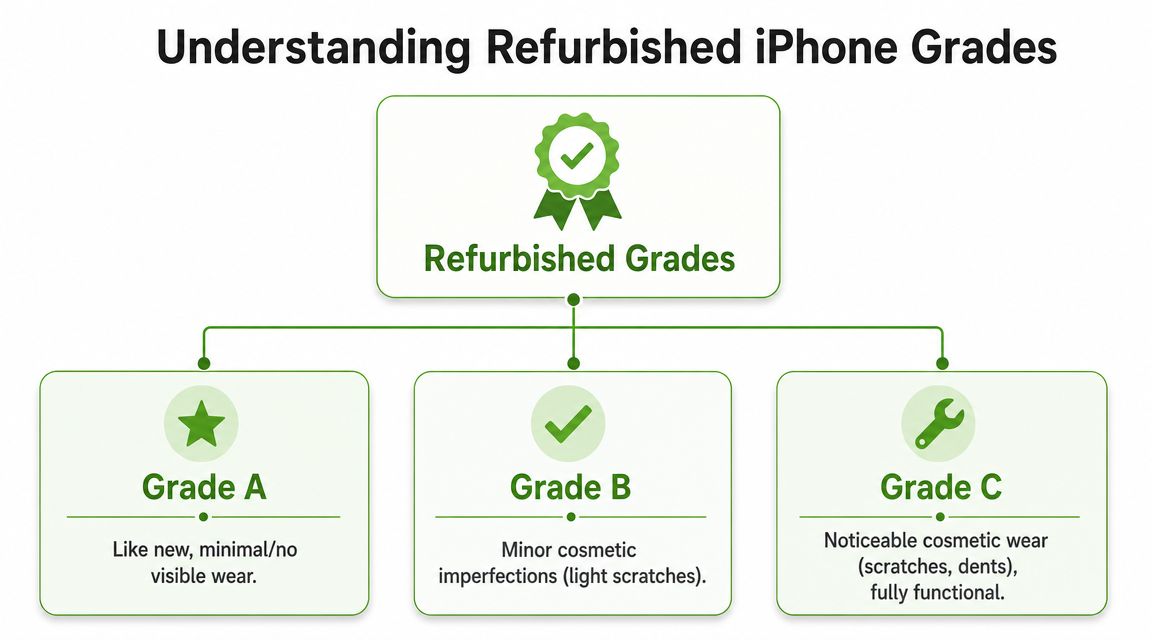
A lot of disappointment in refurbished purchases comes from one simple problem. The buyer and seller use the same grade label but imagine different things.
One person sees “excellent condition” and expects a pristine phone. Another seller means “screen is good, frame has visible wear”. That gap causes most of the friction. So when you compare a refurbished iPhone in Singapore, don't treat grades as universal. Treat them as seller-specific and read the definitions.
How to read grades without guessing
A useful grading system should answer one question clearly: what will the phone look like in your hand, not just in the listing title?
Here's the practical way to interpret common grade logic in Singapore:
- As-New: Suitable for buyers who care a lot about appearance and want something close to a near-pristine experience. This is usually the right pick for gifting, professional use, or anyone who gets annoyed by visible wear.
- Premium or Excellent tiers: Good for buyers who want strong value without obvious cosmetic damage affecting the overall feel of the device.
- Value tier: Often the sweet spot for practical users. You accept more visible marks, but you still expect the phone to work properly.
- Lower cosmetic tiers: Best for people who prioritise function and price over looks. These can make sense for a spare phone, student use, or work-only deployment.
The key isn't the label itself. The key is whether the seller defines that label in plain language.
A practical way to match grade to budget
Most buyers shouldn't aim for the highest cosmetic grade by default. They should buy according to use case.
Consider these buyer profiles:
| Buyer type | What usually matters most | Grade direction |
|---|---|---|
| First-time iPhone user | Value and reliability | Mid-tier grade |
| Student | Function over cosmetic perfection | Value-focused grade |
| Corporate or client-facing user | Appearance and confidence | Higher cosmetic grade |
| Parent buying for teen | Durability, support, sensible spend | Mid or lower cosmetic grade |
| Secondary phone user | Lowest practical cost | Lower cosmetic grade |
Cosmetic wear is fine. Surprise cosmetic wear isn't.
That's why transparent grading matters. If a seller uses names like As-New, ReLoved, or ReEco, the naming only helps when each tier has a clearly described standard behind it. Singapore buyers tend to be comfortable with minor marks if the savings are fair and the device is fully functional. What they don't tolerate well is ambiguity.
Ask for specifics before you buy. Are scratches limited to the frame? Is the screen clean? Are dents acceptable under that grade? The more direct the answers, the safer the purchase.
Choosing the Right Refurbished iPhone Model
The wrong way to buy a refurbished iPhone is to sort by lowest price and stop there.
The better approach is to ask how long you need the phone to stay comfortable to use. A very old iPhone may still power on, run apps, and look tempting on price, but that doesn't automatically make it good value. In Singapore, where people rely heavily on mobile banking, transport apps, work chat, video calls, and strong network performance, model generation matters a lot.
Why generation matters more than refurbished status
A refurbished phone doesn't lose its original chipset just because it was refurbished. The performance question is about the model generation, not whether the device was new or refurbished.
Apple's refurbished iPhone listings show this clearly. For example, a refurbished iPhone 15 Pro still carries the A17 Pro chip, ProMotion display, and advanced 5G support, while the iPhone 15 line keeps modern connectivity features such as Wi‑Fi 6 or 6E, Bluetooth 5.3, Ultra Wideband, NFC, and 5G support. Apple's refurbished listing for this class of device shows why those models remain technically strong for dense, fast-moving usage environments like Singapore. You can review that hardware context on Apple's refurbished iPhone 15 Pro product listing.
That's why a refurbished iPhone from a recent generation often gives the best balance. You're still getting modern silicon, camera processing, efficient radios, and current-day responsiveness without paying current flagship pricing.
Which type of buyer fits which model
You don't need the most expensive model to buy well.
- Base model buyers: If your priorities are messaging, payments, social apps, video, and reliable daily use, a recent base model usually gives the strongest value.
- Pro model buyers: If you shoot a lot of photos or videos, prefer smoother display response, or keep phones longer, a Pro model can be worth the premium.
- Older flagship buyers: Sometimes an older Pro is a better buy than a newer base model, but only if the condition and support terms still make sense.
A lot of buyers in Singapore do well by targeting the sweet spot rather than the bottom of the market. If you're weighing broader second-hand options before narrowing down, this guide on how to buy a second-hand iPhone in Singapore is a useful companion.
Don't buy based on age alone. Buy based on how the model fits your next few years of use.
Your Pre-Purchase and Setup Checklist
A refurbished iPhone should feel predictable before and after payment. If you need to chase the seller for basic answers, that's already a warning sign.
Use a short checklist and keep it practical.
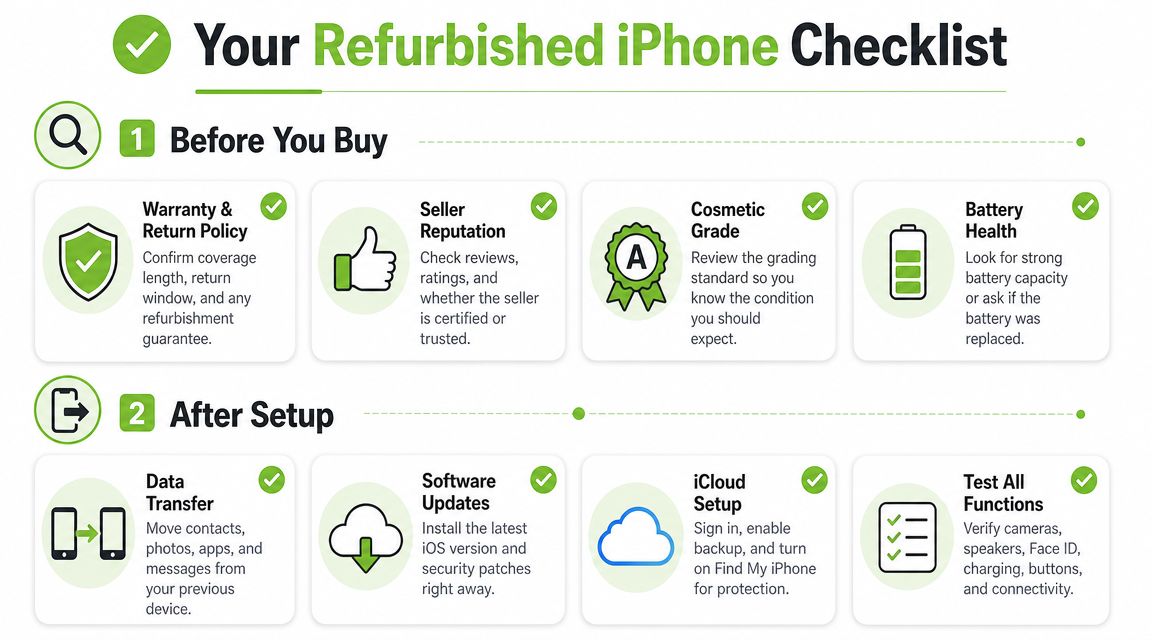
Before you pay
Check these first:
- Warranty terms: Read what is covered. Don't assume “shop warranty” means much unless the terms are written clearly.
- Return or exchange policy: A proper return window reduces risk, especially for online orders.
- Grade description: Make sure the cosmetic condition is defined in concrete terms.
- Battery information: If the seller doesn't state any battery standard or cannot answer clearly, pause.
- Seller reputation: Look for consistency in how they present stock, answer questions, and handle after-sales issues.
If you want a fuller list to compare against before checkout, see things to look out for before buying a refurbished phone.
When the phone arrives
Give yourself ten minutes and check the basics before you settle in.
- Inspect the exterior. Compare the phone against the grade you purchased.
- Test the screen. Look for dead spots, strange brightness behaviour, or touch issues.
- Press every button. Volume, power, mute switch or Action button should all feel normal.
- Open the camera app. Test front and rear cameras, focus, flash, and video.
- Check charging and speakers. Plug in a cable, then test calls, media, and microphone.
- Review battery health in settings. This doesn't tell you everything, but it helps catch surprises early.
- Confirm activation and account status. Make sure there's no lock or setup issue.
If something feels off on day one, report it immediately. Waiting only weakens your position.
Don't overcomplicate setup. Update iOS, sign in to iCloud, restore your data, test the essentials, and keep all packaging and proof of purchase until you're fully satisfied.
Why Choose myhalo for Your Refurbished iPhone
For a Singapore buyer, the appeal is straightforward. You want a phone that matches its description, a process that doesn't feel shady, and support you can use if something goes wrong.
That's where a structured local retailer can make sense. Based on the publisher information provided, myhalo offers refurbished iPhones with a transparent grading system, warranties tied to device categories, a 14-day hassle-free exchange, and devices that go through 30 quality checks under an ISO 9001:2015-certified process. It also offers practical local conveniences such as trade-ins, delivery options, instalment plans, and a physical Bugis Junction store for buyers who prefer face-to-face support.
Why that matters in real buying decisions
A good refurbished purchase usually comes down to four things:
- Trust: You need an accountable seller, not just a listing.
- Transparency: Cosmetic grade, warranty, and device status should be clear before payment.
- Protection: Exchange support matters because even well-checked devices can still raise questions once they're in your hand.
- Value: Savings only count if the phone is reliable enough to avoid follow-up costs.
Those are practical criteria, not marketing points. If a seller can satisfy them consistently, they're worth considering. If they can't, move on.
Who this suits best
myhalo is a sensible fit for buyers who want local support and don't want to rely on a private marketplace seller. It also suits buyers who want to compare several iPhone generations, cosmetic grades, and budget levels in one place instead of piecing that together from scattered listings.
If your goal is simple, buy an iPhone at a better price without getting burned, then a retailer with visible grading, written policies, and after-sales structure is usually the safer route.
If you're comparing options now, browse myhalo for refurbished iPhones, grading details, and local support policies before you decide. It's a practical way to compare condition, warranty, and value in one place instead of guessing from marketplace listings.