





Apple Battery Replacement Singapore: 2026 Expert Guide
Your iPhone used to last all day. Now it drops fast, gets warm, slows down at awkward moments, and spends more time on a charger than in your hand. That’s usually the point where people start searching for apple battery replacement singapore and trying to work out whether the battery is the problem, how much the fix should cost, and which repair route is worth trusting.
The good news is that battery issues are usually straightforward if you diagnose them properly and choose the repair path based on your priorities. Cost matters. So do part quality, warranty impact, turnaround time, and whether you want to keep the phone for another year or longer instead of replacing it early.
Table of Contents
Is It Time for a New Battery
If your phone dies at 20%, shuts down during video calls, or only feels safe when a power bank is nearby, don’t guess. Check the battery first.
Start with Battery Health
On supported iPhones, go to Settings > Battery > Battery Health & Charging. The number that matters most is Maximum Capacity. That figure tells you how much charge the battery can still hold compared with when it was new.
Apple’s official diagnostic threshold for battery replacement is below 80% of original capacity, and lithium-ion batteries typically lose around 20% capacity after 500 full charge cycles under optimal conditions, according to this battery replacement reference for Singapore users. In local conditions, heat can make battery ageing feel worse in daily use.
That number matters because daily runtime drops with it. A battery at lower health doesn’t suddenly fail all at once. It becomes less predictable. You start seeing shorter endurance, sharper drops in percentage, and more stress under tasks like navigation, gaming, hotspot use, or video recording.
Practical rule: If Battery Health is below 80%, or your iPhone shows a service warning, stop treating it as “normal ageing” and start treating it as a battery job.
Signs that point to replacement
Battery Health is the first check, but it isn’t the only one. In the workshop, the strongest replacement cases usually combine a low health reading with one or more real-world symptoms:
- Fast drain during ordinary use. Messaging, browsing, and music shouldn’t feel like heavy-load tasks.
- Unexpected shutdowns. If the phone powers off before reaching low single digits, the battery may no longer deliver stable output.
- Performance dips. Sluggish opening, stutter under camera use, or lag when the battery is low can all point to a tired cell.
- Service notification. If iOS says the battery needs service, pay attention.
- Constant charging habits. If you’re topping up several times a day just to get through normal use, the battery has already changed how you use the phone.
Signs that are often mistaken for battery failure
Not every charging complaint is a battery problem. A dirty charging port, a failing cable, a weak adapter, or background app activity can mimic battery trouble. If the phone charges only when the cable sits at an angle, inspect the port first. If the battery percentage is stable but charging is erratic, test with another cable and adapter before booking a replacement.
A good technician should separate battery degradation from charging-path issues instead of swapping parts blindly.
Official Apple Service vs Third-Party Repairers
The choice is not just Apple versus non-Apple. It is how much certainty, speed, and cost you want to trade for one another once the phone is already due for a battery.
What you get from official service
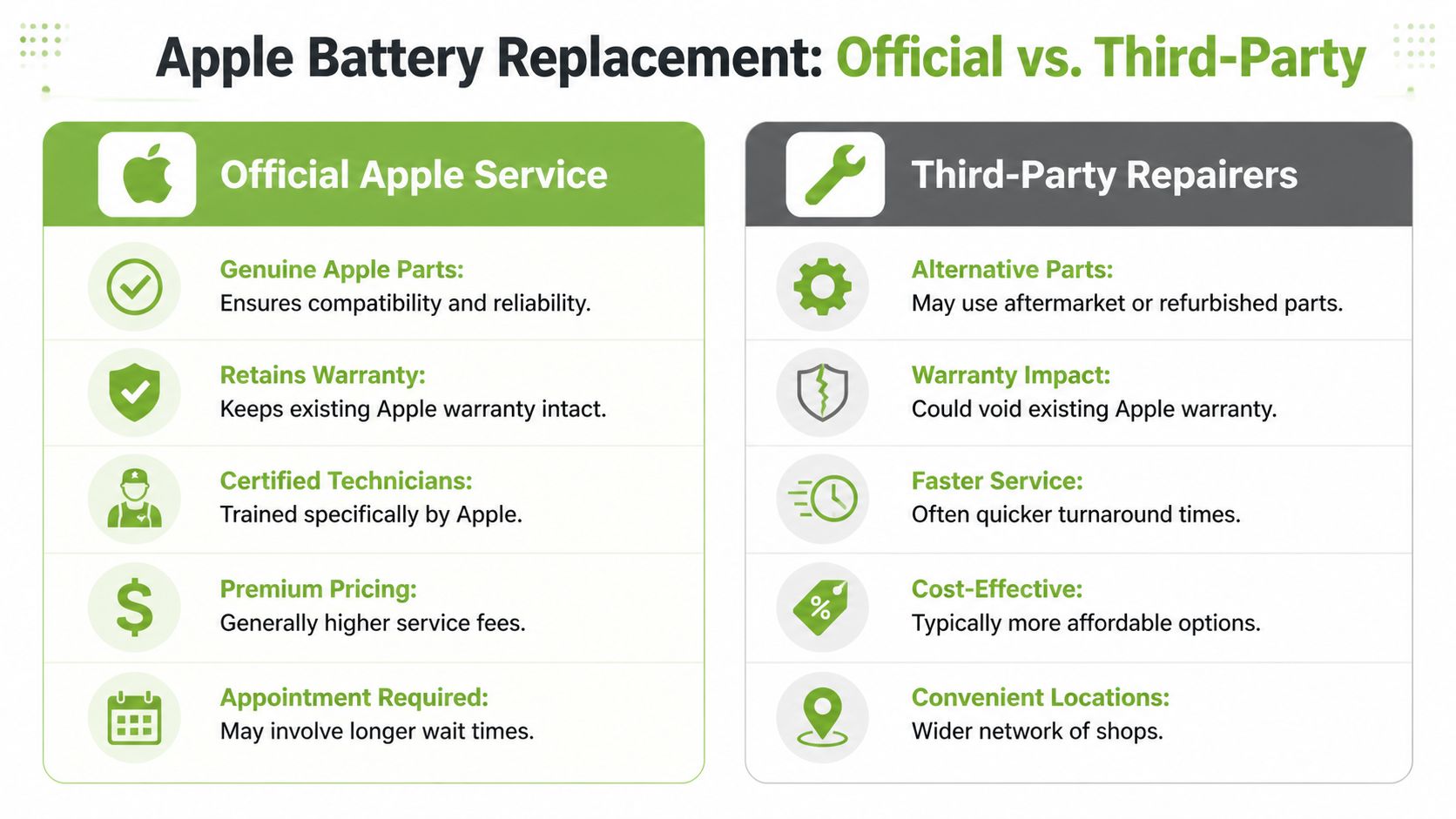
Apple and Apple Authorised Service Providers follow a controlled process. That usually means genuine Apple parts, standardised checks, and the lowest risk if your iPhone is still under Apple warranty or you want to keep everything within Apple's official repair network.
That route suits owners who care more about manufacturer alignment than turnaround time or price. In practice, it is the conservative option. You book in, wait your turn, and pay the official rate for the documentation and parts chain that come with it.
Paperwork matters too. For company phones, insurance claims, or staff reimbursements, proof of purchase can save time before service starts. A practical reference for that is downloading Apple invoices.
Where third-party repair makes sense
Independent repairers make the most sense when the phone is out of warranty and you want a sensible repair bill without replacing the device early. The best shops are upfront about battery quality, testing, warranty terms, and whether any battery message may remain after installation on newer models.
Speed is often the biggest difference. Many independent shops can complete a battery job much faster than an official booking flow, which matters if this is your daily phone and you cannot leave it in service for long.
The risk is uneven quality. One shop may fit a high-grade battery and test charging, health reporting, and current draw properly. Another may offer a lower price because it skips those checks or uses a weaker cell.
Here is the practical comparison:
| Factor | Official Apple or ASP | Independent repairer |
|---|---|---|
| Parts | Genuine Apple parts | Varies by provider |
| Cost | Usually higher | Usually lower |
| Warranty impact | Best if preserving Apple coverage matters | Can affect remaining Apple coverage |
| Turnaround | Depends on booking and service flow | Often faster for walk-in jobs |
| Aftercare | Standard Apple process | Depends on the shop's testing and warranty |
A careful independent repair is often the better value move for an older iPhone. An official repair is usually the safer call for newer devices, covered devices, or owners who do not want any compromise on part origin or service route.
If you are still comparing your options, this guide to Apple service centre options in Singapore helps clarify where Apple Store and authorised support fit before you decide.
Navigating the Third-Party Repair Landscape
“Third-party” sounds like one category. It isn’t. There’s a big gap between a careful independent shop and a counter that only competes on speed and price.
Not all replacement batteries are equal
The biggest quality difference usually sits inside the phone where you can’t see it. Some shops fit Grade A batteries that perform similarly to original Apple batteries in normal use. Others use lower-grade units that may start out with noticeably less usable capacity.
In practice, that means two phones can both come back with a “new battery” and still behave very differently. A stronger battery feels stable through the day, holds voltage more consistently, and gives a more predictable Battery Health reading after replacement. A weaker unit may still solve the immediate shutdown problem, but it often won’t feel like a proper reset of the phone’s endurance.
One useful rule is this: if a shop only talks about price and speed, and avoids talking about battery grade, that’s a warning sign.
Questions worth asking before you agree
Before handing over your iPhone, ask direct questions. A reliable shop should answer them without dodging.
- What battery grade are you installing? Ask whether it’s a high-grade equivalent or a cheaper lower-grade part.
- What warranty do you give on the battery? If the answer is vague, assume the aftercare will be vague too.
- Will you test Battery Health after replacement? You want the phone checked, not just closed up and returned.
- How do you handle calibration or post-repair checks? Good repair doesn’t end when the adhesive is sealed.
- Have you worked on this model often? Repair experience matters more on newer devices and tight internal layouts.
A proper shop should also tell you what won’t improve after a battery swap. A new battery won’t fix a damaged charging port, a swollen frame, liquid damage, or a board fault. Honest diagnosis is worth more than a cheap quote.
Ask the shop to explain the part quality in plain language. If they can’t do that before payment, don’t expect clarity after the repair.
For broader context on how to evaluate a repair provider, this article on mobile phone repair in Singapore is a useful read.
The Step-by-Step Replacement Journey
Good battery service should feel routine, not risky. Most customer anxiety comes from not knowing what happens once the phone leaves their hand.
In Singapore, customers expect clear process and efficient turnaround. That expectation didn’t appear by accident. In 2018, after the Batterygate controversy, Apple replaced around 11 million iPhone batteries globally, nearly 11 times the typical annual amount, according to this report on Apple’s replacement surge. Since then, people have expected battery service to be transparent, fast, and easy to verify.
Before you hand over the phone
Start with your own prep. Do these first:
- Back up your data to iCloud or a computer.
- Check Battery Health and note what it says before repair.
- Remove your case and screen protector only if the shop asks.
- Know your Apple ID password in case settings need to be changed.
- Ask about turnaround time before you commit.
Most battery replacements are straightforward, but backup is still essential. A good repair shop protects the device. A careful owner protects the data.
What happens during the repair
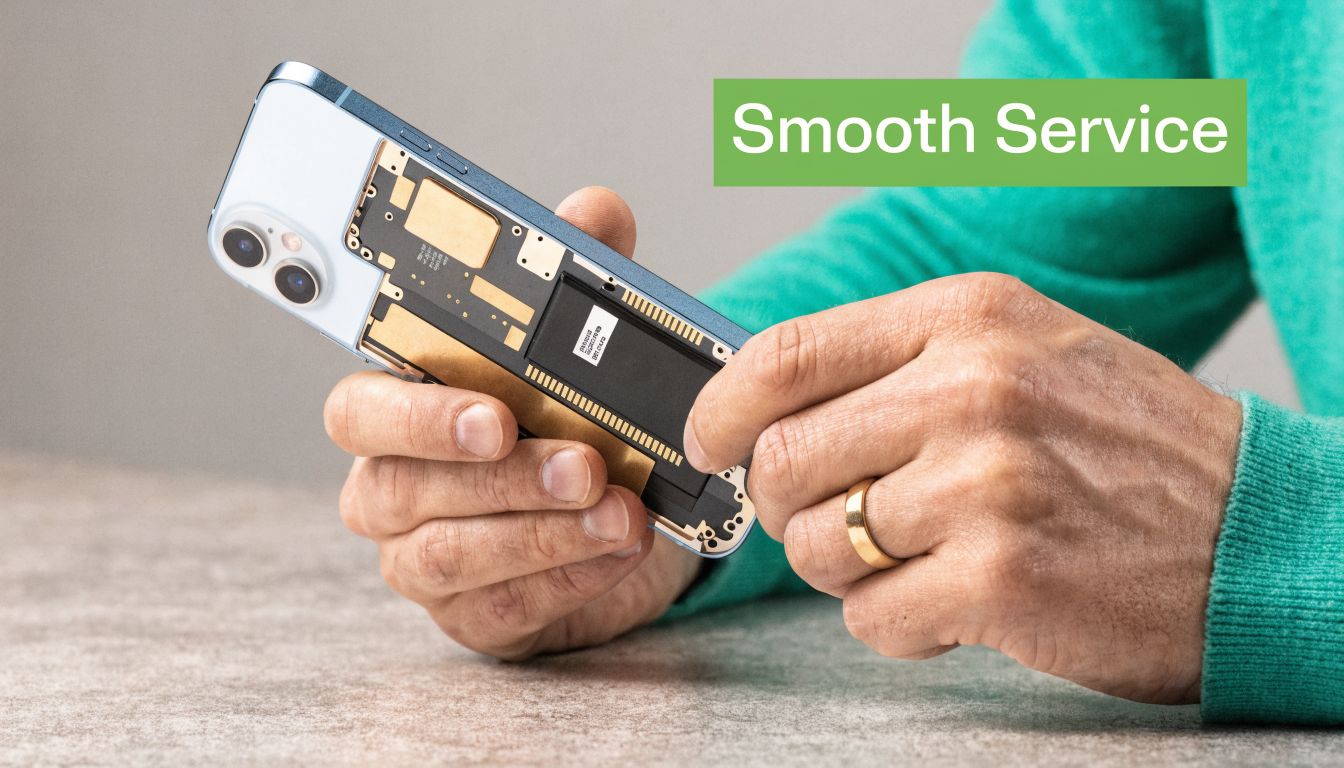
For a standard walk-in battery job, the phone is inspected, opened, the old battery is removed, the replacement is fitted, and the device is tested before handover. A professional service will also check charging behaviour and confirm the battery reads correctly in iOS after installation.
Typical turnaround in real shop conditions is 1 to 2 hours depending on the model and workflow. That’s fast enough for a same-day fix without feeling rushed.
Here’s a visual look at the kind of repair process people are usually curious about:
Checks before you leave
Don’t just collect the phone and walk off. Test it on the spot.
- Battery Health reading. It should show properly after replacement.
- Charging behaviour. Plug it in and confirm it charges normally.
- Display and touch response. Make sure the screen feels normal.
- Speakers, mic, and cameras. Quick checks catch issues early.
- Frame and screen condition. Inspect for marks before leaving.
A careful handover protects both the customer and the shop. If something looks off, it’s far easier to sort it out immediately.
Apple Battery Replacement Price Guide Singapore 2026
Price decides the job for many iPhone owners in Singapore. A battery swap only makes sense if the quote is clear, the part quality is acceptable, and the repair saves you from replacing the whole phone too early.
Official pricing benchmark
Start with the official benchmark. Apple’s out-of-warranty battery replacement in Singapore generally falls within the S$109 to S$169 range, depending on model. For a closer breakdown and current reference point, see this Apple battery replacement cost guide for Singapore.
That range is useful, but it is not the whole buying decision. I have seen customers pay less at independent shops and get a good result. I have also seen repeat jobs caused by poor battery cells, weak adhesive work, or vague warranty terms. A cheap quote is only a good quote when the battery performs properly after a few months, not just at handover.
Estimated cost comparison table
For common battery replacement requests such as the iPhone 11, iPhone 12 series, and iPhone 13 series, the practical way to compare providers is by combining price with what is included.
| iPhone Model | Official Apple Price (Est.) | myhalo Price (Est.) |
|---|---|---|
| iPhone 11 | S$109 to S$169 | Request a quote |
| iPhone 12 series | S$109 to S$169 | Request a quote |
| iPhone 13 series | S$109 to S$169 | Request a quote |
This table stays conservative on purpose. Public pricing is often shown as a range, and independent repairers may price by battery grade, service method, or warranty length. Exact quotes should be model-specific.
A useful comparison is not just "What does it cost?" but "What am I getting for that price?" Ask for these details before booking:
- Battery quality. Is it a high-grade replacement or a lower-cost part?
- Warranty terms. How long is the battery covered, and what does the warranty exclude?
- Service scope. Does the price include installation, post-repair testing, and battery health verification?
- Turnaround time. Is it same-day, or do you need to leave the phone behind?
That short checklist filters out weak offers fast. It also makes it easier to compare Official service, ASPs, IRPs, and third-party specialists like myhalo on the points that affect cost over time, not just the amount on the invoice.
A Sustainable Choice with myhalo
A common Singapore repair decision looks like this. The phone still works, the screen is fine, Face ID is fine, but the battery drains before the day ends. In that case, replacing the battery is usually the cleaner and lower-cost fix than retiring the whole device early.
Why battery replacement is the greener move
Electronic waste is a real issue in Singapore, and phones contribute to it when usable devices are replaced for one failing part. A battery swap does not make sense for every iPhone, but it often does when the rest of the phone is still in decent condition.
This is the practical test I use at the bench. If the board is healthy, the display is serviceable, the cameras work, and the customer is still happy with performance, a new battery usually gives the phone another meaningful stretch of life. That is a better outcome than discarding a working device because endurance has dropped.
Battery replacement also avoids some hidden costs of upgrading too early. A new phone often means a larger cash outlay, accessory changes, setup time, and the question of what happens to the old device. A repair is simpler when the fault is isolated to battery wear.
On an older iPhone that is otherwise stable, battery replacement is often the repair with the biggest day-to-day improvement per dollar spent.
Where myhalo fits
The practical value of a service like myhalo is not only the repair itself. It is the combination of clear assessment, battery support, and options that help customers keep a device in use longer without guessing.
For myhalo Protect, battery support applies when battery health drops below 75%. That gives customers a defined trigger instead of waiting until the phone becomes unreliable every day. It also helps with planning. Some people want to keep their current iPhone another year. Others want to stabilise it now, then upgrade later through trade-in or a refurbished replacement if repair stops making financial sense.
That ownership path is more sustainable because it gives you more than one responsible option:
- Replace the battery first if the phone is still worth keeping.
- Keep using the device longer instead of upgrading on a weak battery.
- Trade in responsibly if you decide to change phones later.
- Choose a warranty-backed refurbished device if the current phone has broader issues beyond the battery.
Good repair practice is not about pushing every phone through the same answer. It is about checking the condition accurately, fixing the part that has failed, and helping the customer avoid unnecessary waste and unnecessary spending. That is the value of a professional service model.
Frequently Asked Questions
Will my data be erased
A battery replacement normally shouldn’t erase your data. Still, you should always back up the phone before service. Repairs involve opening the device, running tests, and sometimes updating settings. Backup is your safety net, not a sign that something will definitely go wrong.
Will water resistance remain the same
Treat post-repair water resistance cautiously. Even with careful sealing, it’s best not to assume your iPhone is exactly as water-resistant as it was when factory-sealed. Sensible advice is simple. Keep the repaired phone away from avoidable liquid exposure.
What should I check after replacement
Check the basics before you leave the shop:
- Battery status. Confirm the battery reads properly in settings.
- Charging. Plug it in and make sure it charges normally.
- Display. Test brightness, touch response, and Face ID if applicable.
- Audio and camera. Open the camera, record a short clip, and test speakers.
- Exterior condition. Inspect the frame and screen right away.
If something feels different, raise it immediately while the repair record is still open.
How long does the repair usually take
Typical turnaround for a battery replacement is 1 to 2 hours depending on the model and service queue. That’s short enough for many same-day repairs, but always confirm before making plans around it.
Is a cheaper battery always worse
Not automatically. The primary issue is whether the shop can explain the battery grade and stand behind the work. A fair-priced repair with a strong battery and clear warranty can be a very good choice. A rock-bottom quote with vague answers usually isn’t.
Should you replace the battery or buy a new iPhone
If the phone still suits your needs apart from battery life, replacement usually makes more sense. If the device also has major board issues, severe physical damage, or you already planned to upgrade for other reasons, then replacement may be less attractive. Good advice depends on the whole condition of the phone, not just the battery percentage.
If your iPhone is draining too fast, shutting down unexpectedly, or living on a charger, myhalo is a practical place to start. You can explore repair support, refurbished Apple devices, trade-in options, and protection plans built around longer device life, lower waste, and a more affordable way to stay on reliable tech in Singapore.