




myhalo Power Bank Guide 2026
You're at the MRT platform, phone at 8%, and you've still got a meeting in town, a dinner errand, and a long ride home. Or you're at Changi, the gate change is announced, and your phone is already asking for a charger before take-off. That is when a portable charger stops feeling optional and becomes the small device that keeps the rest of your day moving.
For myhalo, the better question is not whether you need a power bank. It is which Elonxtech or Wekome model fits your routine, your devices, and your travel habits without becoming dead weight in your bag.
Your myhalo Power Bank Buying Checklist and Next Step
Why myhalo sells this category locally
What a myhalo Power Bank Does for You
Your Power Bank Buying Checklist and Next Step
Why myhalo sells this category locally
What a myhalo Power Bank Does for You
What an Elonxtech or Wekome Power Bank Does for You
Why Buying from a Singapore Lifecycle Partner Matters
Table of Contents
- What an Elonxtech or Wekome Power Bank Does for You
- Decoding the Specs Without the Jargon
- Matching Capacity to Real-World Recharges
- Safety, Certifications and Heat in Singapore
- New, Refurbished or Surplus, Which Path Fits You
- Why myhalo sells this category locally
- Why Buying from a Singapore Lifecycle Partner Matters
- Your Power Bank Buying Checklist and Next Step
What an Elonxtech or Wekome Power Bank Does for You
A power bank is portable energy in a pocket-sized form. You charge it before leaving home, then it gives that stored energy back to your phone, tablet, watch, earbuds, or even a small laptop when there is no wall socket nearby.
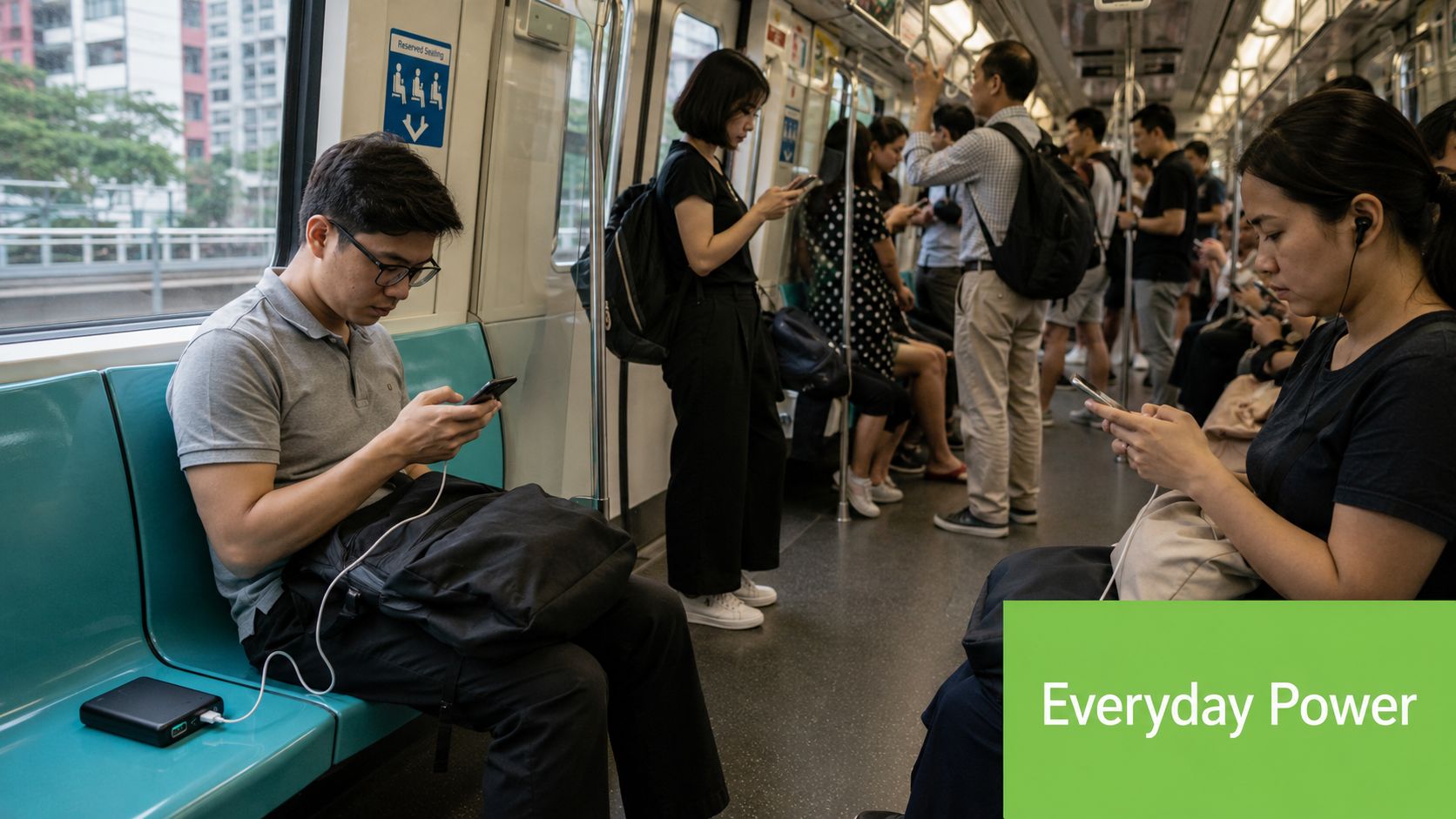
On a Singapore weekday, the use cases are familiar. A student gives a phone a top-up between classes. A commuter charges on the MRT so the battery can last through the evening. A freelancer keeps a tablet alive during a hawker-centre work session. The value is daily continuity, not a dramatic rescue.
Why these brands make sense for Singapore users
If your catalogue already centres on Elonxtech and Wekome, the article should do the same. These brands speak more directly to the products buyers can actually compare at myhalo, whether they want a compact daily-carry unit, a magnetic wireless option, or a larger pack for multi-device use.
That also matches how Singapore users shop for this category. Most people are not hunting for a novelty accessory. They want a dependable power bank that suits commuting, work, study, travel, and daily backup charging. For a closer look at how Singapore buyers usually approach this category, see myhalo's Singapore power bank guide.
Practical rule: buy for the part of the day when you are usually stranded, not for the rare emergency you hope never happens.
Once you look at it that way, the next question is simple. How much energy do you need, and how fast do you need it delivered?
Decoding the Specs Without the Jargon
A spec sheet looks intimidating because it mixes different units. The easiest way to read it is to think of the power bank as a water tank, where the tank size is the stored energy and the tap speed is how fast it can pour that energy into your device.
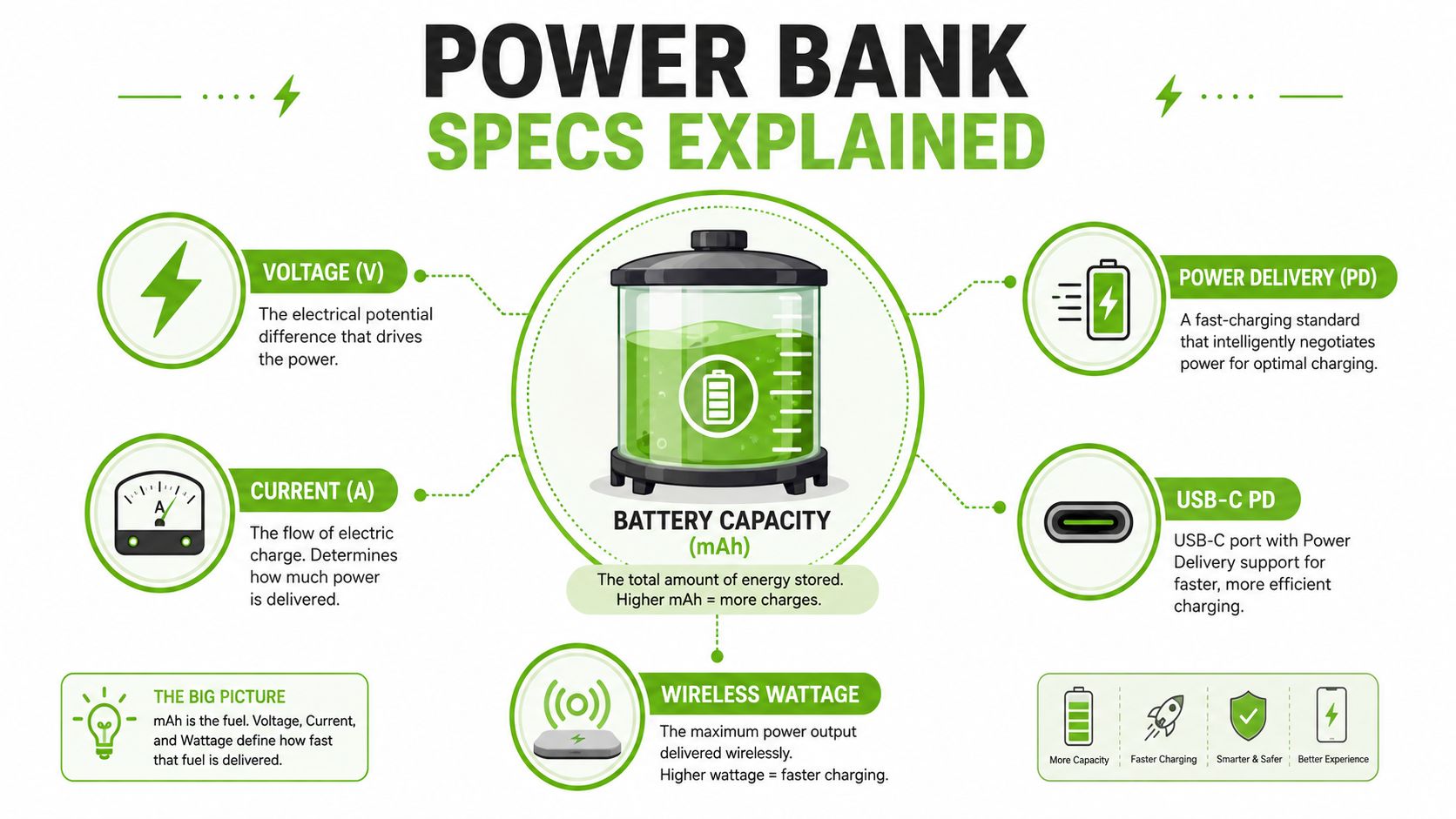
A mAh number tells you the size of the tank in a rough battery sense. A watt-hour (Wh) number tells you the energy content more directly, which is why it matters more for practical charging and cabin checks. A device listing can show both, and the two numbers are not interchangeable.
The simplest way to read PD, or Power Delivery, is as a faster, smarter tap over USB-C. A listing with 20W USB-C PD, 22.5W output, or a higher laptop-friendly rating can move energy to a phone more quickly than a basic charger, although the exact speed still depends on the phone and the cable. Wireless wattage works too, but it is usually less efficient than wired charging, so you trade convenience for some speed and some energy loss.
For a plain-English rule of thumb, use this:
- mAh means how much energy is stored.
- Wh means how much energy is really inside the battery pack.
- Watt output means how fast the pack can send energy out.
- USB-C PD means fast wired charging over USB-C.
- Wireless wattage means convenience without the cable, but usually with more loss.
Read the Wh line first if you travel often. It gives you a better sense of usable energy than the marketing headline on the box.
If you want a local Singapore explainer to compare with retailer listings, this Singapore power bank guide is a useful reference point. Keep the mental model simple. Bigger tank, faster tap, less waste when wired, more waste when wireless. Once those four ideas click, the rest of the labels start to make sense instead of feeling like alphabet soup.
Matching Capacity to Real-World Recharges
A power bank only helps once its stored energy turns into real phone top-ups. That is where many buyers get caught out, because 10,000mAh on the box does not translate into a full 10,000mAh reaching your phone. Some energy is lost in voltage conversion, some disappears through the cable, and some is spent when the pack shares output across multiple ports.
That is why it helps to compare by usage tier instead of by the headline number alone. A 5,000mAh model suits light emergency use and short top-ups. A 10,000mAh model is often the sweet spot for everyday Singapore commuting. A 20,000mAh model gives more breathing room if you are charging a phone plus earbuds, a tablet, or a second device over a long day.
This is where Elonxtech and Wekome can be positioned more clearly. If a buyer wants something slim and easy to carry, a smaller or mid-capacity pack makes sense. If they want magnetic wireless convenience, a Wekome-style compact wireless unit can fit that role well. If they want longer runtime or more output flexibility, a higher-capacity Elonxtech or Wekome option is usually the better fit.
A simple recharge guide
| Capacity tier | Example myhalo models | iPhone (~3,000mAh) | iPad (~7,000mAh) | MacBook Air (~50Wh) |
|---|---|---|---|---|
| 10,000mAh | Certified Surplus Wekome WP-12 10000mAh magnetic wireless power bank | Around 2 full top-ups | Around 1 partial to near-full top-up | Still limited |
| 20,000mAh | Elonxtech GEN3 PLUS PD 20W 20000mAh powerbank | Several phone top-ups | Better for tablet use | Limited, best for light backup only |
| 27,000mAh | Elonxtech 100W 27,000mAh POWERPRO | Several phone top-ups with more reserve | Better for heavier tablet use | More realistic for light laptop rescue |
Use the table as a planning guide, not a promise. Different phones and laptops draw power differently, and the result depends on the power bank design, the cable, and the device's own charging behaviour. A phone on a crowded MRT commute, a tablet in a café, and a laptop in a warm office bag all place slightly different demands on the same pack.
Cable choice matters too. A weak cable can slow charging even when the power bank is capable, so this fast-charging cable guide is useful if you want to match the bank with the right lead instead of guessing.
Aim for the smallest capacity that covers your typical worst day, rather than planning for a rare emergency.
Safety, Certifications and Heat in Singapore
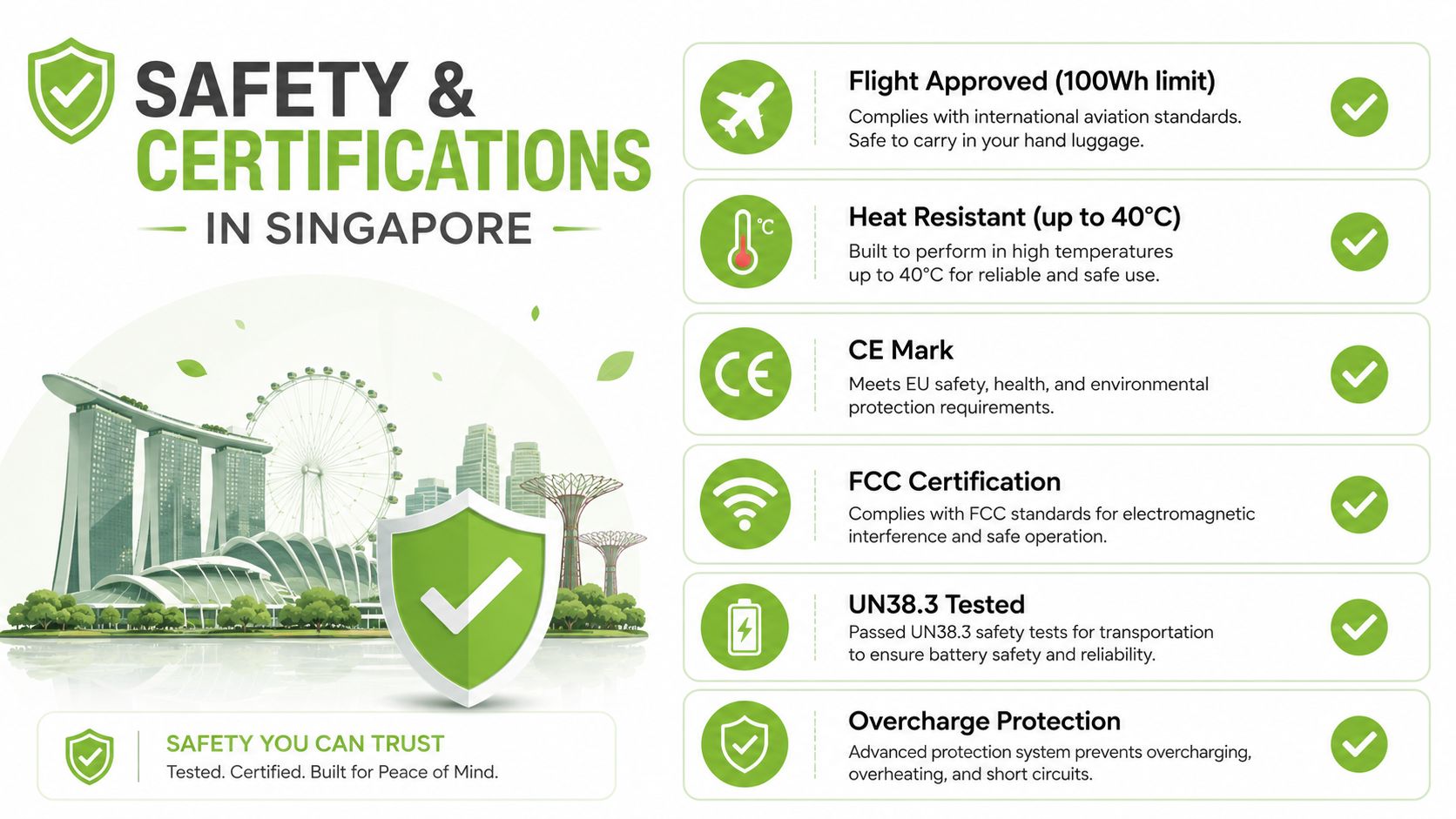
A power bank is a battery you carry in a bag, on a train, and sometimes onto a plane, so compliance matters as much as charging speed.
For Elonxtech and Wekome listings, buyers should look for clearly stated safety and compliance details instead of vague claims. Useful signals include published battery protections, certification references, device input and output limits, and any Singapore-market compliance detail that helps confirm the product is meant for local use.
What those labels mean in practice
Battery safety standards help show that the cells and charging system have been tested against common risks. Equipment safety standards matter because a power bank is both a battery and a charging device. If a seller provides model-specific compliance detail, that gives buyers something concrete to verify instead of relying on marketing language.
When a listing is thin on safety detail, treat that as a warning sign, not a minor omission.
Singapore's heat changes the picture again. A power bank that lives in an MRT bag, a car glove compartment, or a warm office corner will age under daily stress, especially if it is charged often and stored in a place that traps heat. Buyers should think about how long the battery will stay healthy in local conditions, not just how fast it charges on day one.
That kind of lifecycle thinking matters whether you are comparing a new Elonxtech unit or a Certified Surplus Wekome option. A battery that is used again and again will gradually hold less charge, run warmer than before, or start to swell.
Use this quick checklist before you keep carrying one every day:
- Check the certification marks. Look for IEC, IMDA, or other clear compliance cues on the listing or packaging.
- Watch the heat. A power bank that gets unusually warm during light charging deserves attention.
- Check the shape. Swelling is a replacement issue, not a cosmetic one.
- Notice the runtime. If a device that used to top up your phone now barely helps, the cell is wearing out.
Travel checks also matter. Singapore buyers who fly often should pay attention to the Wh figure, because that is more useful than a vague capacity claim when you are trying to judge whether a pack sits within common airline-friendly limits. Clear numbers make the decision easier, especially when the seller explains the rating plainly instead of hiding behind product copy.
New, Refurbished or Surplus, Which Path Fits You
A power bank is one of those purchases where the buying path matters almost as much as the model. Brand-new units give you the freshest battery and the cleanest packaging. Refurbished or Certified ReLoved options sit in the middle, while Certified Surplus leans further toward value-first buying.
The practical question is not which one is morally better. It is which one gives you the right mix of cost, confidence, and useful life. For a student who just needs daily phone backup, a well-checked refurbished unit may be enough. For an SME kitting out a team, a consistent graded stock can make more sense than buying random low-cost listings with unclear condition.
How the three paths differ
| Buying path | What you get | Trade-off |
|---|---|---|
| New | Fresh battery, factory-sealed condition, longest freshness | Higher upfront cost |
| Certified ReLoved | Working hardware with transparent grading and warranty | Some prior use |
| Certified Surplus | Lower-cost functional stock with cosmetic wear possible | More visible signs of use |
That's where lifecycle thinking helps. A device that's bought with transparent grading is easier to keep, easier to hand on, and easier to trade in later because the buyer understands its condition from the start.
myhalo's Certified Surplus Wekome WP-12 10000mAh magnetic wireless power bank is a useful example of this kind of decision path. The value is not only that it's cheaper than a fresh sealed unit, it is that the condition and category are framed for someone who wants a working accessory without paying for untouched packaging.
Lifecycle value is about buying the right level of certainty, not always the newest box.
For buyers in Singapore, that matters because a power bank is rarely a one-month purchase. It sits in the bag, gets charged, gets forgotten, gets found again on a travel day, and hopefully keeps working. If you choose the path that matches your real usage, you waste less money and reduce the odds of replacing a device before you need to.
Why myhalo sells this category locally
Power banks are a natural fit for myhalo because they sit at the intersection of mobility, device care, and practical daily accessories. For Singapore buyers, the category is less about impulse shopping and more about keeping phones, tablets, earbuds, and light work devices usable throughout the day.
That matches the way myhalo positions accessories. Instead of treating a power bank as a throwaway add-on, the category fits into a broader lifecycle approach where buyers compare portability, charging standards, condition, warranty, and long-term usefulness before they buy.
This is also why Elonxtech and Wekome make sense in the range. They give buyers options across compact daily carry, magnetic wireless convenience, and higher-capacity backup, without forcing every shopper into the same use case.
Why Buying from a Singapore Lifecycle Partner Matters
The cheapest listing can look fine until you need help. A Singapore-based lifecycle partner changes the equation because you are not just buying a battery pack, you are buying a support path for the full lifespan of the accessory.
myhalo operates with ISO 9001:2015 and ISO 27001 certified processes, and each unit goes through 30 quality checks before it is sold. The company also provides transparent device grading and battery-health disclosure, which matters because a power bank's real value depends on how much usable life is left in the cell, not just whether it switches on. Those controls reduce guesswork for buyers and for SMEs that need consistent stock across multiple devices.
The practical benefits are straightforward. If a power bank arrives and does not fit your charging habits, a clear exchange path matters. If the battery degrades early, warranty handling matters. If you later upgrade, trade-in or reuse options matter because they keep money in circulation instead of leaving dormant devices in drawers.
Sustainability belongs in that same business logic. A longer device lifecycle means better resource use, fewer replacement purchases, and less operational friction when teams standardise their accessories. That is value creation, not just a green slogan.
A good lifecycle partner lowers total cost over time by making devices easier to verify, reuse, repair, and replace on predictable terms.
myhalo also supports the handover stage with repair, reuse, Certified ReLoved devices, Certified Surplus products, and responsible recycling. For a power bank buyer, that means the conversation does not end at checkout. It starts with the right capacity, continues with safety and care, and ends with a clean route for the next upgrade.
Your Power Bank Buying Checklist and Next Step
Before you buy, run through four simple checks. First, choose your capacity tier based on your real day, not an ideal one. Second, decide whether wired, wireless, or a mix fits your routine, remembering that wired remains the more common and efficient choice for everyday use. Third, look for safety marks and any Singapore compliance detail the seller publishes. Fourth, choose the buying path that matches your budget and how long you want to keep the unit.
A quick version looks like this:
- Pocket top-up use: go smaller and lighter.
- Daily phone backup: 10,000mAh is usually the most balanced starting point.
- Multi-device or travel use: consider 20,000mAh.
- Travel and compliance: check the Wh figure and published safety marks.
- Long-term value: think about grading, warranty, and later trade-in support.
If you want help comparing options, browse the catalogue at myhalo, visit the Bugis Junction store at 200 Victoria Street #03-25/26, or message the team for fit advice and warranty questions. The right power bank should make daily life easier now, and leave you with more flexibility when it is time to upgrade later.
If you want a power bank that fits Singapore commuting, travel, and day-to-day use, myhalo can help you compare Elonxtech and Wekome options by capacity, safety, and lifecycle value in one place. Browse the range, check the grading details, and choose the accessory that matches how you move through the city.