




Wireless Earbuds Singapore: Top Picks for 2026
You're probably reading this with one frustrating pair of earbuds in mind. Maybe the battery now dies halfway through your MRT ride, maybe the call quality turns muddy the moment you step onto a busy road, or maybe you're staring at dozens of listings and realising most guides tell you what's trendy, not what will still feel like a good buy six months later.
That's the primary challenge with wireless earbuds in Singapore. The market is crowded, the feature names are confusing, and the wrong purchase usually isn't obvious on day one. It shows up later, when the fit becomes annoying, the charging case gets unreliable, or support disappears the moment something goes wrong.
A better way to buy is to think about the full lifecycle. Start with the way you use earbuds. Choose features that solve daily problems. Buy from a seller that's clear about condition, support and battery health. Then take care of the set properly so it lasts longer, performs consistently, and keeps its value if you ever repair, trade in, reuse or recycle it.
Table of Contents
- Your Guide to Choosing Wireless Earbuds in Singapore
- Decoding the Jargon Key Earbud Features Explained
- Finding Your Perfect Fit Earbuds for Your Lifestyle
- Smart Spending Navigating Price Bands in Singapore
- Where to Buy Wireless Earbuds in Singapore
- Beyond the Box Pairing Maintenance and Care
-
Frequently Asked Questions About Wireless Earbuds
- Are refurbished wireless earbuds hygienic enough to buy?
- Is brand new always the safer choice?
- What's the difference between Certified ReLoved and Certified Surplus?
- How do I know if earbuds will fit me well?
- What should I check before buying second-hand from a marketplace seller?
- Do expensive earbuds last longer?
- What if I'm buying earbuds for a small team or business use?
- Can earbuds be part of a more sustainable tech setup without compromising value?
Your Guide to Choosing Wireless Earbuds in Singapore
Buying earbuds used to be simple. Wired or wireless. Cheap or expensive. Today, the decision is less about one headline spec and more about fit, support, and whether the pair suits your daily routine in Singapore.
The market keeps expanding because portable audio has become a default part of daily life. The Singapore wireless earphones market was valued at USD 185 million in 2025 and is projected to grow to USD 200 million in 2026, with online channels capturing 75% of sales, according to Singapore wireless earphones market data. That tells you two things. People are buying more earbuds, and most are making that decision through digital listings where photos and spec sheets often hide the underlying trade-offs.
Start with the terms that affect real use
A few basic terms matter more than the rest:
- ANC means active noise cancellation. Think of it as your buffer against train rumble, office air-con noise, or chatter in a café.
- Transparency mode does the opposite. It lets outside sound in, which is useful when crossing roads, ordering kopi, or listening for platform announcements.
- Codecs affect how audio is transmitted from your phone to your earbuds. In practical terms, they shape how clean or detailed your music and video audio feels.
- Fit decides more than comfort. A poor seal weakens bass, lets in noise, and makes even expensive earbuds feel average.
Buy for the whole ownership journey
A smart purchase isn't just “what sounds good in a review”. It's also:
- How the earbuds fit after an hour
- Whether the battery still holds up after months of use
- What support exists if one side stops charging
- Whether the seller is transparent about condition and grading
- Whether the device can be repaired, reused or responsibly recycled later
Practical rule: The best earbuds for most people aren't the ones with the longest spec list. They're the pair that fits securely, works reliably, and comes from a seller that doesn't become impossible to reach after checkout.
If you're searching for wireless earbuds Singapore buyers can live with long term, that mindset will save you more regret than any “top picks” list.
Decoding the Jargon Key Earbud Features Explained
Specs can make ordinary earbuds look futuristic. Most buyers don't need more jargon. They need to know what each feature changes in real life.
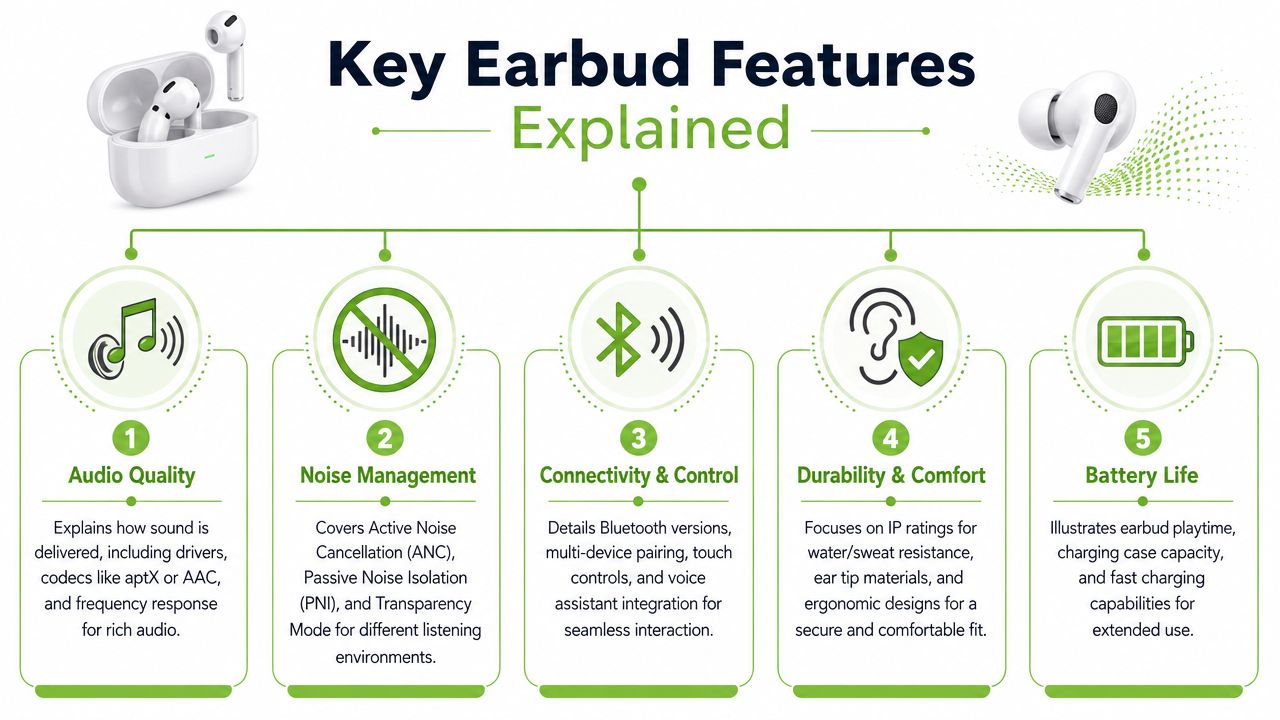
What the specs actually mean day to day
Active Noise Cancellation matters most if you commute, work in shared spaces, or prefer lower listening volumes. In Singapore's 2025 to 2026 market, top models offer adaptive ANC up to 45 dB, alongside LDAC codec support, AI-integrated health sensors, and in some cases latency under 120 ms for gaming and video sync, as noted in this Singapore wireless earbuds guide. The practical point isn't the number on the box. It's whether ANC reduces enough background noise that you don't feel tempted to crank the volume.
Transparency mode is the feature many people underestimate. If you walk near traffic in Bugis, Raffles Place or Orchard, being able to hear your surroundings without removing an earbud is useful and safer.
Codecs sound technical, but the plain-English version is simple. They're part of how your phone sends audio. If you mostly stream music casually, standard support is often fine. If you care about cleaner detail, especially with higher-quality tracks, better codec support can make the sound less compressed.
Which features matter for commuting gym and work
For different use cases, the priority changes:
-
Commuting
- Essential: ANC, secure fit, stable Bluetooth
- Nice to have: Transparency mode, strong call microphones
- Why: Train noise and frequent device switching expose weak connections and poor isolation quickly
-
Gym sessions
- Essential: Secure fit, sweat resistance, easy controls
- Nice to have: Compact case, transparency mode
- Why: Slippery earbuds and fussy touch controls become irritating within one workout
-
WFH and office calls
- Essential: Clear microphones, reliable connection, comfort for long wear
- Nice to have: Multi-device pairing
- Why: Good music tuning won't help if your calls sound distant or the earbuds become tiring after back-to-back meetings
-
Gaming and video
- Essential: Low latency
- Nice to have: Strong app controls and custom EQ
- Why: If speech and action don't line up, even decent sound becomes distracting
Good earbuds don't fail loudly. They fail in small daily ways. Touch controls that misfire. Cases that don't seat properly. Ear tips that loosen after twenty minutes.
When comparing wireless earbuds Singapore retailers stock, ignore the longest feature list first. Ask which feature solves your most common annoyance.
Finding Your Perfect Fit Earbuds for Your Lifestyle
The right pair of earbuds depends less on brand loyalty and more on where and how you use them. A commuter's priorities aren't the same as a gym user's. A student on video calls doesn't need exactly what a mobile gamer wants.
Why in ear design keeps winning
There's a reason most shoppers still end up with in-ear models. The in-ear segment captured the largest global market share and is expected to maintain that dominance, reflecting preference for compact, ergonomic designs that suit both active and passive use, according to global wireless earbuds market analysis. In practice, that lines up with what works in Singapore. In-ear earbuds travel well, fit into a pocket, and usually provide better passive isolation than open designs.
Which Earbud Features Matter for Your Lifestyle
| Use Case | Top Priority Feature | Good-to-Have Feature | What It Means for You |
|---|---|---|---|
| Daily MRT commute | ANC | Transparency mode | Less train noise, fewer volume spikes, easier switching between quiet listening and awareness |
| Gym and runs | Secure fit | Sweat resistance and easy controls | Earbuds stay in place and don't become irritating once you start moving |
| WFH and hybrid meetings | Microphone quality | Multi-device pairing | Calls sound clearer and switching between laptop and phone feels less clumsy |
| Study and café work | Comfort | Small case size | You can wear them longer without pressure build-up |
| Mobile gaming and video | Low latency | Custom sound settings | Audio stays in sync and dialogue feels more natural |
| General daily use | Balanced fit and battery reliability | Case convenience | Fewer annoyances over time, especially for first-time buyers |
Why refurbished can be the smarter first purchase
A lot of buyers still assume “new” automatically means “better value”. It often doesn't.
If your goal is long-term satisfaction, a professionally refurbished pair can make more sense than buying the cheapest brand-new option. You may get a better original build, better fit, and better sound tuning for the same budget range. That matters because low-end new earbuds often look attractive at checkout but become disposable the moment battery performance dips or one side develops charging issues.
Here's the trade-off plainly:
- Cheaper brand-new models can work well for light use, but build consistency varies.
- Professionally refurbished premium models may offer stronger overall value if condition, battery health and grading are disclosed clearly.
- Peer-to-peer marketplace deals can look tempting, but risk rises quickly when hygiene, battery condition and authenticity aren't verified.
Store-floor advice: If you're buying your first serious pair, don't pay for features you won't hear, use or notice. Put the budget into fit, microphone quality, and reliable charging first.
That's usually the difference between a pair you keep using and a pair that ends up forgotten in a drawer.
Smart Spending Navigating Price Bands in Singapore
Price matters, but the sticker price isn't the full story. Two earbuds at similar checkout cost can deliver very different ownership experiences once you factor in battery condition, warranty clarity, charging case reliability and after-sales support.
What changes across price bands
At the lower end, you're usually choosing basic convenience. Bluetooth works, audio is acceptable, and controls are simple. That can be enough for casual users.
Move up a tier and you usually start seeing better microphones, stronger ANC, more stable app support, and fewer frustrating hardware shortcuts. Those differences don't always show in a product page, but they show up during calls, long commutes and everyday charging.
At the top end, the improvements are often more refined than dramatic. Better tuning. Smarter noise control. More polished switching between devices. If you won't use those strengths often, spending more doesn't always improve value.
How to judge a seller not just a sticker price
Professional refurbishment deserves more attention than it gets. The professional refurbished market can offer up to 67% cost savings, and some programmes apply 30 checks per device under ISO 9001:2015 certification, according to this discussion of refurbished earbud buying gaps in Singapore. That matters because the value isn't only in paying less. It's in buying from a process instead of a gamble.
If you're weighing refurbished options, check these points before you pay:
-
Grading clarity
A seller should explain what cosmetic grades mean, not hide behind vague phrases like “good condition”. -
Battery health disclosure
Earbuds are tiny battery devices. If a seller won't discuss battery condition transparently, treat that as a warning sign. -
Quality control process
A proper testing workflow is more useful than a flashy listing. That includes charging, pairing, audio output and case function. -
Warranty terms you can understand
Short doesn't always mean bad. Unclear always means risky.
One practical place to compare condition-led refurbished options is myhalo's Certified ReLoved earbuds collection, especially if you want to compare devices through a lifecycle lens rather than chasing whatever launched most recently.
For SMEs and budget-conscious households, this approach also supports smarter resource use. Extending the life of audio devices reduces replacement churn, preserves more value from each purchase, and makes procurement more resilient when you need reliable gear without overspending.
Where to Buy Wireless Earbuds in Singapore
Where you buy matters almost as much as what you buy. A decent pair from a poor seller can become a bad experience fast.
How to assess a retailer before you pay
Singapore buyers usually choose from brand stores, electronics chains, online marketplaces and refurbishment specialists. Each has a place. The key is knowing what to verify.

Use this checklist before checkout:
-
Look for transparent grading
If a device isn't brand new, the listing should tell you exactly how it's graded and what cosmetic wear to expect. -
Check whether battery health is disclosed
That's especially important for used or refurbished earbuds. -
Read the warranty in plain language
You should know who handles claims, how to contact them, and whether exchange support exists locally. -
Prefer sellers with documented processes
ISO 9001 Certified workflows help indicate consistent quality checks. ISO 27001 Certified operations matter when customer data and service records are involved. -
Check whether the seller supports the whole device lifecycle
Retailers that also handle repair, reuse, Certified ReLoved stock, Certified Surplus products, and responsible recycling are usually thinking beyond one transaction.
If you want a concrete example of what to evaluate on a current product page, see the Samsung Galaxy Buds2 listing. Don't focus only on the model. Look at how the seller presents condition, support and purchase information.
Simple care habits that protect your purchase
The seller matters because ownership starts after checkout. The best retailers make that easier by giving clear guidance, realistic support, and options like RescueAdvise or a mylo AI Assistant to answer practical setup questions.
A trustworthy store shouldn't just move boxes. It should help you keep the device useful for longer. That's where lifecycle support becomes practical, not abstract. If one earbud stops charging, if the case hinge loosens, or if you need to understand whether repair or replacement makes more sense, good support protects both your money and your time.
Beyond the Box Pairing Maintenance and Care
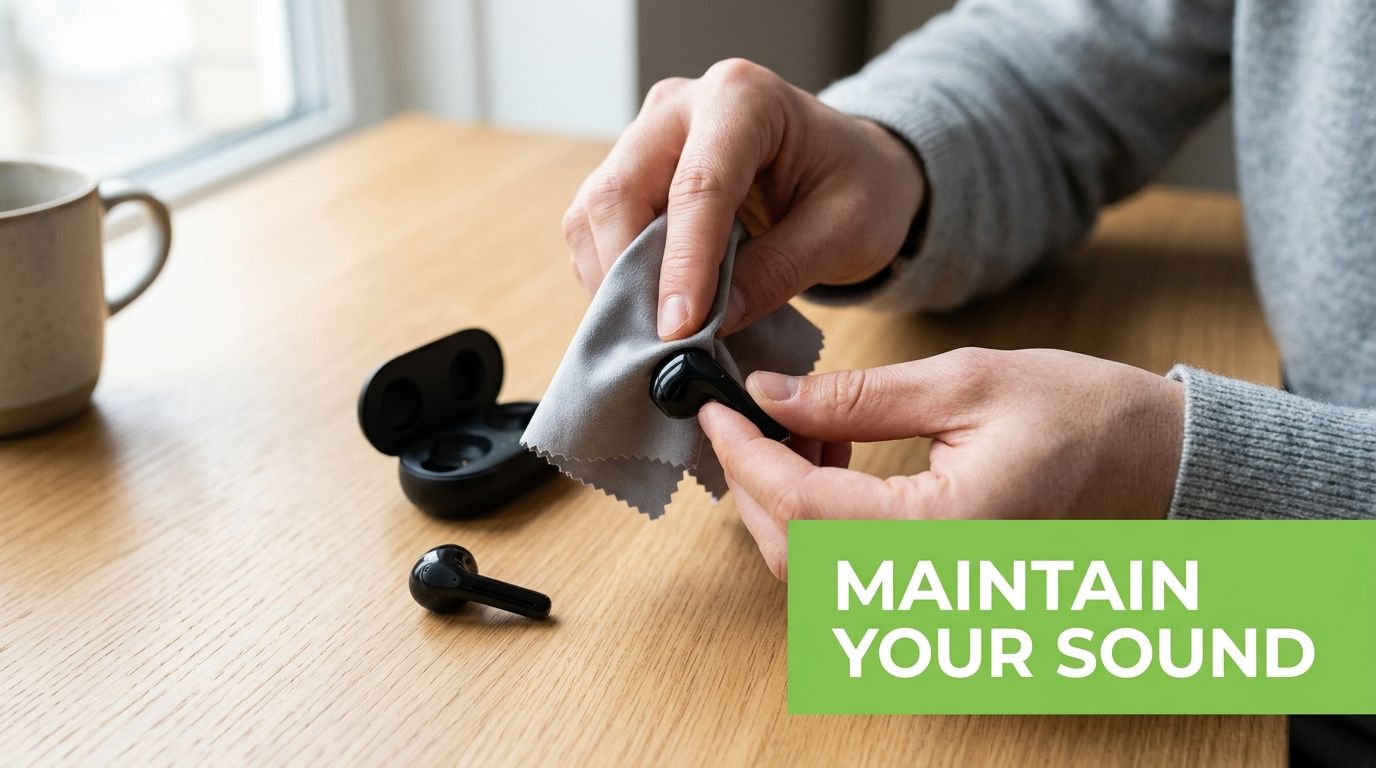
A lot of earbud problems start with habits, not hardware. Pairing them properly, cleaning them regularly, and charging them sensibly can extend useful life and reduce the usual complaints about uneven battery drain, weak audio and unreliable charging contacts.
Pair them properly from day one
Start simple. Fully charge the earbuds and case before first use. Update firmware if the app prompts you. Then test both earbuds separately and together. That quick check catches common issues early, such as one side not charging correctly in the case.
If your earbuds support app settings, don't leave everything at default without listening critically. Adjust touch controls if they're too easy to trigger. Enable transparency mode for outdoor walking if you use them around traffic. Turn off features you never use if they drain battery needlessly.
What good after sales support really looks like
Earbuds are small, sealed devices. That makes after-sales support more important, not less.
With 75% of Singapore's workforce using earbuds daily, local guidance around hygiene, safe volume practices under 60% max, and transparency mode for urban safety matters, according to wireless earbud safety guidance referenced for Singapore users. Good support should also cover practical ownership questions, not just warranty defects.
A useful support standard includes:
- Clear fault diagnosis so you know whether the issue is pairing, earwax blockage, charging contact dirt or battery wear
- Accessible repair or replacement paths so you're not forced into a full rebuy immediately
- Advice on lifespan so you can decide whether to maintain, replace or trade in
- Device care education because many “faults” are avoidable with proper cleaning and storage
If you want a deeper view of wear patterns and battery ageing, this guide on how long AirPods last and what affects lifespan is useful even if you're comparing non-Apple earbuds. The ownership lessons are broadly relevant.
Here's a practical visual walk-through for cleaning and handling:
Daily habits that extend earbud life
A few habits make a visible difference:
-
Clean the ear tips and mesh gently
Don't let wax build up until audio sounds softer on one side. -
Wipe the case interior
Charging pins and recesses collect lint more easily than most users realise. -
Avoid constant deep discharge
Tiny batteries age better when they aren't repeatedly run flat. -
Store them dry after workouts
Even sweat-resistant earbuds need time to dry before being sealed in the case.
Use transparency mode when walking near traffic, and keep volume disciplined. Earbud convenience isn't worth sacrificing awareness or hearing comfort.
Frequently Asked Questions About Wireless Earbuds
Are refurbished wireless earbuds hygienic enough to buy?
They can be, but only when refurbishment is professional and transparent. Hygiene isn't something you should assume. Ask how ear tips, mesh areas and cases are cleaned or replaced, and whether the seller separates cosmetic grading from functional testing. If those answers are vague, move on.
Is brand new always the safer choice?
Not always. Brand new can be the simpler choice, especially if you want sealed packaging and straightforward manufacturer support. But professionally refurbished earbuds can be a smarter value choice if the testing process is documented, the grading is clear, and battery condition is fully disclosed. The weak option isn't “refurbished”. The weak option is undocumented used stock.
What's the difference between Certified ReLoved and Certified Surplus?
In plain terms, these categories help buyers understand where a device sits in its lifecycle. Certified ReLoved usually points to professionally refurbished devices prepared for reuse. Certified Surplus usually refers to legitimate excess or clearance stock that still deserves proper documentation and support. The important thing isn't the label alone. It's whether the seller explains condition, testing and warranty in a way you can verify.
How do I know if earbuds will fit me well?
No spec sheet can fully answer that. Fit depends on your ear shape, the nozzle design, ear tip size and how deep the earbuds sit. As a rule, discomfort within a few minutes won't improve much with time. Mild pressure from a new fit may settle. Sharp pressure or constant loosening usually won't. If you can, choose sellers that provide enough product detail and support to help you narrow down shape and fit before buying.
What should I check before buying second-hand from a marketplace seller?
Keep it basic and strict. Confirm pairing works on both sides, make sure the case charges reliably, inspect mesh and charging contacts, and ask direct questions about battery behaviour. If the seller avoids specifics, that's your answer. Marketplace purchases can work, but they require more caution because support often disappears once the payment is made.
Do expensive earbuds last longer?
Sometimes, but not automatically. Better materials, software support and case design can help. But tiny batteries still wear over time, and poor care shortens lifespan regardless of price. That's why maintenance matters. Cleaning, sensible charging and proper storage protect a premium pair just as much as a budget one.
What if I'm buying earbuds for a small team or business use?
Then consistency matters more than hype. Standardise on a model that's easy to pair, comfortable for calls, and simple to replace or service. For SMEs, the practical win comes from reducing support headaches, keeping accessories manageable, and choosing a supplier that can help with reuse, replacement, repair and responsible disposal when units age out.
Can earbuds be part of a more sustainable tech setup without compromising value?
Yes, if sustainability is treated as resource efficiency rather than just messaging. Buying only what you need, extending device life, choosing repairable or reusable options where practical, and using trade-in or recycling channels when a device reaches end of life all support better value. That's good for household budgets and business resilience alike.
If you're comparing wireless earbuds in Singapore and want a more practical way to buy, start with a seller that treats audio gear as part of a longer device lifecycle. myhalo is one option if you want to look beyond one-off retail, with support that aligns more closely to repair, reuse, Certified ReLoved and responsible tech ownership.