




Eco Friendly Products Singapore Guide for Smart Tech Choices
You're probably staring at a phone, laptop, or tablet that still works, but not quite well enough to feel worth keeping. A new device looks tempting, the old one is sitting in a drawer, and the central question is simple, do eco friendly products in Singapore have to cost more, or can they also make practical sense?
For a lot of buyers, the answer depends on whether they're choosing a greener label, a repaired device, or a refurbished unit with clear quality checks. That's where a more useful way of thinking helps, because the best choice is often the one that lowers total cost of ownership, extends device life, and cuts waste without forcing you to pay for features you don't need. In that sense, sustainability is not just about feeling good about a purchase, it's about making a better one.
myhalo fits into that logic as a technology lifecycle partner, not just a retailer. It works around repair, reuse, Certified ReLoved devices, Certified Surplus products, and responsible recycling, so the decision isn't only about buying, it's about what happens before and after the sale. For a simple way to organise those choices, a landing page tool can help you map the customer journey, especially if you're trying to explain why one device path is cheaper or more durable than another.
Table of Contents
- Why Singapore Shoppers Are Rethinking Tech Purchases
- What Eco Friendly Tech Products Mean for You
- Singapore Market Reality and Price Sensitivity
- Understanding Singapore Green Labelling Scheme
- Choosing Between New Refurbished and ReLoved Devices
- Extending Device Life Through Repair and Trade In
- Cost Warranty and Quality Assurance Factors
- Practical Steps to Start with Eco Friendly Tech
Why Singapore Shoppers Are Rethinking Tech Purchases
A common Singapore scene goes like this. Someone upgrades to a newer phone, the old one moves into a drawer, and the buyer tells themselves they'll “deal with it later”. Later usually means more clutter, more wasted value, and another purchase decision built on price alone.
That's why the conversation around eco friendly products Singapore is changing. People aren't only asking whether a device is greener, they're asking whether it's worth paying for and whether it can last long enough to justify the spend. That matters in tech, because phones, tablets, and laptops are not small impulse buys. They affect work, study, and daily routines.
Green choices work best when they protect value
A useful mindset shift is to think in lifecycle terms. A device that can be repaired, resold, or responsibly recycled behaves more like a well-maintained car than a disposable item, and that's where the savings usually show up. You're not paying repeatedly for the same function, you're stretching the usefulness of what you already own.
Practical rule: if a device still meets your needs, the greener move is often to extend its life first, then replace it only when repair no longer makes sense.
That's also why businesses should look at eco-friendly tech as a resilience issue, not just an environmental one. If equipment lasts longer, teams replace fewer units, manage budgets more predictably, and reduce avoidable downtime. For SMEs, that can mean fewer surprise purchases and less pressure on cash flow.
myhalo's role in that kind of decision is straightforward. It supports repair, trade-in, reuse, and responsible disposal, which gives buyers more than one exit path for each device. That is the kind of structure readers need when they want greener tech without turning shopping into guesswork.
What Eco Friendly Tech Products Mean for You
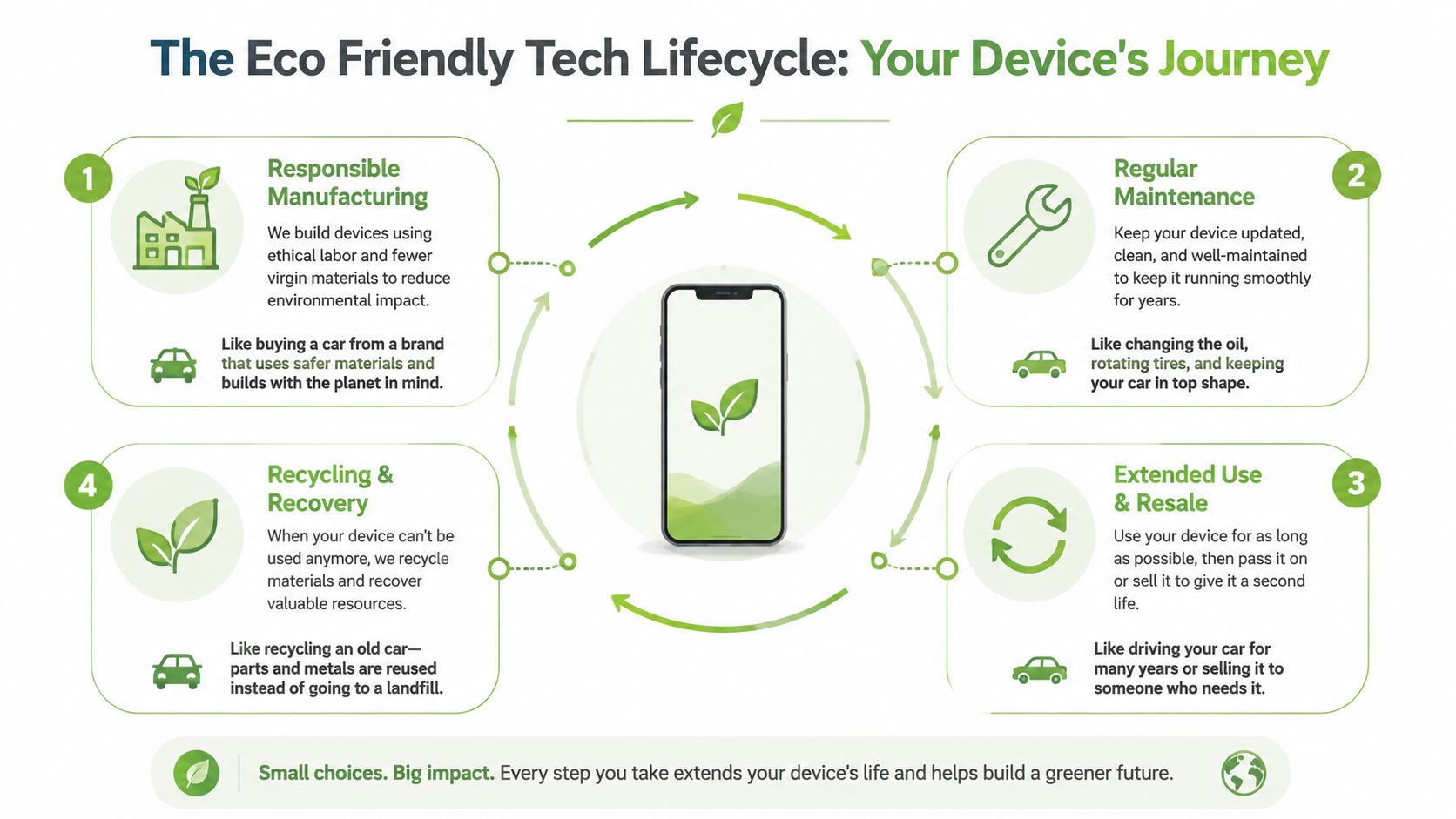
An eco-friendly tech product isn't just a device with a green sticker. In practice, it's a product that uses fewer resources over its whole life, from how it's made to how long it stays in use, and what happens when it's no longer needed. That's why refurbished phones, tablets, and laptops can be sensible choices when they're backed by clear grading, battery health disclosure, and warranty support.
Think of the device lifecycle, not just the checkout page
A useful analogy is a car. You don't judge a car only by the day you buy it, you judge it by how well it's maintained, how long it runs, and whether it can still be sold on after you're done with it. Tech works the same way. Regular maintenance, careful use, and responsible resale all reduce the cost of ownership over time.
That's where categories like Certified ReLoved and Certified Surplus make sense. A Certified ReLoved device is about giving a tested unit a second life with clearer condition standards, while Certified Surplus helps buyers access devices that were never used in the same way as a worn-out hand-me-down. The value is practical, not abstract. You get a working device without paying for unnecessary novelty.
Why reuse is more than an environmental story
Reuse matters because it keeps useful products circulating longer. That means fewer devices sitting idle, fewer premature replacements, and less pressure on procurement budgets. For an SME, that can translate into better spending discipline. For a household, it can mean getting a dependable laptop for school or work without stretching the budget as far as a brand-new model.
A device that is still fit for purpose is not “old”, it's underused value waiting to be recovered.
The key is to look for visible proof, not vague promises. Transparent grading, battery health disclosure, and warranty terms help buyers compare real condition instead of guessing. That makes eco-friendly tech less about ideals and more about making a smarter, longer-lasting decision.
Singapore Market Reality and Price Sensitivity
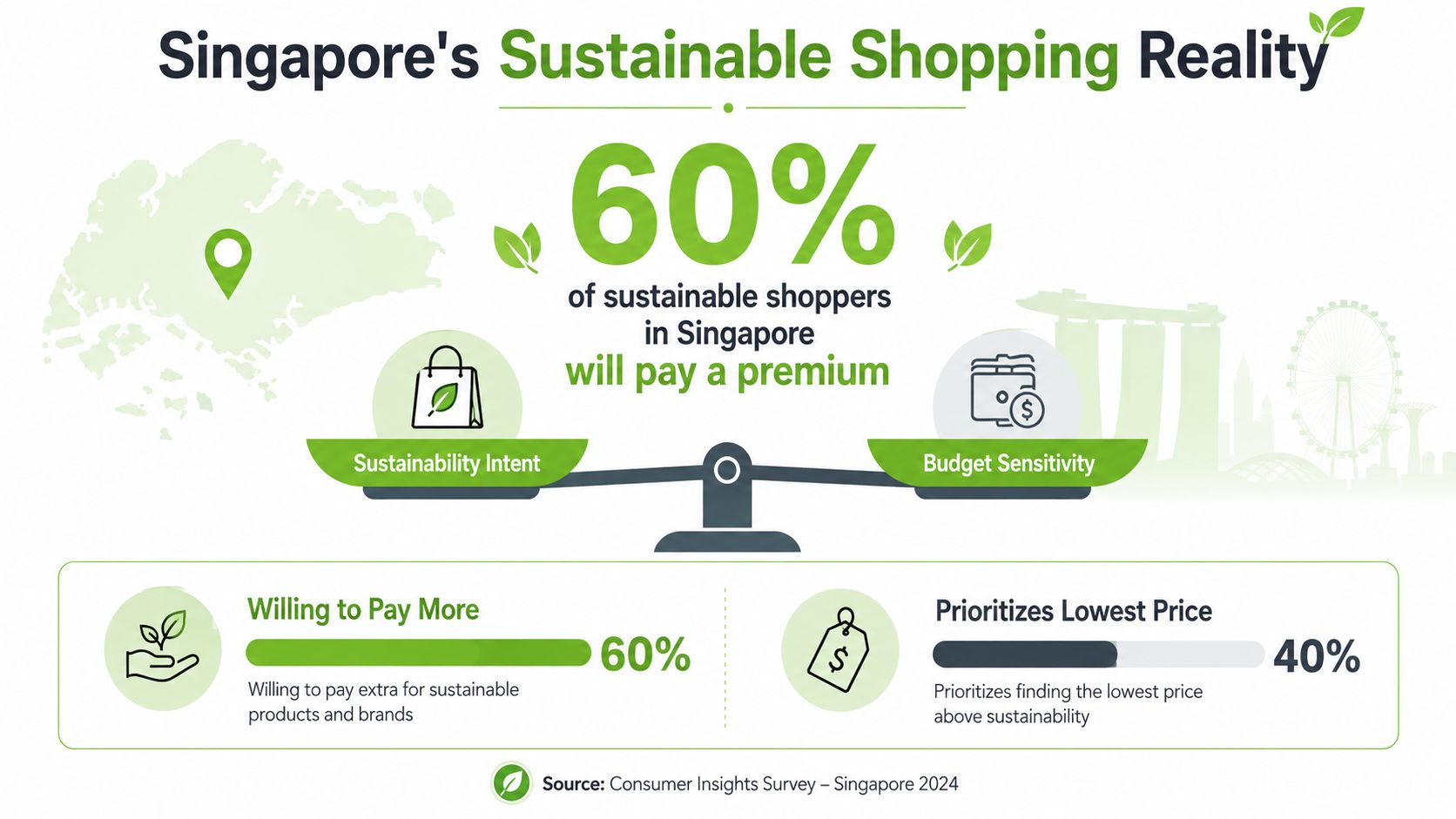
Singapore buyers do want greener products, but the market is split by budget sensitivity. A YouGov study reported that 60% of “sustainable shoppers” in Singapore are willing to pay more for products that are good for the environment, while 46% of the general population said the same YouGov study. A Singapore Business Review summary of Bain & Company research also said 85% of Singapore shoppers are willing to spend more on eco-friendly products, and nearly half had already been buying sustainable goods in the previous two years Singapore Business Review summary.
Those figures point in the same direction. Demand is broadening, but people still want a clear reason to pay a premium. That's especially true in tech, where buyers can compare features, battery condition, warranty, and lifespan in a very practical way.
Sustainable intent is real, but cost still decides
The clearest sign of that tension comes from packaging. A Singapore Environment Council report covered by The Straits Times found that 95% of consumers in Singapore are inclined to choose products with sustainable packaging, yet more than half would avoid them if they cost more The Straits Times report. That is a strong reminder that buyers like the idea of sustainability, but the final decision often comes down to what feels affordable.
For eco-friendly tech, that means the strongest offer is usually not the priciest one. It's the one that balances condition, warranty, and usable life. A refurbished laptop that still performs reliably can make more sense than a new machine with features the buyer won't use. The same logic applies to SMEs trying to keep hardware spending predictable.
Packaging waste makes the case for longer-life devices
The same report said packaging waste made up about one-third of the 1.82 million tonnes of domestic waste thrown away in 2021, and plastic packaging alone accounted for 289,000 tonnes, enough to fill 32,111 dumpster trucks The Straits Times report. Singapore's national domestic recycling rate was 13% in 2021, a 10-year low and unchanged from 2020 The Straits Times report.
Those numbers make a simple point. Reusable, repairable, and longer-life products address waste pressure at the source, which is more effective than treating disposal as an afterthought. That is why eco-friendly tech in Singapore works best when it is positioned as practical value, not just a greener label.
Understanding Singapore Green Labelling Scheme
A lot of buyers get stuck at the same point. They see a green claim, but they cannot tell whether it is real, vague, or just marketing. That confusion is not unusual. In a WWF/Accenture Singapore study, 30% of respondents said competing claims had confused them and 23% said they do not trust businesses' sustainability claims at all WWF/Accenture Singapore study.
Use the label as a technical filter
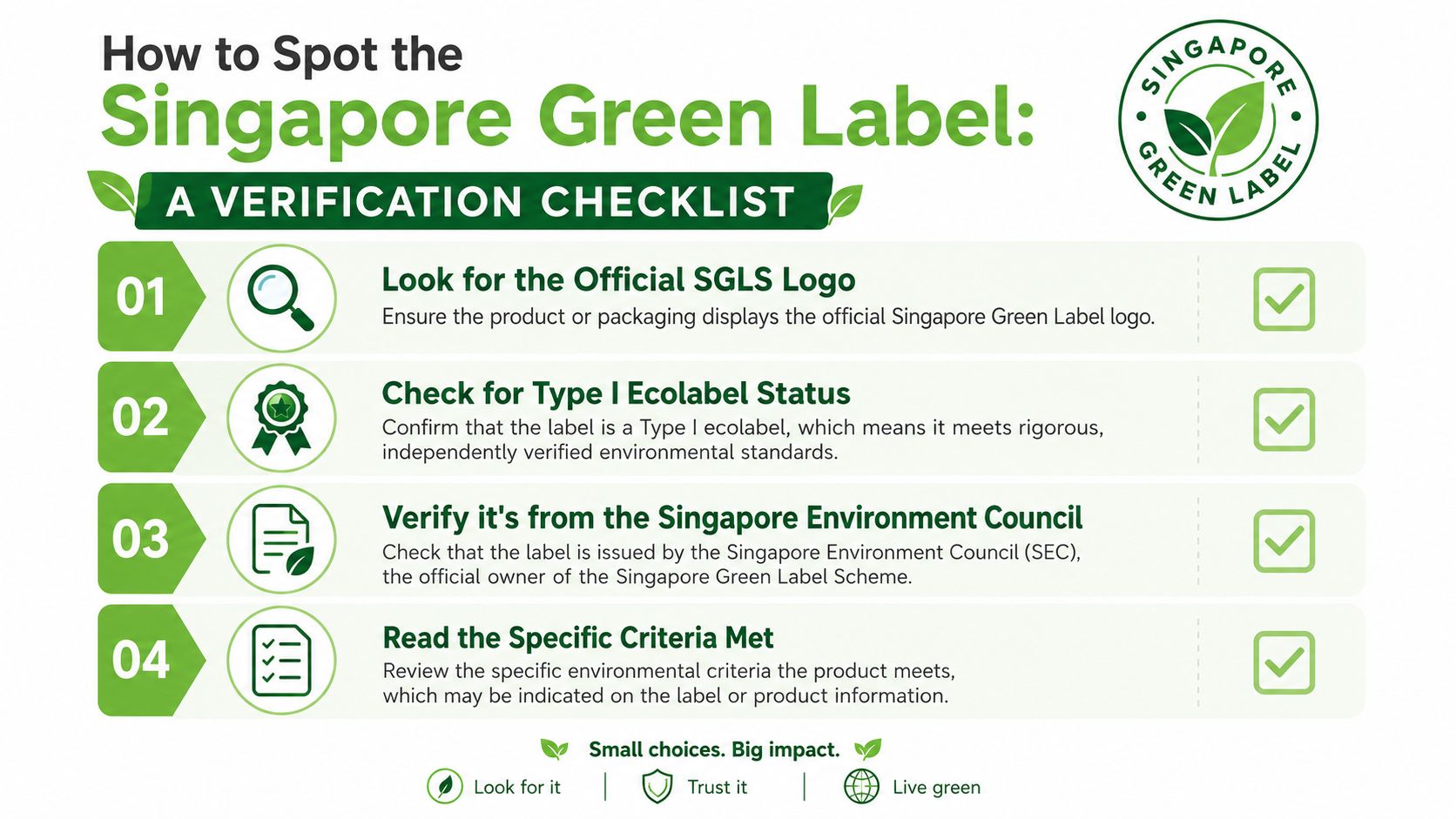
The Singapore Green Labelling Scheme (SGLS) is a Type I ecolabel administered by the Singapore Environment Council. Products are certified only after independent third-party verification against category-specific criteria based on life-cycle considerations SGLS overview. The scheme was launched in May 1992 and later handed over to the SEC on 5 June 1999 SEC history page.
That history matters because it shows the label is part of Singapore's established product-verification system. For buyers, SGLS is useful when you want more than a brand's own claim.
What genuine certification should show
For product categories covered by SGLS, applicants must demonstrate minimum quality and fitness for intended purpose, plus a substantial measurable reduction in environmental impact versus conventional products in the same class SGLS product categories. Some categories also require independent technical assessment or third-party evidence.
A simple buyer checklist helps keep things grounded.
- Look for the official SGLS logo and check that it is presented clearly.
- Check the category so you know the claim matches the product type.
- Look for evidence of third-party verification, not just a brand statement.
- Read the criteria met, especially where the product sits in a technical category.
Applied to tech, the point is not to chase the most “green” sounding device. It is to identify products that can prove lower impact, or at least a longer useful life with less waste. That is a much stronger standard than vague eco language.
Choosing Between New Refurbished and ReLoved Devices
A buyer doesn't usually need every option. They need the right one. The decision gets easier when you compare condition, warranty, and likely lifetime value side by side, rather than treating all devices as if they were interchangeable.
Device condition and warranty options
| Category | Condition | Warranty | Best For |
|---|---|---|---|
| Brand-new factory-sealed | Unused, sealed from the manufacturer | Varies by brand and seller | Buyers who want the latest model and untouched packaging |
| Certified Surplus | New or near-new surplus stock | Seller-backed warranty | Buyers who want value without paying full retail for current stock |
| Certified ReLoved Premium | Refurbished to a high cosmetic and functional standard | Short warranty, seller-supported | Buyers who want a cleaner-looking device with stronger presentation |
| Certified ReLoved Excellent | Refurbished with minor signs of use | Short warranty, seller-supported | Buyers who care more about function and value than cosmetic perfection |
| Certified ReLoved Value | Fully functional with more visible wear | Short warranty, seller-supported | Budget-conscious buyers who prioritise function |
| ReEco | Fully functional with cosmetic wear | Seller-backed warranty terms vary | Buyers who want lower upfront cost and can accept visible use |
The table makes one thing clear. If the device is backed by transparent grading and warranty, the buyer can judge it on use, not just on whether it is new. That is where 30-point quality checks and battery health disclosure matter, because they reduce uncertainty before purchase. myhalo runs these checks under an ISO 9001:2015-certified process, and it also holds ISO 27001 certification for information security, which matters for people buying used phones and laptops that still contain or once contained personal data.
Cost per year beats sticker price
A cheaper sticker price is not automatically a cheaper purchase. If a laptop lasts longer, is easier to maintain, and comes with a realistic exchange policy, the annual cost can be more sensible than a bargain buy that fails early. That's why the right comparison is not “new versus refurbished”, it's “how much useful life do I get for the money I spend”.
For buyers who want a practical checklist before deciding, this guide on what to look out for before buying a refurbished phone is worth reading once. The most useful habit is to compare condition, warranty, and expected usage, then choose the option that fits the job instead of chasing the newest label.
Extending Device Life Through Repair and Trade In
The cleanest way to reduce tech waste is often to stop replacing devices too early. A phone with a damaged battery, a laptop with a failing keyboard, or a tablet with storage issues may still be repairable, and that can be enough to delay a replacement for another cycle of use. For Singapore buyers, that lines up well with Green Plan 2030, which aims to reduce waste sent to landfill by 30% by 2030 Green Plan 2030.
Repair first, replace later
Repair is usually the most direct form of value recovery. If a device still does its job after a fix, you avoid the cost of a full replacement and keep the original hardware in circulation longer. For SMEs, that can be especially helpful because one repaired work laptop can be the difference between a planned maintenance expense and an unplanned capital outlay.
Trade-in turns old devices into usable value
Trade-ins are useful because they convert idle assets into offset value. A device that no longer suits one user may still have enough remaining life to support another. That is a practical circular model, not a theoretical one.
myhalo's service layer supports that logic through repair, data migration, trade-ins, myhalo e-Xtender, and myhalo Protect. If you want a more detailed view of how trade-ins fit into the loop, this trade-in guide is a good starting point. The important part is that the old device doesn't have to become waste just because you're ready for an upgrade.
Responsible recycling closes the loop
Not every device should be repaired or resold. Some units are at the end of their useful life, and those should go into responsible recycling so materials can be recovered properly. That is where waste reduction becomes a business habit, not a slogan. The more often teams keep devices in use, repair them when sensible, and pass them on when they still have value, the less pressure they put on procurement budgets and disposal systems.
Keep the device in use for as long as it remains fit for purpose. Replace it only when repair no longer gives you dependable value.
That approach is especially useful for companies trying to balance sustainability with uptime. A laptop that can be repaired, reassigned, or traded in is not just a greener choice, it's a more resilient one.
Cost Warranty and Quality Assurance Factors
Eco-friendly tech only works as a sound purchase when the numbers and the risk controls line up. Start by comparing total cost of ownership, warranty terms, and the seller's checks before the device reaches you. A low upfront price can look attractive on the shelf, yet it becomes expensive if the unit fails early or leaves you paying for repairs that could have been avoided.
Quality systems reduce uncertainty
myhalo's process uses 30-point quality checks, ISO 9001 certification, and ISO 27001 certification, which gives buyers a clearer way to judge both product condition and information-handling discipline. For phones and laptops, that matters because a used device has to be dependable in two ways, it must work properly, and it must be prepared with care where data handling is involved.
Compare condition grade, battery-health disclosure, and warranty terms side by side before choosing between new and refurbished. Transparent grading shows whether a device is lightly used or more worn, and battery-health disclosure helps you judge how much useful life is left. That makes the buying decision more concrete, because you are comparing the actual state of the device instead of relying on a vague label.
Warranty and payment structure affect real value
Warranty support changes how buyers should judge risk. A unit with a defined exchange window and warranty terms gives you a clearer path than a device sold with no real recourse. myhalo also offers a 14-day exchange and 0% instalment plans, which can make higher-quality used devices easier to budget for without forcing buyers into a weaker compromise.
Simple test: if two devices look similar on price, choose the one with clearer grading, stronger warranty support, and a better fit for how long you'll actually use it.
That same logic works for SMEs. A device that costs a little more but runs longer, needs fewer interruptions, and is easier to replace on predictable terms usually gives better value over time. mylo AI Assistant can also help buyers narrow options by use case, which is useful when the decision comes down to matching specs and warranty coverage with the actual workload and replacement timeline.
Practical Steps to Start with Eco Friendly Tech
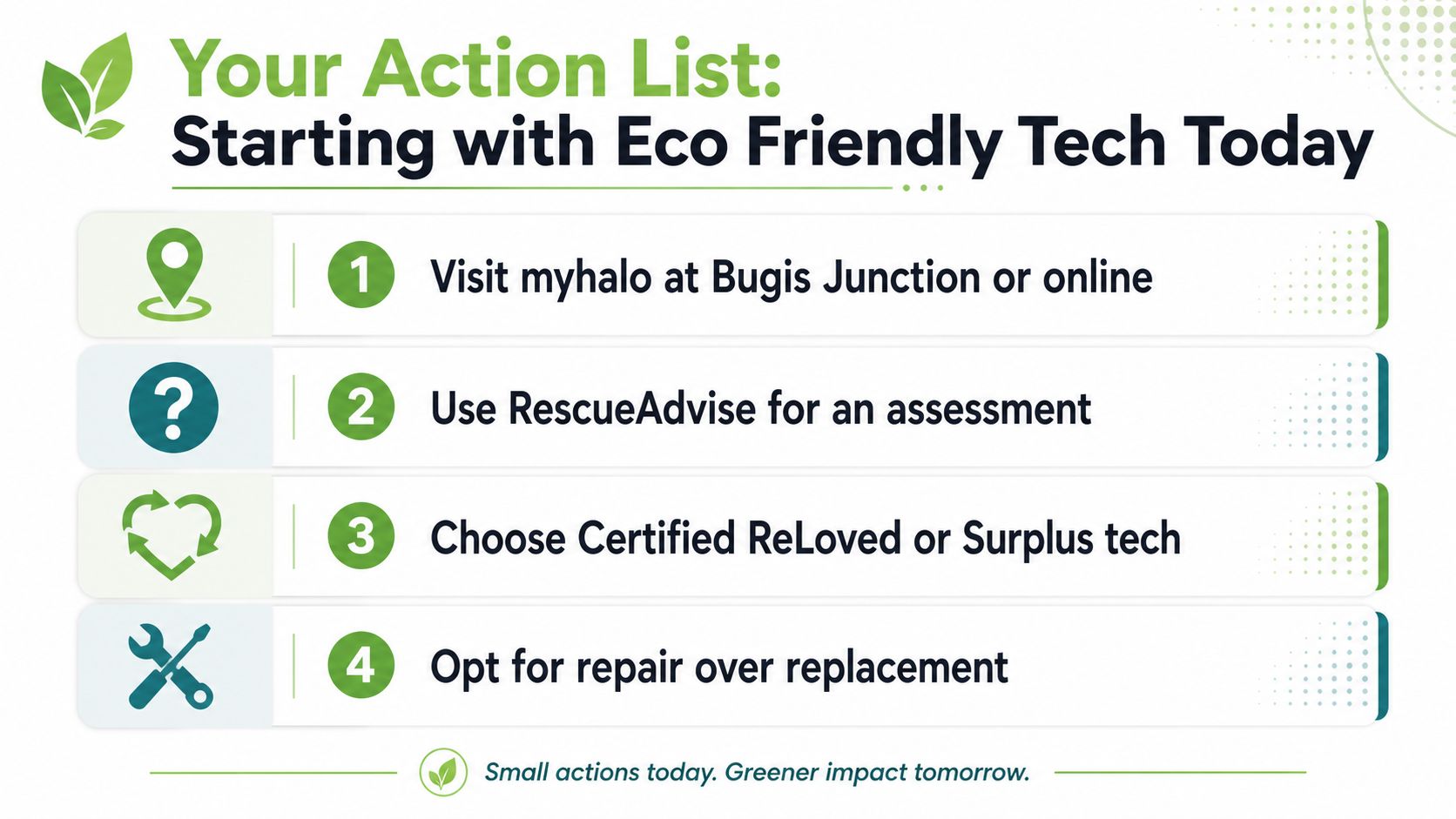
Before upgrading, check whether a battery swap or storage upgrade can restore enough performance to delay a replacement. That one check often saves more money than a full purchase, because you are fixing the part that limits use instead of paying for a whole new device. For households and SMEs, that also means fewer disruptions from setup, migration, and device disposal.
Start with the device you already have
If your current phone or laptop still works, see whether repair can extend its useful life. A battery replacement, storage upgrade, or proper data migration may improve day-to-day performance more than a full replacement. This is usually the lowest-cost way to get a device back to a workable state without adding another item to maintain later.
Choose verified reuse when replacement is necessary
If replacement is still the better call, choose options with transparent grading, warranty terms, and clear condition disclosure. Certified ReLoved and Certified Surplus units are useful here because they give buyers more than one price point while still allowing a fair side-by-side comparison. For practical sustainability, verified reuse is stronger than vague “eco” messaging, because the condition of the device is visible rather than assumed.
Use trade-in before you store the old device away
A device sitting in a drawer is not creating value. Trade-in can recover part of its remaining worth and reduce the chance that it becomes forgotten e-waste. If you want a simple overview of the process in Singapore, this zero e-waste guide gives a useful starting point.
Align the next purchase with your actual use case
A student, a home office user, and an SME team do not need the same setup. Choose based on battery health, storage needs, screen size, and how long you expect the device to stay useful. If you are unsure, myhalo at Bugis Junction or online can be used as one place to compare repair, reuse, and trade-in options in a single workflow, with support from RescueAdvise and mylo AI Assistant.
The gain is not only environmental. It also improves spending discipline, lowers the chance of unnecessary replacements, and gives households and businesses a more resilient device plan over time.