





Best Phone Trade in Guide to Maximise Value in Singapore
Your next upgrade probably starts the same way it does for many in Singapore. You notice your battery fading faster, your storage is always full, and a new model has just landed. So you check a trade-in quote, see a number you like, and assume that's what you'll get.
That's where many people lose value.
The best phone trade in result isn't about finding the flashiest advertised quote. It comes from three things most guides gloss over. First, timing. Second, how well you prepare the phone before anyone inspects it. Third, choosing the right exit path for that specific device, whether that's trade-in, resale, repair first, or formal recycling.
Singapore makes this worth paying attention to. The mobile market is unusually active, with 9,831.5 thousand mobile phone subscriptions and a mobile population penetration rate of 160.9% in 2025, according to Singapore's latest infocomm and media data. Independent reporting tied to a Singapore whitepaper also says people here replace smartphones every 2.7 years on average, compared with a global average of 3.5 years in that same reference. That faster upgrade cycle is exactly why sloppy trade-in habits cost more in Singapore than many people realise.
A phone that's prepared properly, traded at the right time, and routed through the right channel usually delivers a better real outcome than a phone rushed into the first offer.
That matters beyond one upgrade. A good trade-in decision extends device life, recovers value earlier, and keeps reusable hardware in circulation through repair, reuse, Certified ReLoved and Certified Surplus pathways before responsible recycling becomes the only sensible option. That's the right way to think about the device lifecycle if you're a household managing costs or an SME trying to get more value from every tech purchase.
Table of Contents
- Introduction to Getting the Best Phone Trade In Value in Singapore
- How to Prepare Your Phone to Protect Its Trade In Value
- When to Trade In and Whether to Repair First
- Choosing the Right Channel for Your Device
- How to Compare Offers and Complete the Handover Smoothly
- Conclusion and Next Steps to Secure Your Best Trade In
Introduction to Getting the Best Phone Trade In Value in Singapore
You decide to upgrade because your current phone still works, but not well enough. The battery drains by mid-afternoon, the next iPhone or Galaxy launch promo is already live, and an online estimator gives you a number that looks decent. At that point, many Singapore buyers assume the hard part is over.
It is not.
In Singapore, trade-in value changes fast because upgrade cycles are fast and the secondary market is active. A phone with the same model name can land in very different value bands once a buyer checks whether it is a local set or export set, how close it is to the next launch cycle, and whether the quoted condition survives inspection.
The advertised number is not the final decision
The first price you see is only useful if it holds up when the phone is physically checked. That is the part many trade-in guides gloss over.
A better way to judge any offer is to ask three direct questions:
- Is the timing good? Values often soften just before or just after major launches, when more owners offload the same model at once.
- Is your device easy to place in the local market? Local-set phones usually give buyers and trade-in operators more confidence because warranty history, compatibility, and resale expectations are clearer than with export-set units.
- How wide is the quote-to-inspection gap? A high online estimate means little if battery health, screen wear, replaced parts, or account issues trigger a lower final offer on the spot.
Practical rule: Choose the offer that is most likely to survive inspection with minimal downward adjustment.
That approach sounds less exciting than chasing the biggest headline number. It usually puts more money in your pocket.
Why Singapore-specific details matter
Singapore has a strong used-device market, but it is also a picky one. Buyers notice whether a phone is a local set, whether it has a clean repair history, and whether it can be resold quickly without questions. Those details affect value even before obvious condition issues come into play.
There is also a drawer problem. Many usable phones sit too long after an upgrade, then lose value through age, battery decline, and the next launch cycle rather than through actual damage. A delayed decision can turn a resale-worthy phone into a low-yield trade-in, or a device that only makes sense to recycle.
A practical framework helps:
- Trade in if you want speed, low hassle, and a predictable handover.
- Resell directly if the phone is desirable, clearly a local set, and worth the extra time.
- Recycle if the device has little resale value, major faults, or security and battery issues that make reuse unrealistic.
That is how to think about phone trade-in in Singapore. Not as a search for the highest advertised number, but as a decision about timing, channel, and how likely your quote is to hold once someone inspects the phone.
How to Prepare Your Phone to Protect Its Trade In Value
You agree to an online quote at lunch, show up after work, and the price drops on inspection because of a missed scratch, low battery health, or an account lock you forgot to remove. That gap is where trade-in value is often lost in Singapore.
Trade-in operators here commonly use a two-stage valuation process. You submit the model and condition first, then the final price is confirmed only after checks on cosmetics, battery health, account status, and hidden faults. Carousell's trade-in help guidance lays out that workflow clearly. Treat the online quote as a starting point. Your job is to make sure the inspection result matches what you declared.
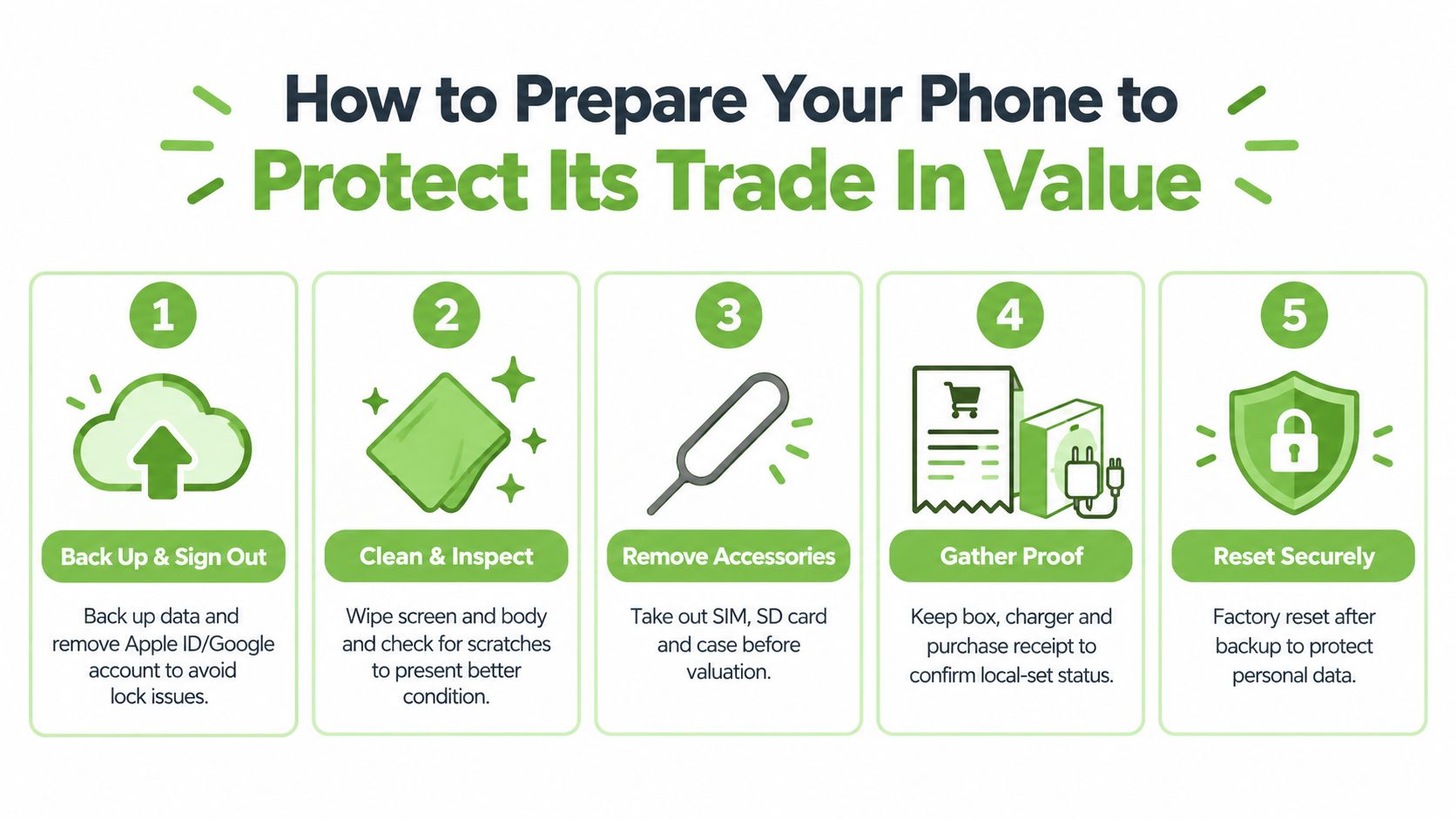
Back up properly, then remove every lock
Start with your data. Back up photos, messages, notes, app data, and anything stored locally. Then check that the backup restored to your new phone, laptop, or cloud account.
Next, sign out of Apple ID or Google, disable Find My iPhone or the Android equivalent, and remove any screen lock that could block testing. If the phone is still tied to your account, some buyers will pause the handover and some will cut the offer.
If you use eSIM, transfer it before you reset the phone. That step gets missed often.
Clean the phone, then inspect it like a buyer would
A dirty phone gets graded harder because dust and residue can hide condition. Wipe the screen, camera ring, frame, speaker grills, and buttons.
Then inspect it under bright light. Look at the screen from an angle. Check the corners and charging port. Turn the display on and test Face ID or fingerprint, cameras, speakers, microphones, and buttons. In Singapore, where buyers often compare several near-identical listings or trade-in offers, a small cosmetic miss can push your phone into a lower grade than you expected.
Take clear photos of the front, back, sides, and screen-on state before handover. Those photos help if there is a dispute about whether damage was already present.
If the phone still has a protector on, remove it and inspect the actual glass. A cracked protector is not the same as a cracked screen, but a buyer will want to see condition underneath. If you want to avoid adding fresh scratches before trade-in, read this guide on choosing a phone screen protector that actually prevents wear.
Gather the proof that supports value in Singapore
This part matters more locally than many owners expect. Local-set phones usually have an easier resale path than export sets, so proof of origin can affect what a buyer is willing to pay.
Prepare these before you hand the phone over:
- Original box and accessories, if you still have them
- Purchase receipt or invoice
- Battery health screen, if your phone shows it
- Repair records, especially for screen or battery replacement
- Warranty details, if any coverage remains
A proper invoice can help confirm the device is a Singapore set. Professional repair records also help. They do not erase the fact of a repair, but they reduce doubt about poor workmanship or non-genuine parts.
Reset only when everything else is done
Factory reset comes last.
Do it after backup, account sign-out, SIM or eSIM transfer, and final checks. Then confirm the phone starts at the setup screen. That is the cleanest signal that the device is ready for the next user and ready for inspection.
Some trade-in companies and refurbishers also document condition, battery status, and data handling more clearly than others. That matters if you want a reliable handover, not just a headline quote. Ask how they record inspection results and whether they provide confirmation of device erasure.
A short explainer can help before you wipe the device for good:
When to Trade In and Whether to Repair First
Timing matters more than many people expect. Not because every phone follows an exact formula, but because buyers respond quickly when a newer model shifts attention away from the current one.
Singapore trade-in offers make this plain. Singtel's trade-in guidance notes that values and promotions may change, and local operators also publish launch-linked cashback on selected models. In simple terms, waiting without a reason can cost you.
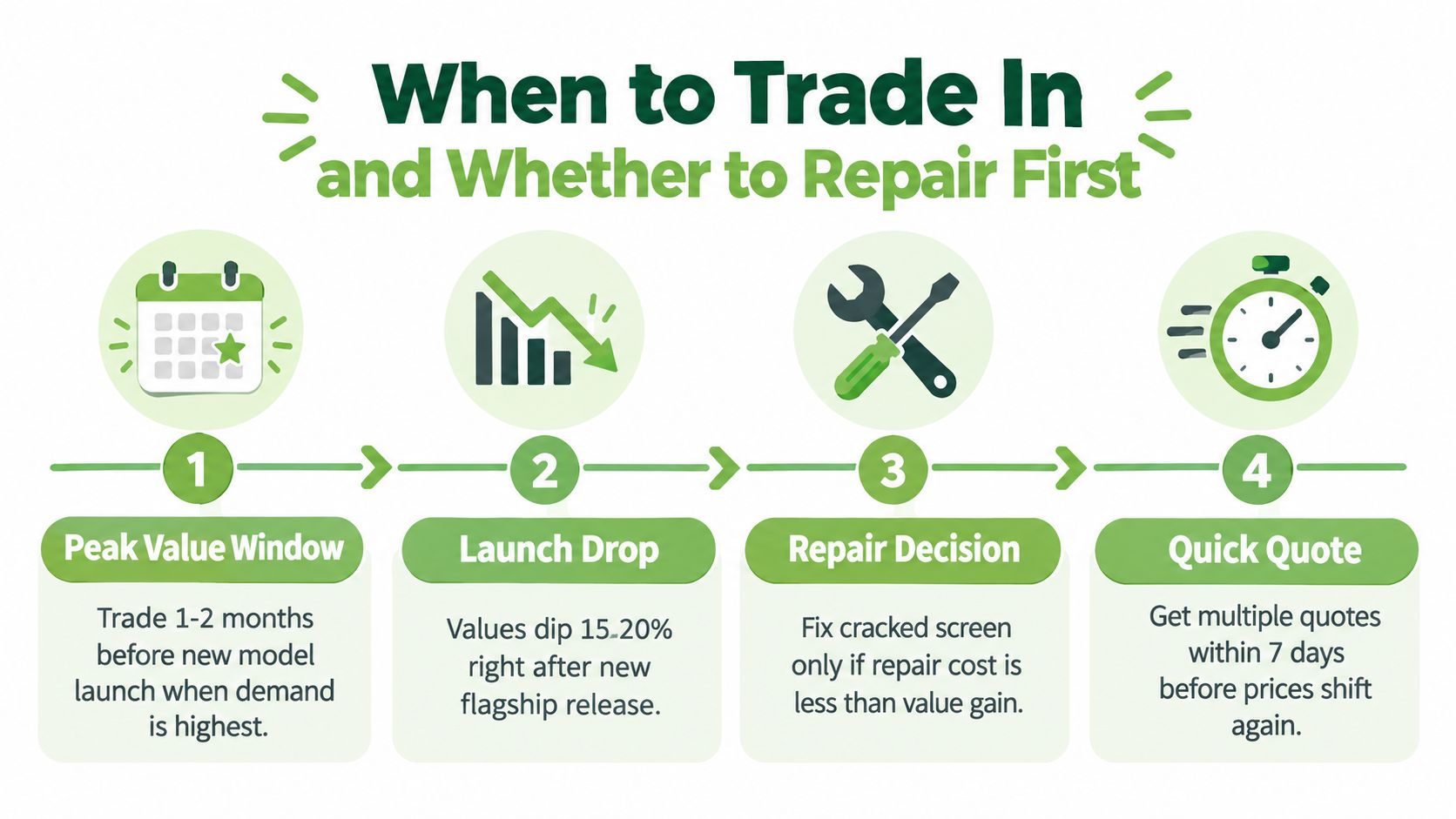
Trade before your phone slides out of the premium resale window
If you already know you'll upgrade at the next launch, don't wait until your old phone has become yesterday's model in everyone's mind. Recent devices usually hold attention better before a major release than after it.
That doesn't mean you should panic-trade every phone. It means you should make a decision early. If your current device is still in strong cosmetic condition, fully functional, and free from battery swelling or lock issues, acting before the next launch wave often protects more value than waiting to “see what happens”.
Timing insight: The best trade-in date is often the moment you're already sure you'll replace the phone, not the day after the replacement becomes publicly available.
Repair first only when the repair changes the value category
People either overspend or under-disclose.
A repair is worth considering when it moves the phone into a meaningfully better condition grade. Think cracked but otherwise healthy screen, or a battery that has degraded enough to drag down buyer confidence. A repair usually isn't worth doing when the phone is already old enough that the market sees it as a low-tier resale item regardless.
Use this decision filter:
| Situation | Better move | Why |
|---|---|---|
| Minor cosmetic wear only | Trade in as-is | Honest wear is expected and usually easier to price than a rushed fix |
| Cracked screen on a recent model | Compare repair cost against likely grade improvement | If the repair restores buyback eligibility, it may preserve value |
| Swollen battery or functional fault | Fix first or route to recycling if uneconomical | Safety and acceptance matter more than appearance |
| Older low-demand model | Disclose condition and compare resale versus recycling | Repair may not recover enough value |
If your display is damaged, get a proper assessment before deciding. This guide on phone screen repairs in Singapore is useful because screen condition often decides whether a phone remains a trade-in candidate or drops into a lower-value path.
Don't “repair” by hiding defects
A fresh case doesn't fix a bent frame. A screen protector doesn't erase a crack. And polishing marks off the housing won't improve battery health.
Be direct about faults. Singapore buyers inspect for hidden issues, and if they find them late, the discussion gets harder. Straight disclosure saves time and tends to preserve trust, especially if you're comparing trade-in against private resale.
Choosing the Right Channel for Your Device
Not every phone belongs in a trade-in programme. Some are better sold privately. Others should go straight to formal recycling or take-back.
The right channel depends on four things. Your phone's condition, how quickly you want to complete the transaction, how much effort you're willing to spend, and whether the device still qualifies as a reusable product rather than near-end-of-life electronics.
A Singapore-specific point gets missed in many generic guides. Local-set versus export-set status can affect pricing, and buyers may also require details like battery health, storage, cosmetic condition, and faults. That's explicitly reflected in Singapore trade-in buyer guidance on phone pricing details. So don't assume two visually similar phones will be valued the same.
Which Channel Fits Your Phone Best
| Channel | Best For | Effort and Speed | Value Consideration |
|---|---|---|---|
| Trade-in programme | Recent phones, clear ownership, straightforward handover | Low effort, fast completion | Usually lower upside than private resale, but far simpler |
| Peer-to-peer resale | Popular models in good condition | Higher effort, slower, more messaging and meetups | Can extract more value if you manage the process well |
| Formal recycling or take-back | Damaged, very old, locked, or low-demand devices | Low to moderate effort | Value may be low or zero, but disposal is responsible and compliant |
When trade-in makes the most sense
Trade-in is the practical choice when you want speed, clearer process, and lower admin. It suits people replacing a main phone, parents handling a family upgrade, and SMEs clearing a small batch of staff devices without running individual listings.
This is also where a lifecycle approach matters. One option in Singapore is myhalo, which supports device trade-in as part of a wider flow that can include repair assessment, migration help, Certified ReLoved reuse, Certified Surplus options, and responsible recycling when buyback isn't suitable. Tools such as RescueAdvise and the mylo AI Assistant can also help users decide whether a device should be repaired, traded, or retired.
For readers exploring more alternatives beyond the standard telco and retail routes, a local marketplace for independent brands can be useful if you want another resale-style option to compare.
When resale is worth the extra work
Private resale fits phones that still photograph well, function perfectly, and appeal strongly in the secondary market. You may do better here if you have the box, charger, receipt, and clean proof of local ownership.
But resale only beats trade-in if you price accurately and handle buyers efficiently. If you're vague about scratches, battery condition, or whether the set is local or export, your listing may attract attention but still collapse at meetup stage.
If you're deciding specifically for Apple devices, this guide on trade-in options for iPhone users in Singapore is a useful reference because iPhone valuation tends to react quickly to condition and launch timing.
When recycling is the right answer
Some devices shouldn't stay in the resale chain. Phones with severe faults, missing ownership clarity, water damage, swelling batteries, or no realistic market demand are usually better routed to formal collection.
That isn't failure. It's efficient resource use.
How to Compare Offers and Complete the Handover Smoothly
The fastest way to lose value is to compare offers that aren't describing the same phone.
One quote may assume a local-set device with strong battery health and no scratches. Another may assume average wear, missing accessories, or a different storage tier. If you don't normalise those details first, you're not comparing like for like.
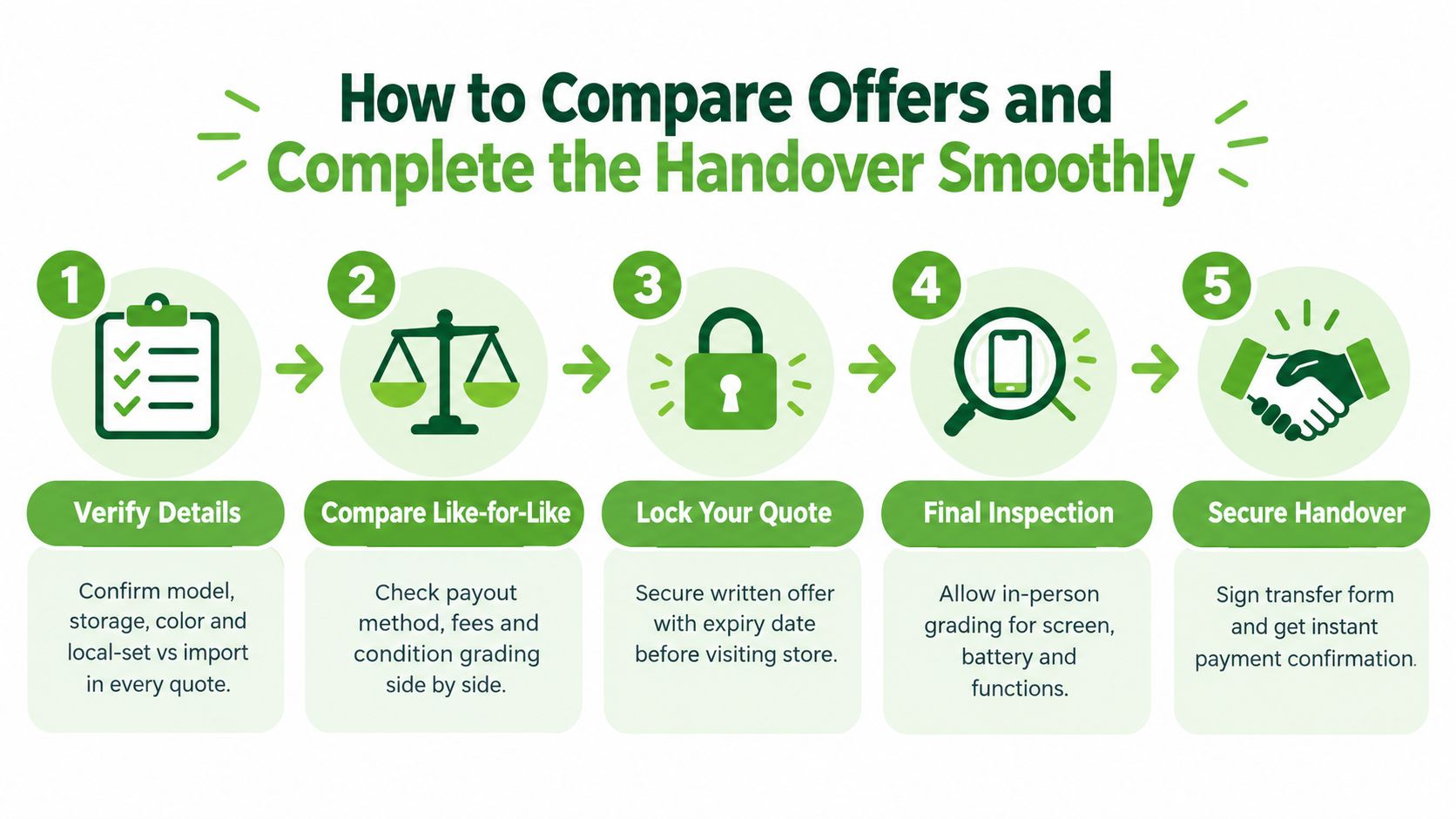
Check the quote fields before you care about the number
Read every offer against the same checklist:
- Exact model and storage
- Local-set or export-set status
- Battery health, if requested
- Cosmetic grade assumptions
- Accessories included or excluded
- Activation lock status
- Quote validity period
- Payout method and timing
If any of these are unclear, ask before you travel.
The only fair comparison is between offers built on the same facts. Anything else is just different assumptions wearing the mask of a price comparison.
Treat inspection as the real decision point
The in-person check is where the estimate becomes real. This is normal.
Inspectors usually verify screen condition, camera function, charging, buttons, speakers, battery behaviour, signs of prior repair, and account status. If you prepared properly earlier, there shouldn't be major surprises. If you didn't, the quote band often slips.
Bring the phone charged, cleaned, signed out, and ready to transfer. Keep your ID or proof of ownership available if requested. If you're moving to a new phone on the same day, finish your data migration first, then remove the SIM or complete eSIM transfer before final reset.
Know your fallback if the device doesn't qualify
Not every phone will clear trade-in. If it doesn't, you still have formal routes in Singapore.
The National Environment Agency accepts mobile phones and tablets in its 3-in-1 e-waste bins if they fit through the 500 mm x 250 mm slot, according to NEA's e-waste recycling guidance. Singapore's wider e-waste guidance also notes a mail-in option through ReCYCLE envelopes available via Singtel outlets and post offices, with postage waived, as described on the Towards Zero Waste e-waste page.
There's also a retail take-back route. Under Singapore's Extended Producer Responsibility framework, from 1 July 2021, retailers of regulated consumer products must provide a free one-for-one take-back service during delivery of a purchased product, and large retailers with stores of at least 300 square metres must provide in-store e-waste collection at each qualifying store. Those rules are set out in NEA's EPR system guidance-system-for-e-waste-management-system).
That matters because a failed trade-in shouldn't send the device back into a drawer.
Conclusion and Next Steps to Secure Your Best Trade In
The best phone trade in result in Singapore usually comes from discipline, not luck.
Prepare the device before asking for serious offers. Time your decision before your phone drifts into a weaker resale window. Compare channels based on effort, trust, and real condition, not just the highest visible number. Then treat inspection as the moment that matters, because that's when the estimate either holds or falls apart.
There's also a bigger pattern behind all this. A phone has more than one useful life. Sometimes the smartest move is a clean trade-in. Sometimes it's a repair that keeps the device productive for another owner. Sometimes it belongs in a Certified ReLoved or Certified Surplus pathway. And sometimes responsible recycling is the only sensible finish. Good technology management is about keeping each device in the highest-value use case it can still support.
If you want a quick decision checklist, use this:
A practical final check before you act
- Check battery health today and note any visible faults.
- Confirm local-set status and gather the box, charger, and receipt if available.
- Back up and migrate first, then sign out and reset only when ready.
- Lock a quote while it's still relevant if you already know you'll upgrade soon.
- Choose the channel that matches the phone, not the one that sounds easiest in theory.
Good trade-in habits don't just recover value once. They make every future upgrade simpler, safer, and less wasteful.
For people who want a structured process, look for providers that use clear grading, battery disclosure, secure data handling, and documented checks. That's what turns a one-off transaction into a more reliable device lifecycle.
If you want a straightforward next step, myhalo offers phone trade-in support, repair and device migration services, plus reuse pathways through Certified ReLoved and Certified Surplus devices. If you're deciding whether to trade in now, repair first, or recycle responsibly, it's a practical place to start with transparent grading, 30-point checks, and a lifecycle-focused approach.